Buying Ethereum (ETH) takes less than 15 minutes on most crypto exchanges. You create an account, verify your identity, deposit funds, and place an order. This guide covers every step in order, compares the main platforms and their fees, explains how to store ETH safely once you own it, and flags the things every beginner should know before spending a dollar.
What you need before you buy ETH
Before placing your first order, three things need to be in place. First, a government-issued ID for identity verification. Regulated crypto exchanges are required by law to verify who you are before allowing you to buy. Second, a payment method: a bank account, credit card, or debit card. Third, a decision on where to store your ETH after purchase, either on the exchange or in your own wallet.
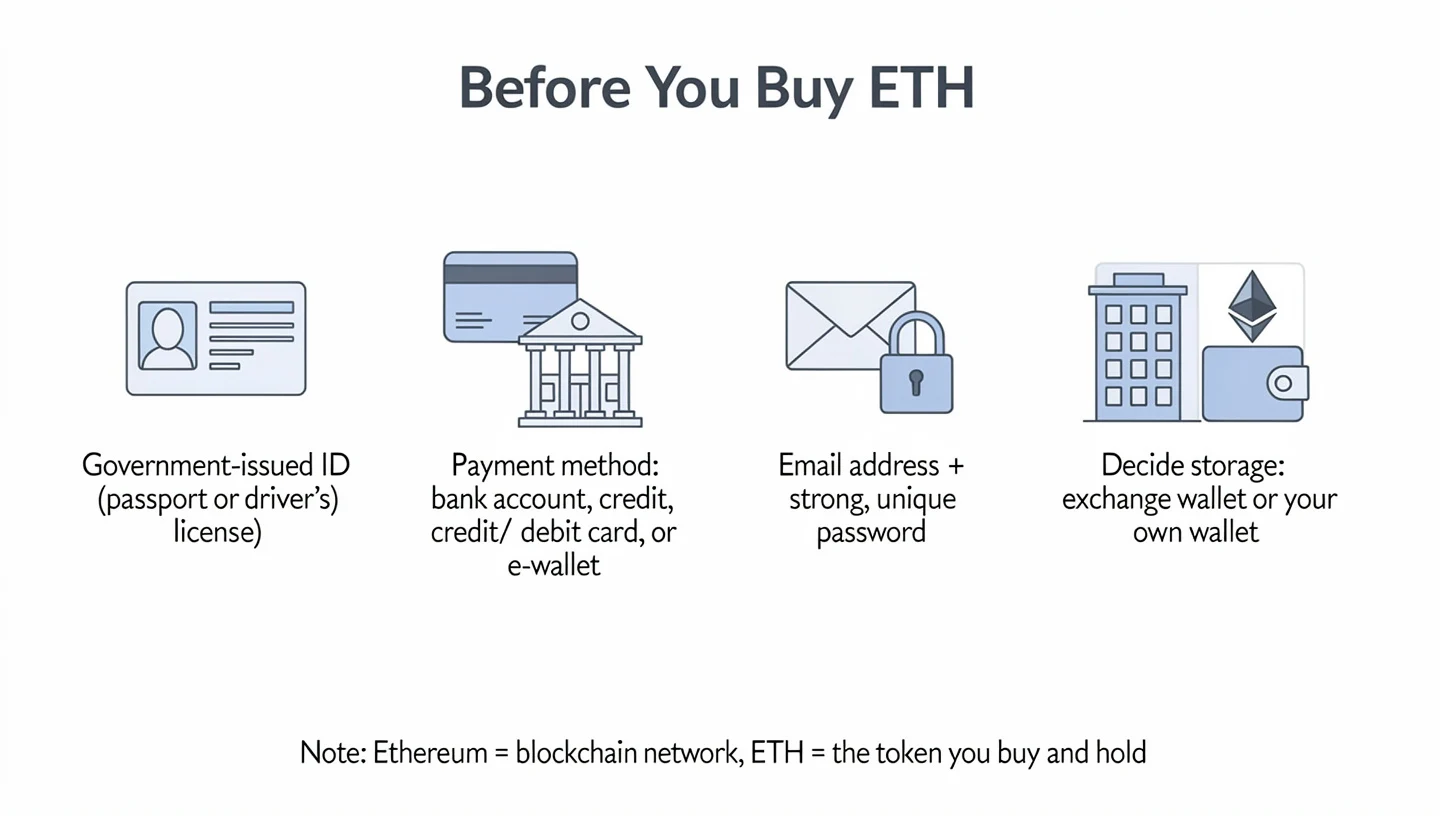
One clarification worth making at the start: Ethereum is the blockchain network. ETH is the native token you buy and hold. When people say they want to buy Ethereum, they mean they want to acquire ETH. The two terms are used interchangeably in practice. To understand the network itself, the guide on what Ethereum is explains how it works from the ground up.
- Government-issued ID (passport or driver’s license)
- Bank account, credit/debit card, or e-wallet
- Email address and a strong, unique password
- Decision on storage: exchange wallet or your own wallet
How to buy Ethereum: step-by-step
The fastest route to owning ETH runs through a centralised crypto exchange. The process is the same on every major platform. You register, verify your identity, deposit funds, and buy Ethereum with a market or limit order. The five steps below apply to Coinbase, Kraken, Binance, and most other regulated platforms.
Step 1: choose a crypto exchange
Not all crypto exchanges operate in every country, and their fee structures vary significantly. Three criteria matter most when choosing where to buy Ethereum: whether the exchange is regulated, what it charges, and whether it accepts users in your country.
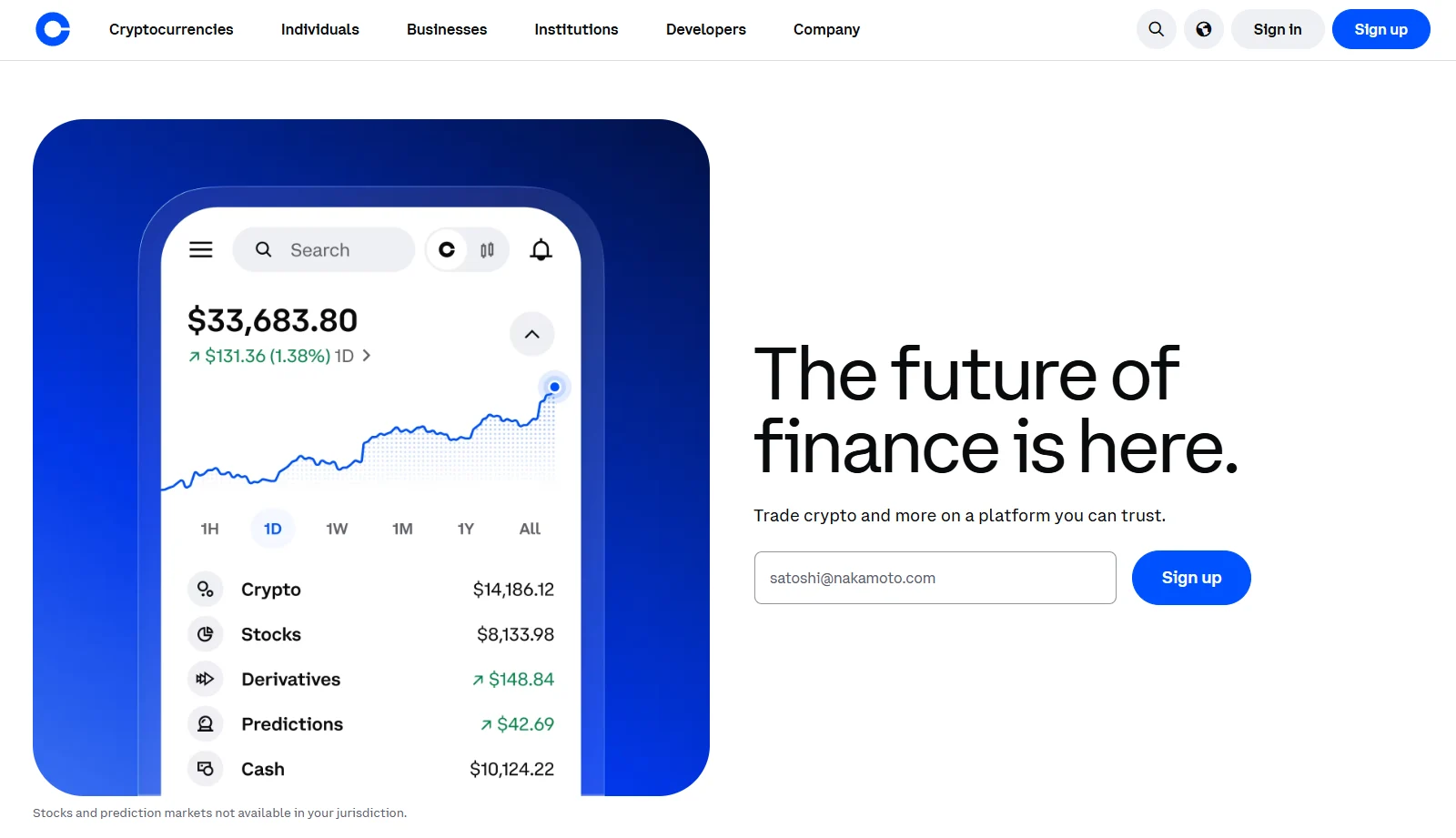
Coinbase is the most beginner-friendly option for US and UK buyers. It is publicly listed, regulated by FinCEN in the United States, and holds an FCA registration in the UK. The tradeoff is higher fees than most competitors. Kraken has a strong security record, lower fees than Coinbase, and is available in most countries. Binance charges 0.1% on spot trades, the lowest of the three, but is unavailable in several US states and has faced regulatory scrutiny in multiple jurisdictions. To verify that an exchange is regulated, check for a registration number with FinCEN (US), FCA (UK), or BaFin (Germany) on the platform’s legal or compliance page.
Step 2: create and verify your account
Register with your email address and set a strong password. The first thing to do after creating the account is enable two-factor authentication (2FA). Do not wait. Most exchange hacks target accounts without 2FA enabled. Use an authenticator app such as Google Authenticator or Authy rather than SMS, which is vulnerable to SIM-swapping attacks.
KYC (Know Your Customer) is the identity verification process every regulated exchange requires before you can deposit or trade. You will need to upload a photo of a government ID, such as a passport or driver’s license, and take a selfie for liveness verification. On most platforms, KYC completes within five minutes during business hours. Peak periods can extend this to 24 hours. Identity verification is a legal requirement, not an option. Ethereum was designed from the start to operate through open networks without gatekeepers, a history covered in the guide on who created Ethereum.
Step 3: deposit funds
Once your account is verified, you need to fund it before you can buy ETH. Three methods are available on most major platforms, each with different speeds and costs.
A bank transfer is the cheapest option. In the United States, ACH transfers carry a 0% fee on most platforms and settle in one to three business days. In Europe, SEPA transfers are also free or near-free and arrive in one to two days. Coinbase allows ACH deposits up to $25,000 per day. A credit card or debit card purchase is instant but costs 2-4%. Coinbase charges a flat fee of $2.99 on transactions below $73 and 1.49% above that for bank buys, making the flat fee the bigger cost at small amounts. Kraken charges 0.26% taker and 0.16% maker on its advanced platform, significantly cheaper for anyone buying more than a few hundred dollars. Using a credit card to buy crypto can also trigger a cash advance fee from your bank on top of the exchange fee.
Step 4: place your order
Search for ETH/USD or ETH/USDT in the trading section. Most beginner interfaces let you enter a dollar amount rather than an ETH amount. A market order executes immediately at the current price. A limit order lets you set the price at which you want to buy Ethereum and waits until the market reaches it. You can check the current ETH price on CoinGecko before placing an order.
For a first purchase, a market order is simpler. The minimum purchase amount varies: Coinbase allows buys from $2, Kraken from €10, and Binance from $10. You do not need to buy a whole ETH. Every exchange allows fractional purchases, so $50 buys you $50 worth of ETH at the current market price. Confirm the order, including the total fee, before submitting.
Step 5: withdraw ETH to a wallet (optional but recommended)
After your purchase confirms, you have a choice. You can leave your ETH on the exchange in a custodial arrangement, where the exchange holds the private keys on your behalf. Or you can withdraw to a non-custodial wallet where you control the keys directly.
The principle behind self-custody is straightforward: if you do not hold the private key, you do not fully control the asset. For small amounts or active traders, keeping ETH on a regulated exchange is practical. For larger holdings or long-term storage, withdrawing to your own wallet reduces the risk of losing access due to an exchange failure. The withdrawal fee on Coinbase ranges from $1 to $25 depending on the network selected. ETH transfers on the Ethereum mainnet cost between $0.01 and $0.50 in gas fees as of 2026. For a full explanation of how gas fees are calculated, the guide on Ethereum gas fees covers the mechanics in detail.
Where to buy Ethereum: comparing the main options
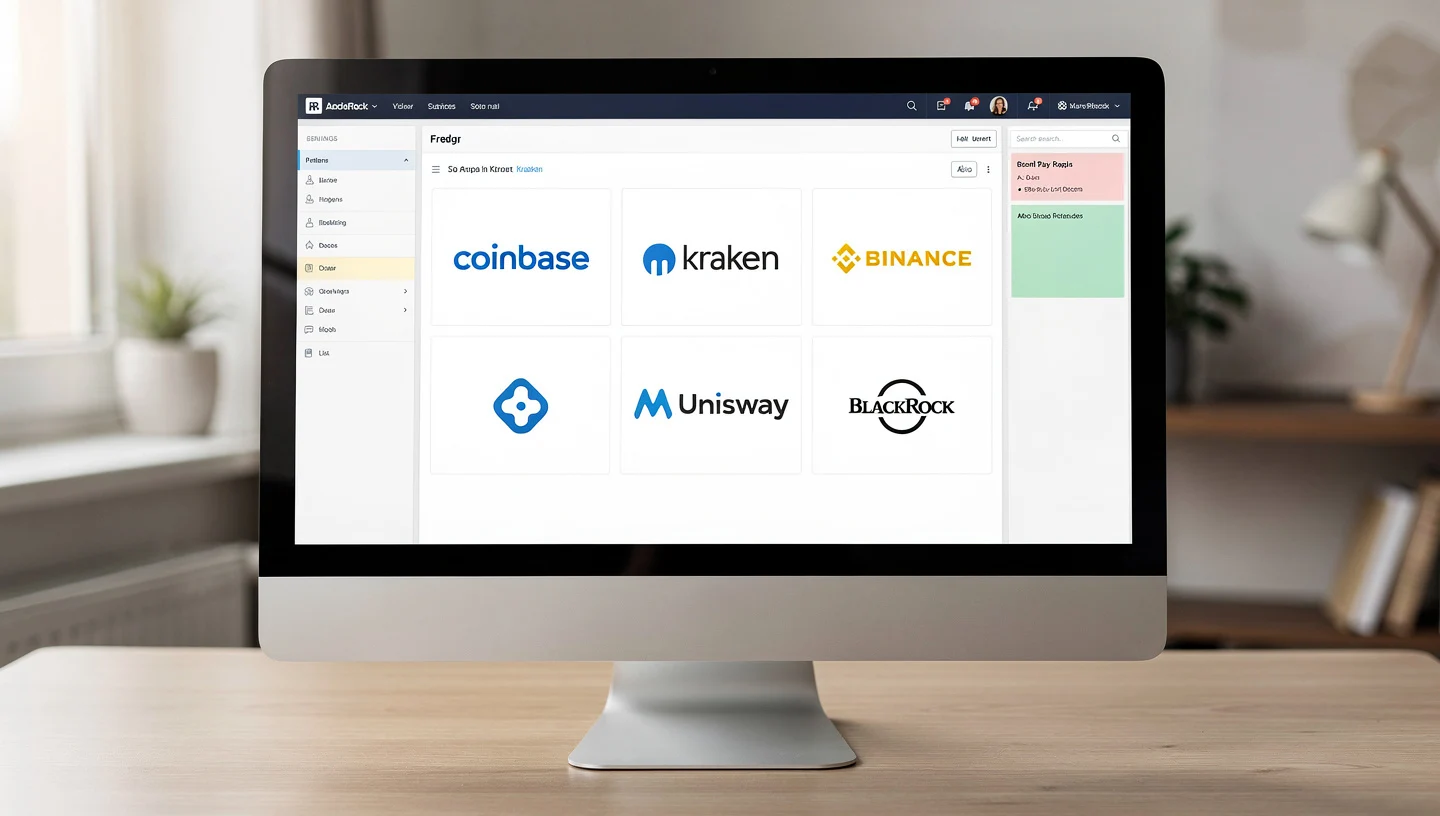
A centralised crypto exchange is not the only way to buy Ethereum. You can also gain exposure through a brokerage account via an Ethereum ETF, or swap directly on a decentralised exchange without creating an account. Each option suits a different type of buyer.
| Platform | Type | Trading fee | Min buy | Best for |
|---|---|---|---|---|
| Coinbase | CEX | 1.49% / $2.99 flat | $2 | US and UK beginners |
| Kraken | CEX | 0.26% taker | €10 | Lower fees, security focus |
| Binance | CEX | 0.1% spot | $10 | Lowest fees, high volume |
| Coinbase Advanced | CEX | 0.06% maker / 0.1% taker | $2 | Active traders on Coinbase |
| MoonPay | Payment processor | 1% + card fee | $20 | Quick card buys, no account needed |
| Uniswap | DEX | 0.05%-0.3% pool fee + gas | No minimum | No KYC, existing crypto holders |
| BlackRock ETHA | Spot ETF | ~0.25% expense ratio | 1 share | Brokerage account holders |
Centralised exchanges (CEX)
A centralised exchange (CEX) matches buyers and sellers on an order book and holds customer funds in custodial wallets. Every major centralised exchange charges in at least two ways: a trading fee as a percentage of the transaction, and a spread built into the quoted price.
The spread is the gap between the price at which you can buy and the price at which you can sell at the same moment. On Coinbase standard, the spread on ETH is typically 0.5-1%. On Kraken, the spread is tighter, around 0.1-0.2% on the Pro interface. On Binance, the spread on ETH/USDT is close to 0.01% given the depth of its order book. A buyer who pays 1.49% in trading fees and 0.75% in spread on Coinbase is paying roughly 2.24% total to enter a position, compared to around 0.11% on Binance for the same amount. That difference matters more as the purchase size grows.
Ethereum ETFs: buying ETH through a brokerage
Spot Ethereum ETF products became available to US investors in July 2024 and now trade on major stock exchanges. The three most widely held are the BlackRock iShares Ethereum Trust (ETHA), the Fidelity Ethereum Fund (FETH), and the Grayscale Ethereum Trust, which converted to an ETF format. Expense ratios run around 0.25% per year, charged automatically against the fund’s assets rather than billed separately.
Buying an Ethereum ETF through a standard brokerage account means you do not hold ETH directly. There is no wallet, no private key, and no ability to withdraw to a wallet or use the ETH in DeFi applications. The ETF holds ETH on your behalf. This structure suits investors who want price exposure through accounts they already have, such as an IRA or a standard brokerage, without managing a crypto exchange account. Staking distributions from some ETF products are under development: Grayscale began distributing staking rewards to shareholders in early 2026.
Decentralised exchanges (DEX): buying ETH without an account
A decentralised exchange (DEX) allows you to swap one token for another directly from a non-custodial wallet, without creating an account or completing KYC. Uniswap is the largest DEX by volume on Ethereum. To use it, you need a wallet such as MetaMask already funded with a stablecoin like USDC or USDT, which you then swap for ETH.
Every transaction on a DEX requires paying gas fees in ETH to the network. This makes DEX trading impractical for first-time buyers who do not yet hold any crypto. It is a useful option for those who already hold stablecoins and want to convert them to ETH without going through a centralised exchange. How smart contracts power every swap on a DEX is covered in the guide on what smart contracts are.
Payment methods for buying ETH
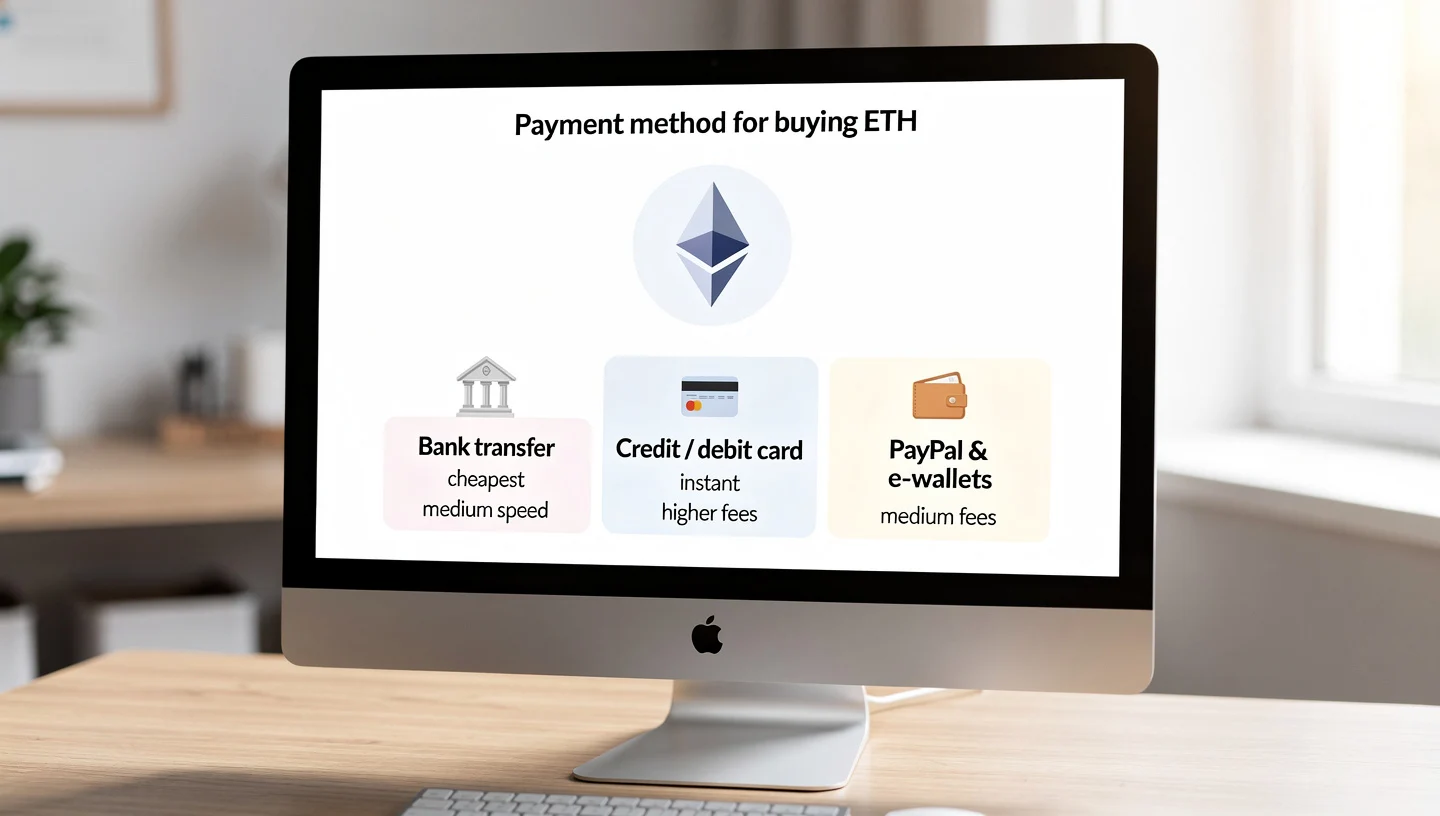
The payment method you use to fund your exchange account affects both the cost and the speed of your purchase. Most platforms support three main methods, each with different tradeoffs.
Bank transfer
A bank transfer is the cheapest way to deposit funds on most platforms. In the United States, ACH transfers carry no fee on Coinbase, Kraken, and Binance US, and funds arrive in one to three business days. In Europe, SEPA transfers are also free or charged a flat fee under €1, with settlement in one to two days. Bank transfers are the right choice for anyone buying more than $100 at a time, where the fee saving over a card purchase is significant.
Credit and debit card
Buying ETH with a credit card or debit card is instant, but the fee is higher: typically 2-4% of the transaction amount. Coinbase and Kraken accept Visa and Mastercard from most issuers. Some banks in the UK and Europe block crypto purchases on credit cards entirely, treating them as cash advances. Check with your bank before attempting a credit card purchase, as a cash advance fee from the bank can add another 2-5% on top of the exchange fee. Debit cards do not carry this risk and are the better card option for most buyers.
PayPal and other e-wallets
PayPal is available as a payment method on Coinbase and through the MoonPay payment processor. Transactions are instant, but ETH bought through PayPal on Coinbase is held in a custodial wallet and cannot be withdrawn to an external address without first selling and rebuying. Revolut allows ETH purchases directly within the app in the UK and EU. Cash App supports ETH purchases in the United States. These e-wallet options are convenient for small purchases but limit what you can do with the ETH afterwards.
Understanding the fees when you buy ETH
Every platform charges fees in at least one of four ways. Many charge in more than one. Understanding each type before you buy prevents surprises on your first transaction.
| Fee type | What it is | Typical range |
|---|---|---|
| Trading fee | Percentage charged per transaction | 0.1% to 1.49% |
| Spread | Gap between buy price and sell price | 0.1% to 2% |
| Deposit fee | Charged when funding your account | 0% (bank) to 4% (card) |
| Withdrawal fee | Charged when sending ETH to a wallet | $1 to $25 |
| Gas fee | Network fee paid to validators | $0.01 to $0.50 (2026) |
The spread is the fee most platforms do not advertise clearly. When you see a buy price quoted, that price is already higher than the mid-market rate. The sell price is lower. The gap between them is revenue for the exchange. On Coinbase standard, a buyer paying $3,000 for ETH might be buying at $3,015 when the actual market price is $3,000. That $15 is the spread, on top of any trading fee.
Gas fees in 2026 are a fraction of what they were at peak network congestion in 2021, when a single ETH transfer cost $50 or more. A standard ETH transfer now costs between $0.01 and $0.50 depending on network activity. This makes withdrawing ETH to a personal wallet practical even for small amounts. Understanding why gas fees exist and how the Ethereum network processes transactions is covered in the guide on the Ethereum Virtual Machine.
How to store Ethereum safely
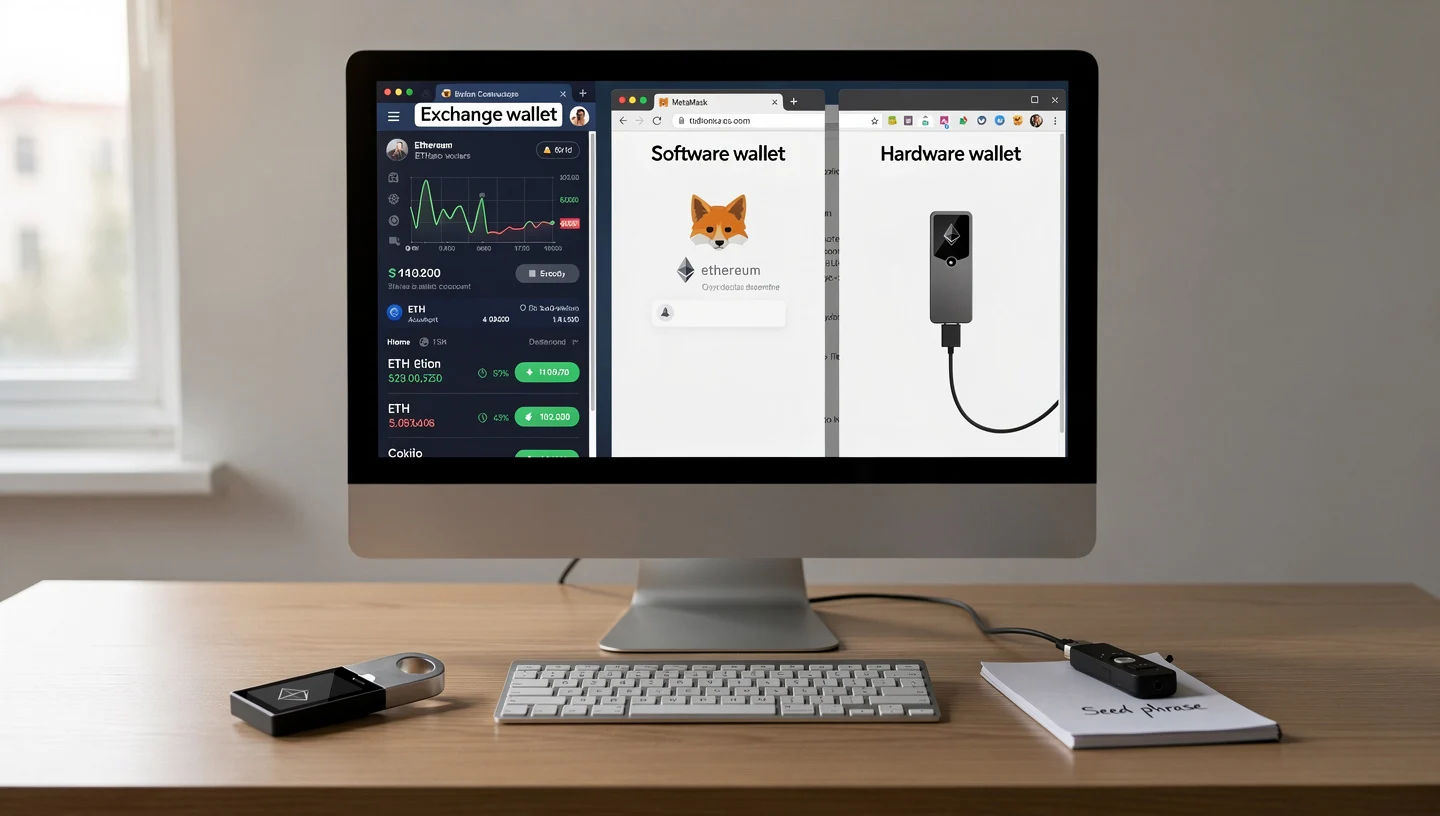
Once you buy ETH, you have two choices about where to keep it. You can leave it on the exchange in a custodial wallet, or move it to a wallet where you hold the private key. The right choice depends on how much you hold, how often you trade, and how comfortable you are managing your own security.
Hardware wallets
A hardware wallet stores your private key on a physical device that never connects to the internet directly. The Ledger Nano X costs around $149. The Trezor Model T costs around $179. Both support Ethereum and thousands of other tokens. When you sign a transaction, the private key stays on the device and never touches your computer or phone. This makes a hardware wallet the most secure option available to individual holders.
A hardware wallet is recommended for anyone holding more than $1,000 in ETH or planning to hold long-term. The setup process generates a seed phrase that you must record and store securely. A cold wallet device that is lost or damaged can be restored on a replacement device using the seed phrase, as long as that phrase has been kept safe.
Software wallets
MetaMask is the most widely used software wallet for Ethereum. It is a browser extension and mobile app, free to download, and non-custodial: the private key is stored on your device, not on a server. MetaMask connects directly to decentralised applications, DeFi protocols, and NFT marketplaces. A software wallet is a hot wallet, meaning it is connected to the internet when in use, which makes it more convenient but also more exposed to malware and phishing attacks than a hardware wallet.
Other non-custodial options include Rabby, Rainbow, and Trust Wallet. All function similarly: you control the private key, no company can freeze your funds, and losing the seed phrase means losing access permanently.
Exchange wallets
Leaving ETH on Coinbase, Kraken, or Binance is the most convenient option for beginners and active traders. The exchange holds the private key in a custodial arrangement. You log in with a username and password, not a seed phrase. If you forget your password, the exchange can help you recover access.
The risk is that you are dependent on the exchange staying solvent and secure. In November 2022, FTX collapsed and customers lost access to approximately $8 billion in assets. Account holders on a bankrupt exchange become unsecured creditors, and recovery is not guaranteed. The practical rule: do not store more on an exchange than you are prepared to lose if the exchange fails. For holdings you plan to keep for months or years, move them to a wallet you control.
How to secure your seed phrase
When you set up any non-custodial wallet, the setup process generates a seed phrase: a sequence of 12 or 24 words that can restore your wallet on any compatible device. The seed phrase is a complete backup of your private key. Anyone who obtains your seed phrase can take all of your funds.
What not to do: do not take a screenshot of your seed phrase. Do not save it in a cloud storage service such as Google Drive, iCloud, or Dropbox. Do not email it to yourself. Do not store it in a password manager that syncs to the cloud. Do not type it into any website. These are the most common ways people lose funds to theft.
What to do: write the seed phrase on paper or stamp it onto a metal plate designed for the purpose. Store it in a physically secure location, separate from the hardware wallet device itself. Some holders keep a second copy in a different physical location. Treat the recovery phrase as seriously as you would a physical key to a safe containing cash.
Things to know before you invest in ETH
Buying ETH is straightforward. Deciding how much to buy and how to manage that position over time is a separate question. Three factors are worth understanding before committing any money.
Price volatility and position sizing
ETH fell more than 80% in value during the 2022 bear market, from a peak of around $4,800 in November 2021 to under $900 by June 2022. It recovered to over $4,000 in 2023 and reached new highs in the following cycle. This price volatility is not unusual. It is a consistent feature of crypto assets across multiple market cycles.
The standard guidance is to invest only what you can afford to lose entirely. Not because ETH will necessarily go to zero, but because no outcome can be ruled out over a short time horizon. Volatility cuts in both directions: large gains and large losses are both possible within the same calendar year. Position sizing relative to your total net worth matters more than which exchange you use.
Dollar-cost averaging (DCA)
Dollar-cost averaging (DCA) means buying a fixed dollar amount of ETH on a fixed schedule, regardless of the current price. Instead of trying to buy at the bottom, which is impossible to predict consistently, a DCA strategy buys across a range of prices over time. If you buy $100 of ETH every week for six months, your total outlay is $2,600 and your average purchase price reflects conditions across that entire period rather than a single day.
Coinbase, Kraken, and Binance all offer automated recurring buy features that execute a DCA strategy without manual input. You set the amount, the frequency, and the payment method. The platform handles the rest. This is a practical approach for long-term buyers who do not want to monitor price movements. How Ethereum works as a network, and what drives demand for ETH over time, is covered in the guide on how Ethereum works.
Ethereum staking: earning rewards on your ETH
Once you hold ETH, one option is to put it to work through staking. Ethereum staking means locking ETH to help validate the network, in exchange for staking rewards. The annualised yield for stakers has been running at approximately 3.5-5% APY in 2026, paid in ETH.
Staking directly as a validator requires 32 ETH and technical knowledge. For most holders, liquid staking protocols are the practical option: deposit any amount of ETH into Lido and receive stETH in return, or into Rocket Pool for rETH. These receipt tokens accrue staking rewards over time and can be used in DeFi while the underlying ETH remains staked. The full mechanics of how staking secures the network are covered in the guide on Ethereum proof of stake.
FAQ
How do I buy Ethereum for the first time?
Create an account on a regulated crypto exchange such as Coinbase or Kraken. Enable two-factor authentication, complete KYC by uploading a government ID, deposit funds via bank transfer or card, and place a market order for ETH. The whole process takes under 15 minutes on most platforms once your identity is verified. For smaller amounts, a credit or debit card is the fastest option despite the higher fee.
What is the minimum amount of ETH I can buy?
There is no minimum amount of ETH you need to buy. Coinbase allows purchases from $2, Kraken from €10, and Binance from $10. Because ETH is divisible, $10 buys you $10 worth of ETH at whatever the current price is. You do not need to buy a whole coin. Most beginners start with whatever amount they are comfortable losing entirely, given the price volatility of crypto assets.
Can I buy Ethereum without KYC?
You can swap tokens on a decentralised exchange such as Uniswap without completing KYC, but you need to already hold crypto in a non-custodial wallet to do so. On centralised exchanges, KYC is a legal requirement in most jurisdictions. Platforms that allow buying with fiat currency without identity verification are typically unregulated and carry higher risk of fraud and loss of funds.
Is it safe to buy Ethereum on Coinbase?
Coinbase is a publicly listed company regulated by FinCEN in the United States and registered with the FCA in the UK. It holds customer funds in segregated accounts and carries insurance against certain types of losses. No exchange is entirely risk-free, as exchange wallets are custodial, meaning Coinbase holds your private keys on your behalf. For large holdings, withdrawing to a hardware wallet reduces reliance on any single platform.
What is the cheapest way to buy Ethereum?
The cheapest combination is a bank transfer deposit on Binance or Kraken, using the advanced trading interface rather than the standard buy button. Binance charges 0.1% on spot trades with no deposit fee for bank transfers. Kraken charges 0.16% maker and 0.26% taker on its Pro interface. Avoid the standard Coinbase interface for large purchases, as the flat fee and spread make it significantly more expensive than its competitors at amounts above $200.
Can I buy Ethereum with a credit card?
Yes. Coinbase, Kraken, and most major exchanges accept Visa and Mastercard. Credit card purchases are instant but carry a 2-4% fee. Some banks classify crypto purchases as cash advances and add their own fee on top, typically 2-5%. Check with your bank before using a credit card for this reason. A debit card avoids the cash advance issue while still offering instant settlement.
What happens to my ETH if an exchange goes bankrupt?
If the exchange holding your ETH goes bankrupt, you become an unsecured creditor. Recovery depends on how the insolvency is handled and how much the exchange has in reserve. When FTX collapsed in November 2022, customers lost access to approximately $8 billion in assets, and the recovery process took years. The only way to eliminate this risk entirely is to hold ETH in a wallet you control, where you hold the private key and no company can freeze or lose your funds.
What is the difference between ETH and Ethereum?
Ethereum is the blockchain network: the decentralised platform that runs smart contracts and hosts thousands of applications. ETH is the native token of that network, used to pay transaction fees and as a store of value. When you buy ETH on an exchange, you are buying the token, not a share in the network. The two terms are used interchangeably in everyday language, but they describe different things. ETH is what gets transferred between wallets. Ethereum is the system that processes those transfers. The role of ETH within the network is covered in the guide on what ETH is.