Ethereum is a network of thousands of computers that all hold the same database and follow the same rules. No single company owns it. No server controls it. When you send ETH or call a smart contract, your request travels to this network. Independent machines called nodes confirm it and record it permanently in a shared ledger called the blockchain.
That is the short version. The mechanics underneath are worth understanding. They explain why Ethereum behaves the way it does: why fees rise and fall, why some transactions take longer than others, and why the network has never been shut down since 2015.
This guide covers blocks, nodes, transactions, validators, gas, the EVM and finality. Each section builds on the last.
Ethereum is a state machine
The simplest way to understand Ethereum is as a state machine. At any moment, the network holds a state: the balance of every account, the data stored in every smart contract, the history of every transaction. When a new transaction happens, the state changes. Every computer on the network updates its copy to match.
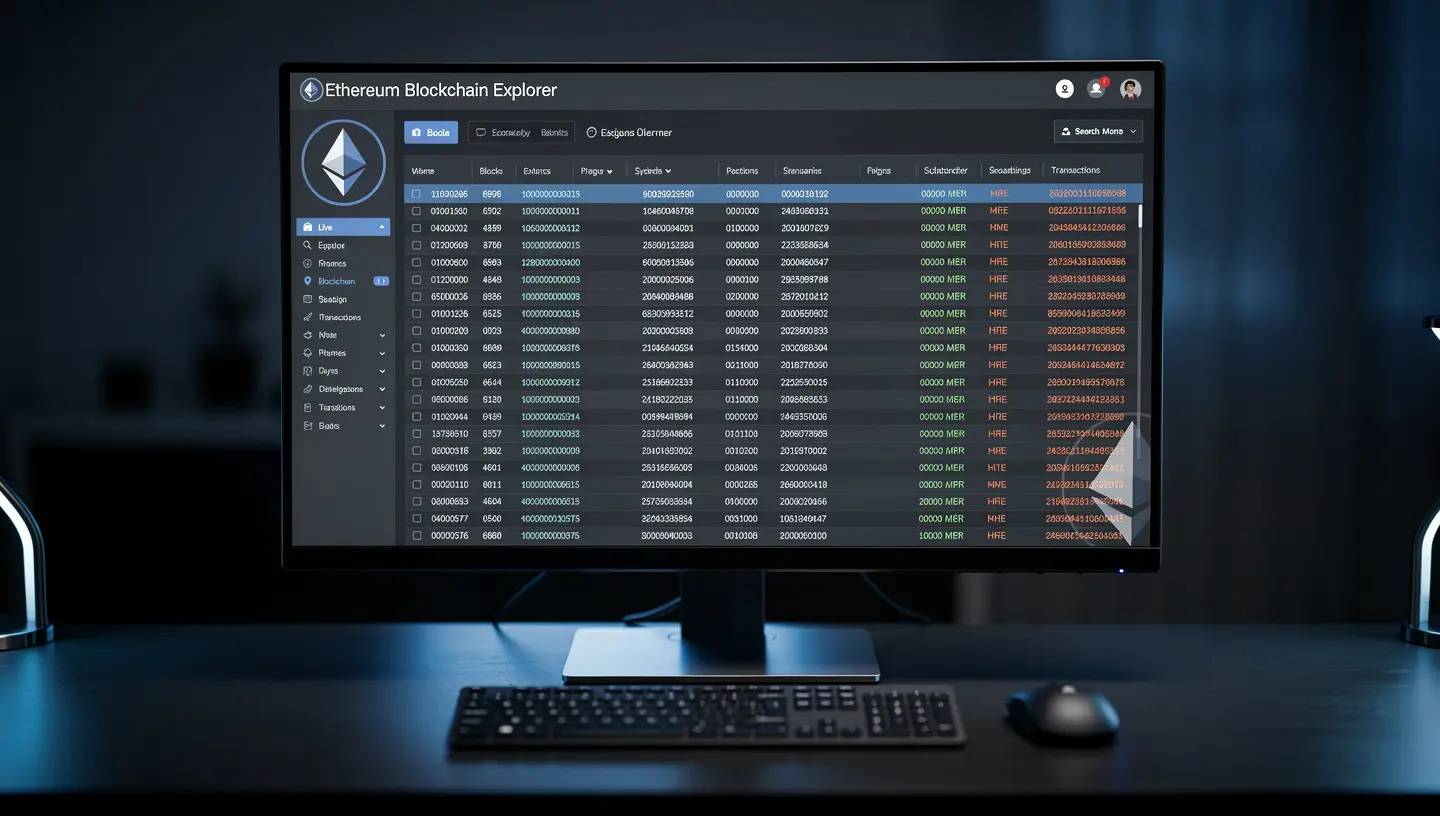
That shared state is what makes Ethereum useful. When you check your ETH balance on any wallet or block explorer, you are reading from the same underlying state that every node on the planet agrees on. There is no separate copy. There is one canonical version of the truth, maintained by thousands of computers at once.
What a block contains
Transactions do not get added to the blockchain one by one. They are grouped into blocks. Each block contains a batch of transactions, a reference to the previous block, a timestamp, the address of the validator who proposed it, and cryptographic data that proves the block is valid.
On Ethereum, a new block is added roughly every 12 seconds. That 12-second window is called a slot. Each slot, one validator is selected to propose a block. The rest of the active validators check it and vote to confirm it.
How blocks chain together
Each block contains the cryptographic hash of the block before it. A hash is a fixed-length fingerprint: change one character in the original data and the hash changes completely. Because every block includes the previous block’s hash, altering any historical block would break the chain from that point forward. An attacker would need to recompute every subsequent block faster than the honest network adds new ones. With hundreds of thousands of validators, that is not feasible.
This is why the structure is called a blockchain. Each block is chained to the one before it, all the way back to the genesis block, the first block the Ethereum network ever produced, on July 30, 2015.
Nodes: who keeps the network running
A node is a computer running Ethereum client software. Each Ethereum node talks to other nodes, shares new transactions, verifies blocks, and maintains a copy of the Ethereum blockchain. As of late 2024, there are more than 7,500 active full nodes globally, run by individuals, companies, and institutions with no central coordination.
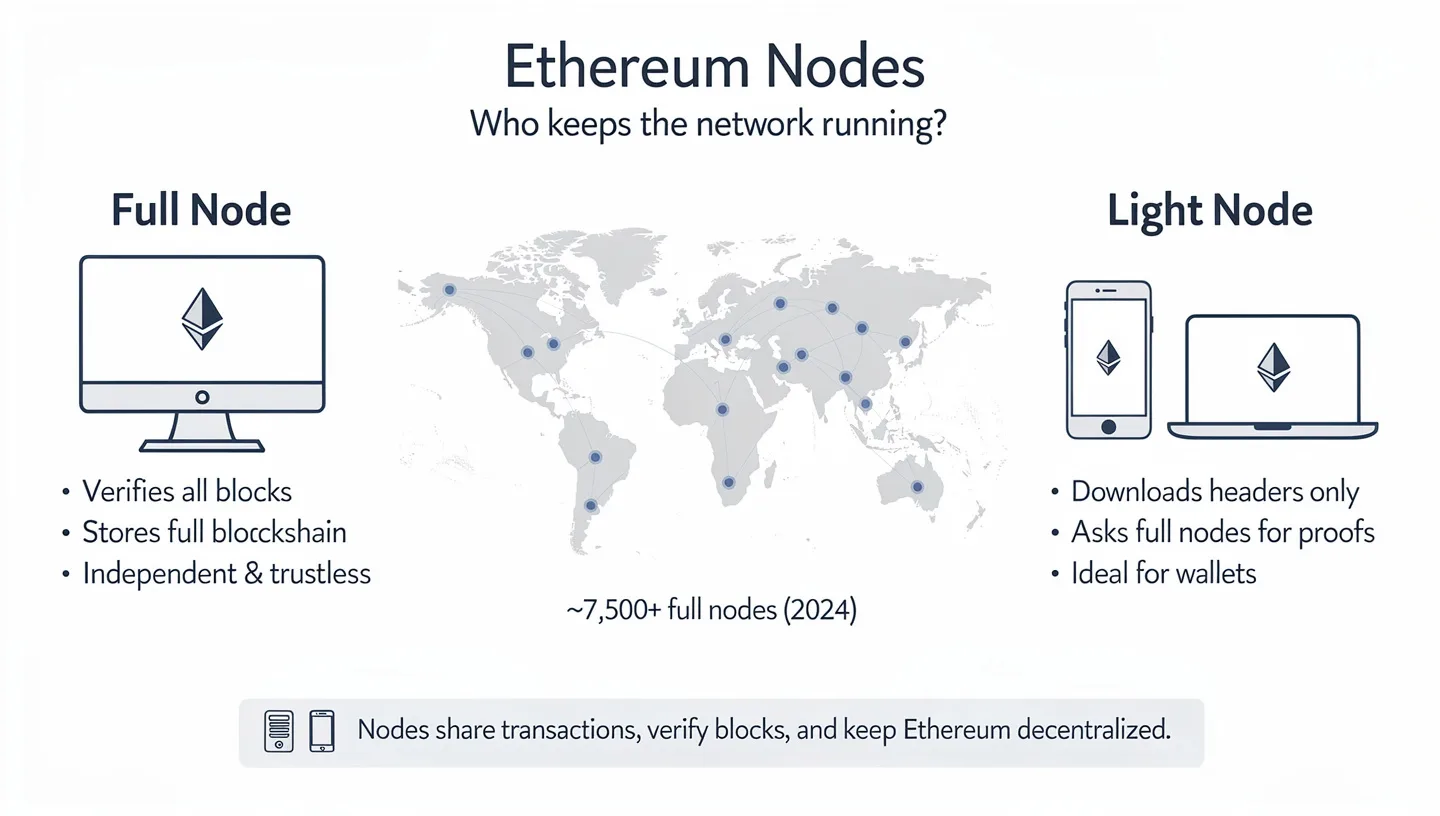
There are three types of nodes, and they serve different purposes.
Full node
A full node downloads and verifies every block from the genesis block to the current tip of the chain. It holds the complete transaction history and the current state of every account and smart contract. All validators run a full node. You can run one too: the software is free, and the hardware requirements are a standard desktop with a fast SSD and a stable internet connection.
Full nodes do not trust anyone. They verify every transaction themselves. That independent verification is what makes the network decentralized in practice, not just in theory.
Light node
A light node does not download the full chain. It downloads only block headers, which are small summaries of each block. When it needs to verify a specific transaction or balance, it requests proof from a full node. Light nodes are used in mobile wallets and applications where storage space is limited.
Light nodes trust full nodes to some degree, which makes them slightly weaker than full nodes on the security spectrum. For most users, the tradeoff is acceptable.
Archive node
An archive node stores everything a full node stores, plus every historical state at every block height. If you want to know the exact ETH balance of a specific address at block 10,000,000, only an archive node can answer that without recalculating the entire chain from scratch.
Archive nodes are large. They require several terabytes of storage. Block explorers like Etherscan run archive nodes. Most regular users never need one.
How a transaction moves from your wallet to the blockchain
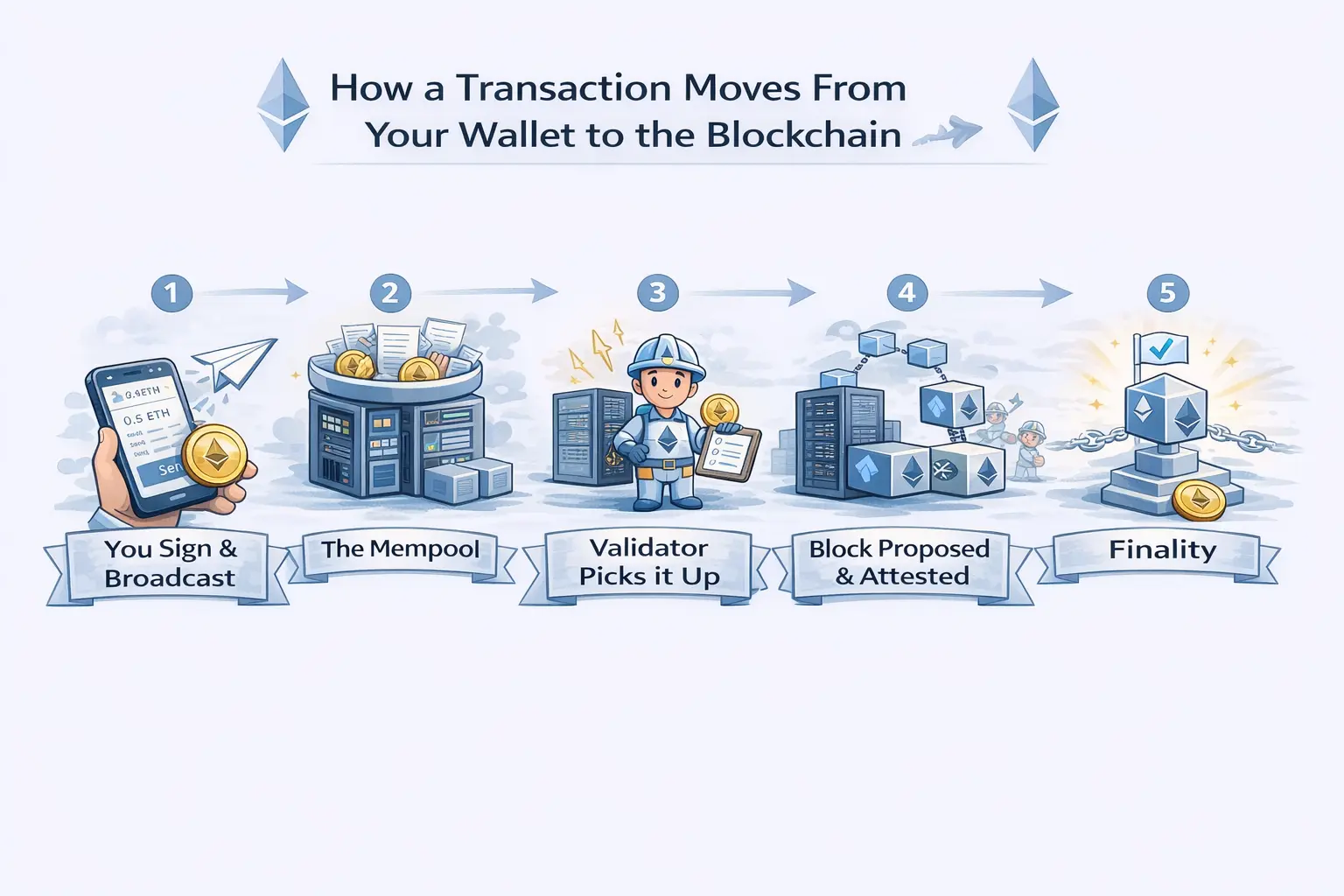
When you send ETH or interact with a contract, five things happen in sequence. Understanding each step explains why an Ethereum transaction sometimes takes a few seconds and sometimes gets stuck.
If you want to understand what Ethereum is before going into the mechanics, that guide covers the basics.
Step 1: you sign and broadcast
Your wallet creates a transaction containing the recipient address, the amount of ETH, a gas limit, a fee and a nonce. The nonce is a sequential number that counts how many transactions your address has sent. It prevents the same transaction from being processed twice.
Your wallet signs the transaction with your private key using a cryptographic method called ECDSA. The signature proves the transaction came from you without revealing your private key. Once signed, your wallet broadcasts the transaction to the network.
Step 2: the mempool
The transaction lands in the mempool, a waiting area held by each node. The mempool is not a single place. Each node has its own copy, and they share new entries with each other. Transactions sit in the mempool until a validator picks them up.
If the network is busy and you paid a low tip, your transaction can wait in the mempool for minutes or longer. Validators choose which transactions to include based on the tip, also called the priority fee. Higher tip means faster inclusion.
Step 3: validator picks it up
Every 12 seconds, one validator is pseudorandomly selected to propose a block. That validator scans the mempool, selects transactions, orders them, and executes them through the EVM. The result updates the state: balances change, contracts execute, storage is written.
The validator packages all of this into a block and broadcasts it to the network.
Step 4: block proposed and attested
The other validators receive the proposed block and check it. They verify that every transaction is valid, that the resulting state is correct, and that the validator followed the rules. If the block passes, they broadcast an attestation: a vote saying they accept this block.
A block needs attestations from enough validators to be included in the chain. In practice, most blocks collect their attestations within one slot.
Step 5: finality
Inclusion in a block is not the same as finality. A block is included quickly, but it takes longer to become final. Finality means the block is permanent and cannot be reverted without destroying at least one third of all staked ETH on the network.
Ethereum uses checkpoint finality. Every 32 slots make one epoch, which lasts about 6.4 minutes. At the end of each epoch, validators vote on a checkpoint. When two consecutive checkpoints are justified, the earlier one is finalized. This typically takes 12 to 15 minutes after your transaction is first included.
For everyday transfers, waiting for finality is rarely necessary. For large institutional settlements, it matters.
Proof of stake: how Ethereum reaches agreement
Ethereum switched from proof of work to proof of stake on September 15, 2022, an event called The Merge. The switch cut the network’s energy consumption by more than 99%. It happened when the original Ethereum mainnet merged with the Beacon Chain, a separate proof-of-stake chain that had been running since December 2020.
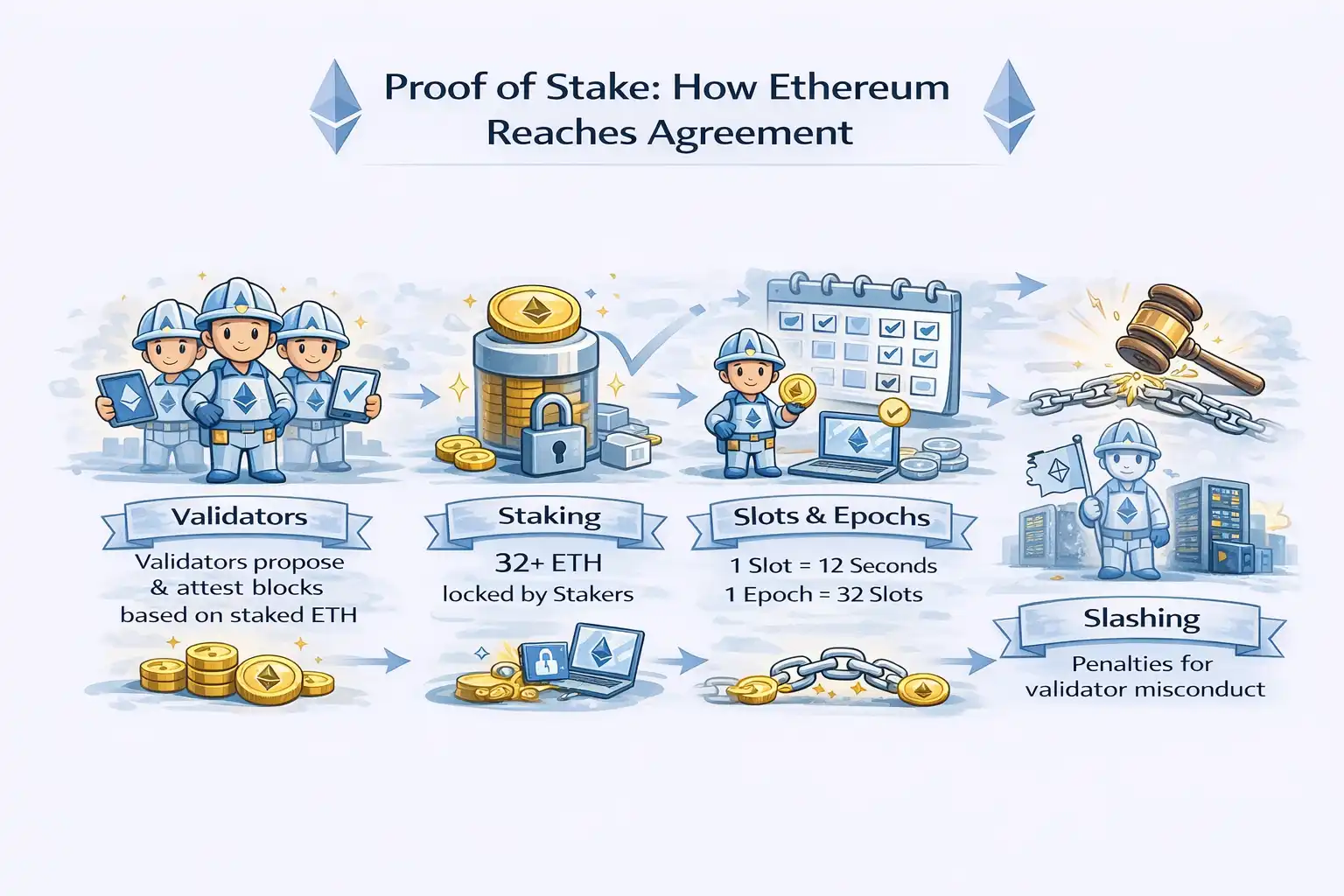
Under proof of stake, an Ethereum validator is chosen to propose and attest blocks based on their stake, not their computing power. The more ETH a validator has locked up, the more often they are selected. But selection is randomized, so no single validator dominates.
Validators and staking
To become a validator, you deposit a minimum of 32 ETH into the staking contract. After the Pectra upgrade in May 2025, a single validator can hold up to 2,048 ETH, which lets large operators consolidate many positions into one. In return for proposing and attesting blocks correctly, validators earn rewards paid in ETH.
If you do not have 32 ETH, liquid staking services accept any amount. They pool deposits from many users, run validators on their behalf, and distribute rewards minus a fee.
Slots and epochs
Time on Ethereum is divided into slots and epochs. A slot is 12 seconds, the window in which one block can be proposed. An epoch is 32 slots, lasting about 6.4 minutes. At the end of each epoch, the validator set is reshuffled and checkpoint votes are tallied.
If a validator is selected to propose a block but fails to do so, that slot is missed. The chain continues without a block in that slot. Missed slots are uncommon but happen occasionally when a validator goes offline.
Slashing
Slashing is the penalty for serious protocol violations. There are two main violations that trigger it. The first is double proposing: submitting two different blocks for the same slot. The second is surround voting: submitting attestations that contradict each other in a way that could be used to rewrite history.
A slashed validator loses part of their staked ETH, is ejected from the active validator set, and must wait before withdrawing the remainder. The minimum penalty is roughly one thirty-second of their stake. If many validators are slashed at the same time, the penalty scales up significantly.
Slashing is rare. It typically happens when an operator runs the same validator key on two machines simultaneously as a failover setup, which Ethereum explicitly forbids.
The Ethereum virtual machine (EVM)
The Ethereum Virtual Machine, or EVM, is the computing environment that runs smart contracts. Every full node on the network runs the EVM. When a transaction calls a smart contract, every node executes the same code independently and must arrive at the same result.
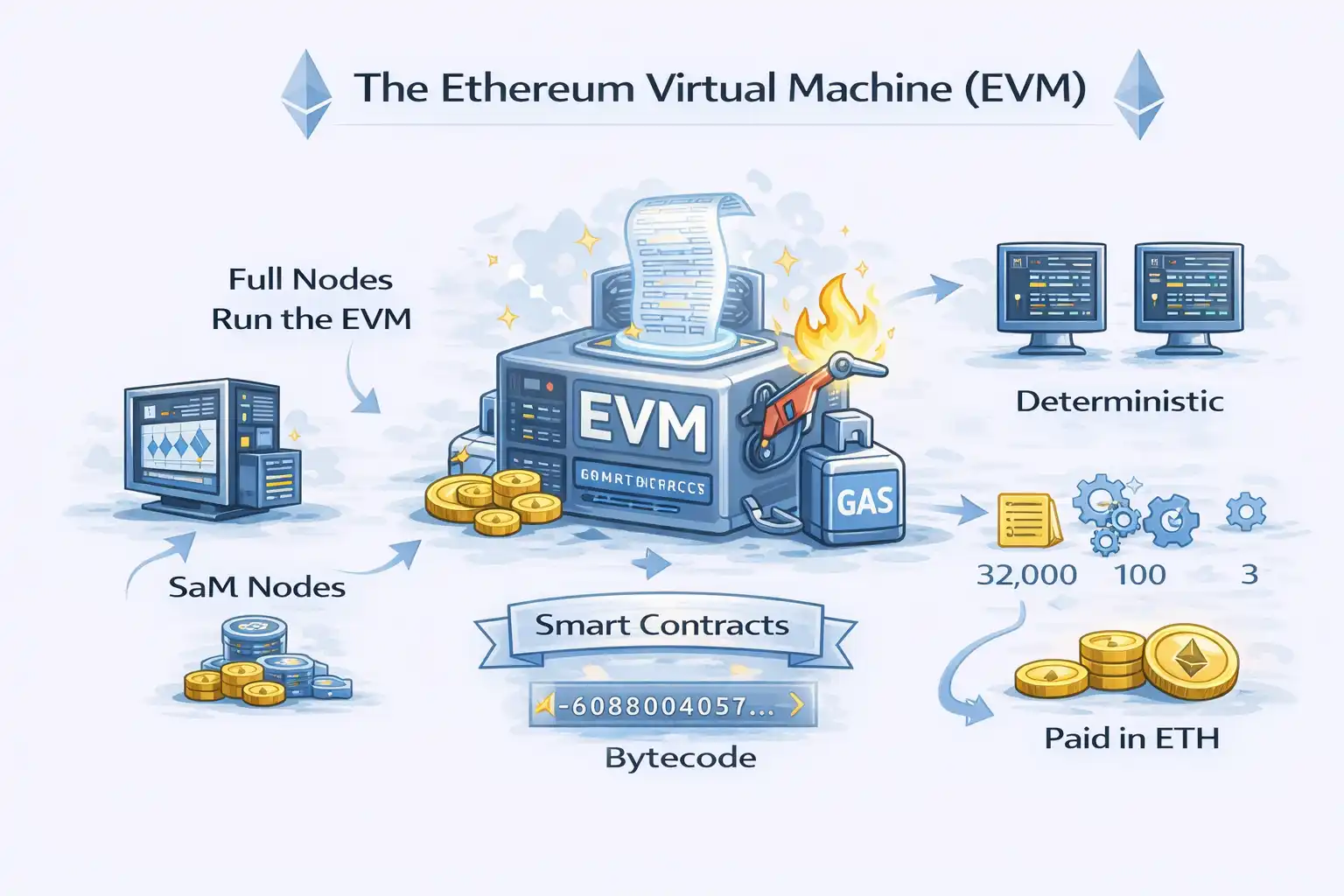
That requirement for identical results is called determinism. The EVM is deliberately designed so that the same input always produces the same output, regardless of which machine runs it. This is how thousands of independent computers can agree on a single shared state without trusting each other.
What the EVM executes
Smart contracts are stored on the blockchain as bytecode. When you call a contract, the EVM reads that bytecode and executes it instruction by instruction. Developers write contracts in Solidity or other high-level languages, which a compiler converts into EVM bytecode before deployment.
Each instruction in the EVM has a fixed gas cost. Simple arithmetic like addition costs 3 gas. Reading from contract storage costs 100 gas. Writing to storage costs 20,000 gas. Deploying a new contract costs 32,000 gas. These costs reflect the actual computing and storage burden each operation places on every node running the EVM.
Gas as a meter for computation
Gas is the unit that measures computation on Ethereum. Every transaction specifies a gas limit: the maximum amount of gas it is willing to use. If a transaction runs out of gas before completing, it fails, the state reverts to what it was before, and the gas already consumed is not refunded.
Gas also sets a hard limit on how much computation can happen per block. Each block has a gas limit that caps the total gas all transactions in that block can consume. This prevents any single block from taking too long to process and keeps block times predictable at 12 seconds.
Gas and transaction fees
Every Ethereum transaction costs a gas fee, paid in ETH. That fee has two parts: the base fee and the tip.
Base fee and the tip
The base fee is set by the protocol, not by the user. It adjusts automatically with every block based on how full the previous block was. If the previous block was more than 50% full, the base fee rises. If it was less than 50% full, the base fee falls. This mechanism keeps blocks from being consistently overloaded.
The tip, also called the priority fee, goes directly to the validator who includes the transaction. Users set their own tip. A higher tip makes a transaction more attractive to validators and typically results in faster inclusion.
EIP-1559 and the burn mechanism
This two-part fee structure was introduced by EIP-1559 in August 2021, part of the London upgrade. The key change: the base fee is not paid to validators. It is burned, permanently removed from circulation. Only the tip goes to the validator.
Burning the base fee means that during periods of high network activity, more ETH is removed from supply than is issued as staking rewards. Since The Merge in September 2022, over 1.5 million ETH has been burned in total. During busy periods, Ethereum’s net supply has contracted.
To understand exactly what ETH is and how the burn mechanism affects its supply, read the guide on what Ether (ETH) is.
Why fees change
Fees rise when demand for block space exceeds supply. Each block can only hold a limited amount of gas. When many users compete to get into the same block, they raise their tips. The validator fills the block with the highest-tipped transactions. Everyone else waits.
Fees fall when the network is quiet. The base fee drops automatically, and validators accept transactions with lower tips because competition is lower. On a slow night, a standard ETH transfer can cost a few cents. During a popular NFT mint or a sharp market move, the same transfer can cost several dollars.
Smart contracts: programs that live on the blockchain
A smart contract is a program stored on the Ethereum blockchain that runs automatically when certain conditions are met. Nobody controls it after deployment. The EVM executes it exactly as written, every time it is called.
A simple example: a contract that holds ETH in escrow and releases it to a buyer when a seller provides proof of delivery. Neither party needs to trust the other. Neither needs a bank or a lawyer to enforce the agreement. The contract does it automatically.
More complex contracts power DeFi protocols: lending markets, decentralized exchanges, stablecoin systems. In each case, the rules are written in code, stored on-chain, and executed by the EVM with no human intervention.
Smart contracts are transparent. Anyone can read the code of any deployed contract on the Ethereum blockchain. That transparency cuts both ways: users can verify what a contract does, but a poorly written contract exposes its vulnerabilities publicly. Auditing smart contract code before using a protocol is standard practice.
How Ethereum differs from Bitcoin
Bitcoin and Ethereum are both decentralized blockchains with no central authority. That is where most of the similarity ends.

Bitcoin was built to transfer value. Its scripting language is minimal and intentionally limited. Developers change it rarely and cautiously. Bitcoin has a fixed supply of 21 million coins and uses proof of work. Many holders treat it as a store of value.
Ethereum was built to run programs. Smart contracts, DeFi, stablecoins, NFTs, DAOs: all of it depends on Ethereum’s programmable layer. Its codebase is updated regularly through hard forks. It has no fixed supply cap but burns a portion of every fee. It uses proof of stake.
Bitcoin processes about 7 transactions per second at the base layer. Ethereum processes around 15 to 30 at the base layer, with Layer 2 networks adding significantly more capacity on top. The story of how Ethereum was designed and why it was built differently from Bitcoin starts with Vitalik Buterin’s decision in 2013 that Bitcoin’s scripting language was too limited for what he had in mind.
FAQ
How does Ethereum work in simple terms?
Ethereum is a network of computers that all store the same database and follow the same rules. When you send ETH or interact with a smart contract, your request is broadcast to the network. Validators collect transactions into blocks, other validators confirm them, and the result is added to the shared record permanently.
What is an Ethereum node?
A node is a computer running Ethereum software that stores a copy of the blockchain and communicates with other nodes. Full nodes store the entire history and verify every transaction independently. Light nodes store only block headers and rely on full nodes for verification. Archive nodes store full node data plus every historical state at every block height.
How long does an Ethereum transaction take?
A transaction is typically included in a block within 12 seconds. It reaches economic finality after two epochs, which takes around 12 to 15 minutes. After finality, reversing the transaction would require destroying at least one third of all staked ETH on the network.
What is the mempool?
The mempool is a waiting area for transactions that have been broadcast to the network but not yet included in a block. Validators pick transactions from the mempool, usually prioritizing those with the highest tip. A transaction can sit in the mempool for seconds or minutes depending on network congestion and the fee the sender paid.
What is the Ethereum virtual machine?
The Ethereum Virtual Machine (EVM) is the computing environment that executes smart contracts. Every full node runs the EVM and executes the same code independently. All nodes must reach the same result. The EVM charges gas for each operation it performs, which prevents infinite loops and controls how much computation can happen per block.
Why do Ethereum gas fees change?
Gas fees change because block space is limited and demand varies. Each block targets 50% capacity. When blocks fill above that, the base fee automatically rises. When blocks are below 50% full, the base fee falls. On top of the base fee, users pay a tip to incentivize validators to include their transaction faster. High network activity drives both figures up.
What is slashing in Ethereum?
Slashing is a penalty applied to validators who break specific rules. The two main violations are proposing two different blocks for the same slot, and submitting contradictory attestations. A slashed validator loses part of their staked ETH, is removed from the active validator set, and must wait a period before withdrawing the remainder. The minimum penalty is around one thirty-second of their stake.
What is finality on Ethereum?
Finality means a block cannot be changed without destroying at least one third of all staked ETH. Ethereum uses checkpoint finality: every 32 slots (one epoch, roughly 6.4 minutes), validators vote on a checkpoint. When two consecutive checkpoints are justified, the earlier one is finalized. This takes about 12 to 15 minutes after a transaction is included in a block.