No, you cannot mine Ethereum in 2026. ETH mining ended permanently on September 15, 2022, when the Ethereum network completed its transition from Proof of Work to Proof of Stake – an event known as The Merge. There are no workarounds, no mining software updates, and no hardware configurations that change this. If you have seen a guide in 2026 claiming to show you how to mine ETH, it is either describing something else entirely, pushing outdated information, or running a scam. This article explains what actually happened, what options you have now, and what to do if you still have a GPU rig sitting around.
What Was Ethereum Mining and How Did It Work?
Before September 2022, Ethereum mining worked the same way Bitcoin mining still works today. Computers around the world competed to solve a mathematical puzzle. The first machine to find the correct solution got to add the next block to the blockchain and collect the reward. That reward was 2 ETH plus gas fees from every transaction included in the block – sometimes worth several hundred dollars at peak prices.
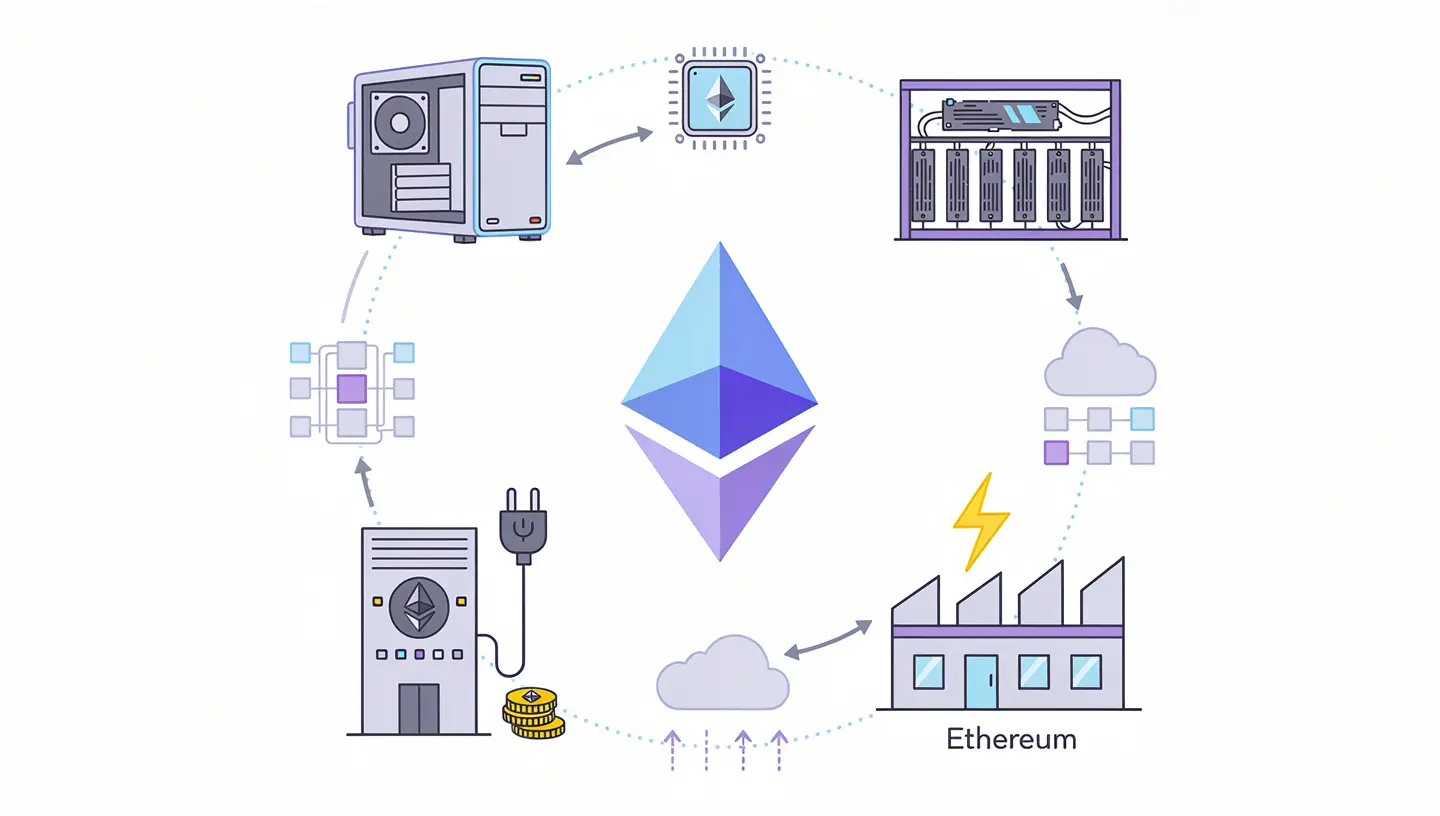
The system was called Proof of Work because the network required physical proof that you had done computational work. More computing power meant more chances of winning the next block. This drove massive investment in GPU mining rigs and later in ASIC machines built specifically for Ethereum’s Ethash algorithm.
How miners secured the network before September 2022
A GPU miner running six Nvidia RTX 3080 cards in 2021 could generate roughly 600 MH/s of hash rate. Hash rate is the speed at which a machine makes guesses at the puzzle solution. More hash rate meant a larger share of the block rewards distributed across the network. Miners also kept records of every transaction, which meant they played a direct role in securing the Ethereum network against fraud.
The block time on Ethereum averaged around 13 seconds under PoW. Every 13 seconds, one miner somewhere in the world won the reward. For the vast majority of individual miners, however, winning a block solo was unrealistic – the probability was simply too low given the total network hash rate.
Mining pools, solo mining, and why most miners never went solo
This is why mining pools became the standard. A pool combines the hash rate of thousands of individual miners. When the pool wins a block, the reward is split proportionally based on each miner’s contribution. Ethermine was the largest Ethereum mining pool before The Merge, at its peak processing over 25% of all Ethereum blocks. Other major pools included F2Pool and SparkPool.
Solo mining was only realistic for operations with hundreds of GPUs generating enough hash rate to win blocks on a somewhat predictable schedule. For a home miner with one or two GPUs, solo mining could go months without a single reward. Pools made mining accessible to anyone with a single GPU and a stable internet connection.
The Merge Explained: Why Ethereum Mining Ended on September 15, 2022
The Merge was not a surprise. Ethereum’s founders had discussed moving to Proof of Stake since the network launched in 2015. The Beacon Chain – Ethereum’s new PoS layer – went live in December 2020 and ran in parallel with the PoW chain for almost two years. Miners had time to prepare.
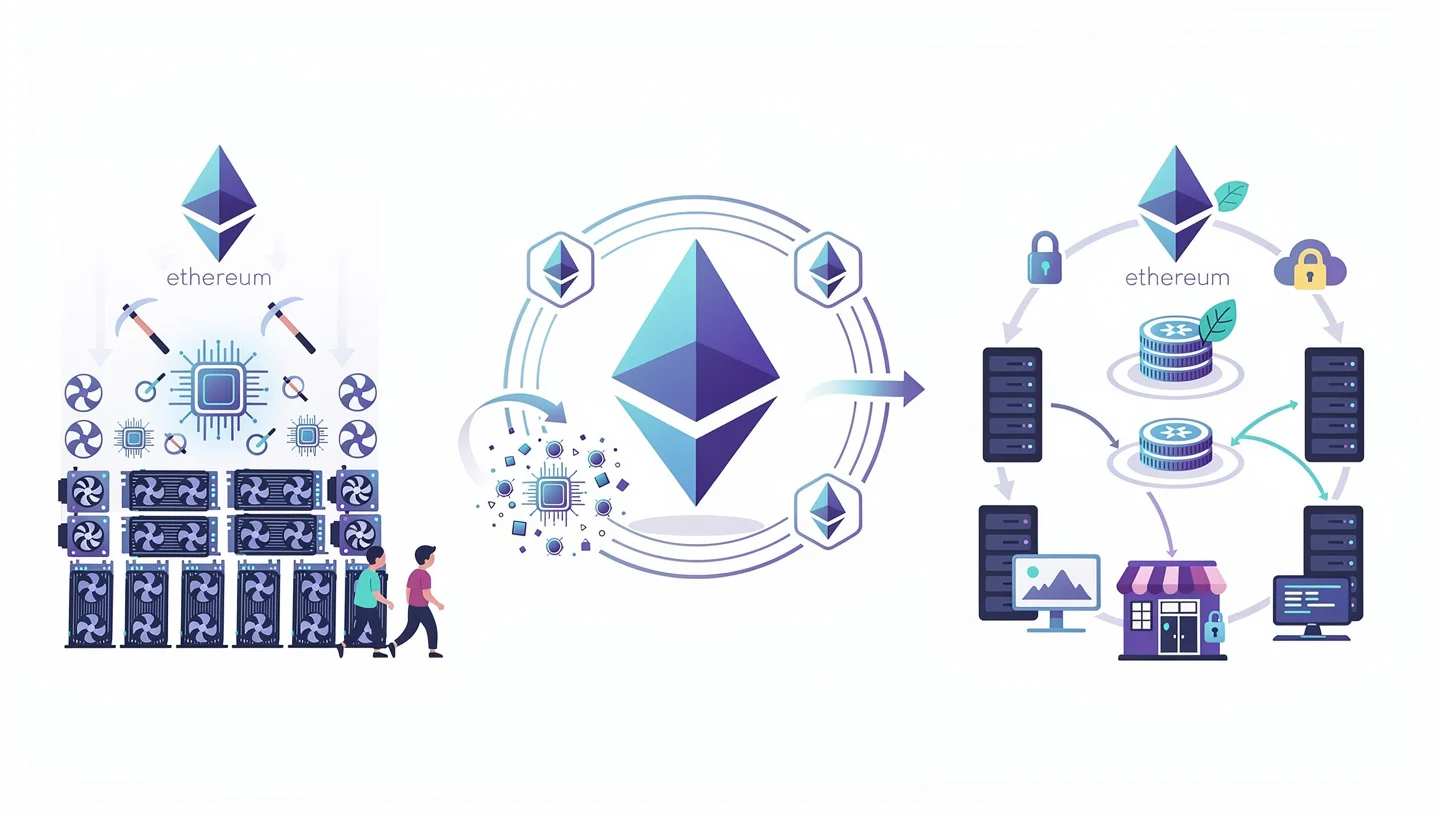
The transition was delayed multiple times, but when it finally happened on September 15, 2022, it was immediate and complete.
What exactly changed on the day of the Merge
Before The Merge: miners used hardware to compete for blocks. After The Merge: validators were chosen to propose blocks based on how much ETH they had locked up as collateral. The computational puzzle-solving stopped entirely. No new ETH was issued as mining rewards. The entire security model of the network changed in a single block transition.
The energy consumption drop was dramatic. Ethereum’s electricity use fell by approximately 99.95% overnight. Mining farms that had been running around the clock went dark. GPU prices on the second-hand market dropped 40 to 60 percent within weeks as millions of cards flooded the resale market.
This was not a temporary change. The code that governs Ethereum no longer includes any mechanism for Proof of Work mining. There is no switch to flip back. The architectural change is permanent.
Why the Ethereum Foundation chose Proof of Stake
Three reasons drove the decision. First, energy consumption – PoW Ethereum used roughly the same electricity as a mid-sized country, which created regulatory pressure and reputational problems. Second, scalability – Proof of Stake opened the door for future upgrades like sharding that would not have been practical under PoW. Third, security – under PoS, attacking the network requires owning a large amount of ETH, which makes attacks expensive in a way that directly damages the attacker’s own holdings.
To understand how the current Ethereum network operates after this change, the guide on Ethereum Proof of Stake covers the validator system and how block proposals work under the new model.
What happened to Ethereum miners after the Merge
Most miners moved their rigs to Ethereum Classic (ETC), which kept Proof of Work and shared nearly identical mining software and hardware requirements. Others switched to Ravencoin, Ergo, or Flux. Some sold their GPU rigs entirely. A portion of miners repurposed their hardware for AI compute workloads and 3D rendering, which pay per GPU-hour rather than per block.
Ethermine shut down its ETH mining servers on the day of The Merge and redirected its platform toward ETC mining and later toward staking services. The major mining software tools – GMiner, T-Rex Miner, PhoenixMiner – remained active but shifted focus to Ethereum Classic and other PoW coins.
Can You Still Mine Ethereum in 2026?
No. There is no version of “mining Ethereum” that produces ETH directly from GPU work on the Ethereum mainnet. The network does not accept block proposals from miners. No software connects to Ethereum’s PoW layer because that layer no longer exists.
The short answer – and why you still see ETH mining guides in 2026
Three reasons explain why “how to mine eth” still returns results in 2026. First, some guides are simply outdated and were never updated after The Merge. Second, some sites use “Ethereum mining” as a headline but describe mining Ethereum Classic or other coins – technically accurate but potentially misleading. Third, some results are outright scams banking on the fact that people still search for this.
It also helps to understand the terminology. Ethereum is the name of the network. Ether (ETH) is the token that runs on it. Since late 2022, the Ethereum network has used Proof of Stake, which means Ether is earned through staking, not mining. The two are now fundamentally different processes.
What “mining Ethereum” actually means in 2026
When someone in 2026 talks about mining Ethereum, they usually mean one of three things:
- Mining Ethereum Classic (ETC) – a separate blockchain that forked from Ethereum in 2016 and kept Proof of Work. This is the legitimate interpretation and the one worth exploring if you have GPU hardware.
- Using Unmineable or similar software – these tools mine a different PoW coin in the background and pay out the equivalent value in ETH. You are not mining ETH; you are mining something else and receiving ETH as payment.
- A scam – cloud mining contracts, phone apps, and browser-based “miners” that promise ETH rewards but deliver nothing or charge fees that exceed any earnings.
Phone mining apps and cloud mining – why they are not what they claim
No smartphone has enough computing power to meaningfully participate in any Proof of Work network. The hash rate a phone can generate is so far below what a modern GPU produces that any earnings would be fractions of a cent per day – before electricity. Any app that claims to “mine ETH” on your phone is either a simulation that shows fake numbers, malware harvesting your data or private keys, or a setup designed to charge you a “withdrawal fee” to access earnings that do not exist.
Cloud mining contracts have a similarly poor track record. You pay upfront for a share of a mining operation run by a third party. In practice, the contracts are almost always structured so the provider collects fees that exceed your earnings, or the operation closes and disappears before you break even. The model exists because it is profitable for the seller, not the buyer.
Ethereum Classic (ETC): The Closest Thing to Mining ETH in 2026
If you have a GPU rig and want to mine something that connects directly to Ethereum’s history, Ethereum Classic is the realistic option. ETC is the original Ethereum blockchain – the chain that continued without the DAO fork rollback in 2016. It kept Proof of Work when Ethereum moved to PoS, and it uses the Etchash algorithm, which is nearly identical to the old Ethash algorithm that ETH miners used before The Merge.
What is Ethereum Classic and why it still uses Proof of Work
Ethereum Classic and Ethereum share the same codebase up to a certain point in history. After the DAO hack in 2016, the Ethereum community voted to reverse the hack through a hard fork. A minority disagreed and continued the original chain – that chain became Ethereum Classic. It has its own development team, its own token (ETC), and its own community, entirely separate from the Ethereum Foundation.
ETC has survived three separate 51% attacks – in 2019, 2020, and 2020 again – which are the main security risk of a smaller PoW network. After implementing the MESS algorithm (Modified Exponential Subjective Scoring), attacks became more expensive and less frequent. The network has been stable since 2021. This is a real risk to understand before pointing hardware at it.
To understand more about how the Ethereum network itself differs from what ETC preserved, the overview of what Ethereum is explains the current state of the mainnet.
Hardware you need to mine ETC in 2026
| Component | Minimum | Recommended for 2026 |
|---|---|---|
| GPU (VRAM) | 4GB | 8GB+ (Nvidia RTX 3070 / AMD RX 6700 XT or better) |
| System RAM | 8GB | 16GB DDR4 |
| Storage | 256GB SSD | 512GB NVMe SSD |
| Power Supply | 600W Gold rated | 850W+ Platinum rated |
| Internet | Any stable connection | 24/7 uptime, wired preferred |
| Cooling | Case fans | Open-air frame with directed airflow |
Old 2GB cards will not work. The DAG file – a dataset generated every 30,000 blocks that must be loaded into GPU memory – has grown beyond 2GB, which means any card with less than 4GB VRAM cannot participate. Cards with 4GB can still mine ETC, but 8GB+ cards have headroom for future DAG growth and run more stable over long periods.
Mining software for ETC – GMiner, T-Rex Miner, and PhoenixMiner
The three most widely used pieces of mining software for ETC in 2026 are GMiner, T-Rex Miner, and PhoenixMiner. All three are free to download, take a small developer fee (usually 0.65-1%) from earnings, and support the Etchash algorithm. Configuration is done through a .bat file or .sh script where you specify the pool address, your wallet address, and your worker name.
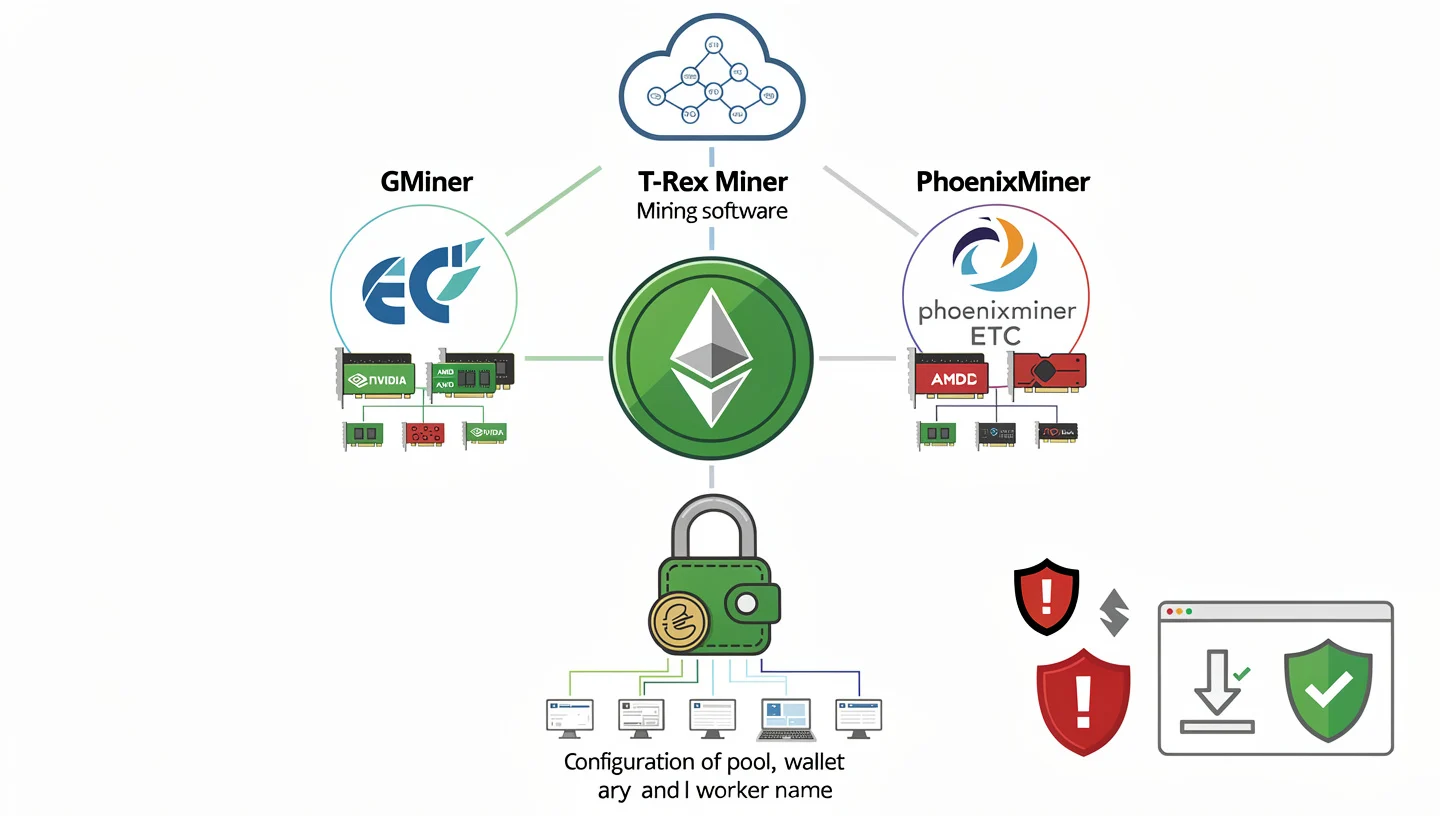
GMiner works well across both Nvidia and AMD cards. T-Rex Miner is Nvidia-specific and generally produces slightly higher hash rates on Nvidia hardware. PhoenixMiner handles AMD cards well and has been in the space since the ETH mining era. Download only from official GitHub repositories or the mining software’s official website – fake versions with malware embedded are a documented problem.
How to join an ETC mining pool – step by step
- Install GPU drivers and confirm your card is recognized by your operating system.
- Download mining software (GMiner or T-Rex Miner) from the official GitHub repository.
- Create an ETC wallet to receive your earnings. Hardware wallets support ETC, or you can use a software wallet.
- Choose a mining pool. 2Miners and Ethermine ETC are the two largest and most reliable pools for ETC in 2026.
- Edit the .bat configuration file: replace the pool address with your chosen pool’s stratum address and replace the wallet placeholder with your ETC wallet address.
- Run the file and check the console output. Your hash rate should appear within 30 seconds. Cross-check it against your pool’s dashboard after 10-15 minutes to confirm your worker is registered.
Pool payouts are typically automatic once your accumulated earnings reach a minimum threshold – usually 0.1 ETC on most pools. You can track earnings in real time through the pool’s web dashboard using your wallet address.
Is ETC mining profitable in 2026? The electricity cost reality
Electricity cost is the number that determines everything. The estimates below use a 500 MH/s rig as a reference point – roughly six mid-range GPUs.
| Electricity rate (per kWh) | Monthly power cost | Estimated monthly revenue | Net result |
|---|---|---|---|
| $0.05 | ~$18 | ~$45 | +$27 (profitable) |
| $0.10 | ~$36 | ~$45 | +$9 (thin margin) |
| $0.15 | ~$54 | ~$45 | -$9 (loss) |
| $0.20 | ~$72 | ~$45 | -$27 (significant loss) |
These numbers shift constantly with ETC’s price and with network difficulty. As more miners point hardware at ETC, difficulty rises and each miner earns less. Always run current numbers through a profitability calculator like WhatToMine before committing hardware to any coin. Revenue estimates from articles written six months ago may be significantly off from today’s reality.
Cooling adds cost that many beginners underestimate. GPU rigs run hot. In warm climates, air conditioning to keep a rig room below 35°C can double or triple the effective electricity cost. An open-air mining frame improves airflow substantially compared to running GPUs inside a standard PC case.
Other PoW Coins to Mine If You Have a GPU Rig
If ETC profitability does not work with your electricity rate, other Proof of Work coins accept GPU mining in 2026. The table below covers the main options.
| Coin | Ticker | Algorithm | Best hardware | Main risk |
|---|---|---|---|---|
| Ethereum Classic | ETC | Etchash | GPU / ASIC | 51% attack history |
| Ravencoin | RVN | KawPow | GPU (high VRAM) | High power draw |
| Kaspa | KAS | kHeavyHash | ASIC (dominates) | GPUs no longer competitive |
| Monero | XMR | RandomX | CPU | Low profit margins |
| Flux | FLUX | ZelHash | GPU | Small market, volatile |
| Ergo | ERG | Autolykos v2 | GPU | Low liquidity |
Ravencoin – the GPU-friendly alternative
Ravencoin uses the KawPow algorithm, which was specifically designed to be resistant to ASIC dominance. This keeps GPU miners competitive on the network rather than being priced out by specialized hardware. RVN has an active community and reasonably consistent trading volume, which matters when converting mining earnings to other assets.
The downside is power consumption. KawPow is more demanding on the GPU than Etchash, which means higher electricity draw per unit of hash rate. At electricity rates above $0.10/kWh, RVN profitability becomes tight quickly. It works best for miners with access to cheap power and modern high-efficiency cards.
Kaspa – high returns but ASICs have taken over
Kaspa generated significant excitement among GPU miners in 2022 and 2023 because its kHeavyHash algorithm was initially GPU-mineable and highly profitable. ASIC manufacturers moved fast. By 2024, dedicated Kaspa ASICs had taken enough of the network’s hash rate that GPU mining KAS became borderline unprofitable at most residential electricity rates. If you are considering Kaspa in 2026, the economics require either a dedicated ASIC or electricity costs well below $0.06/kWh to compete.
Staking ETH: What Replaced Mining After the Merge
Staking is the mechanism that replaced mining in Ethereum’s security model. Instead of spending electricity to compete for blocks, validators lock up ETH as collateral. The network selects validators to propose and attest to blocks based on their stake. Validators earn rewards for participating correctly and face penalties – called slashing – for going offline or attempting to cheat the protocol.
The full mechanics of how validators work and how rewards are distributed are explained in the Ethereum Proof of Stake section earlier in this guide.
How Ethereum staking works – validators instead of miners
Running a solo validator requires a minimum of 32 ETH deposited into the staking contract. On the hardware side, you need a computer running 24/7 with at least 16GB of RAM, a 2TB SSD to store blockchain data, and a stable internet connection. The software setup involves running two clients – an execution client and a consensus client – that work together to keep your validator active on the network.
If your validator goes offline, you lose a small amount of ETH proportional to how long you are offline. If you act maliciously or run the same validator key on two machines simultaneously, you face slashing – a more severe penalty that removes a portion of your staked ETH and ejects you from the validator set.
Solo staking vs liquid staking vs exchange staking
| Method | Minimum ETH | Technical effort | Annual yield | Control |
|---|---|---|---|---|
| Solo staking | 32 ETH | High (node setup and maintenance) | ~3.5% APY | Full |
| Lido (stETH) | No minimum | Low | ~3-4% APY | None (trust protocol) |
| Rocket Pool (rETH) | 0.01 ETH | Low | ~3-4% APY | Partial |
| Exchange staking | No minimum | Very low | 2-4% APY | None (custodial) |
Liquid staking protocols like Lido and Rocket Pool give you a token representing your staked ETH – stETH or rETH respectively. These tokens accumulate staking rewards and can be used in DeFi while your ETH remains staked. This solves the liquidity problem that comes with locking up ETH in a solo validator, where withdrawals require a queue that can take days during high-demand periods.
For a step-by-step walkthrough of the staking process, the guide on how to stake Ethereum covers all three methods with specific instructions for each.
Is staking better than mining ETC right now?
It depends on what you are starting with. If you already own ETH, staking is almost always the more efficient path. You earn 3-4% annually with no hardware cost, no electricity bill, no cooling overhead, and no exposure to coin price volatility beyond ETH itself. Your capital works directly.
If you have GPU hardware and cheap electricity but limited capital, ETC mining gives you a way to earn crypto without buying ETH upfront. The risk is higher – ETC price can move sharply, network difficulty changes, and hardware eventually breaks down and needs replacing. The profit ceiling is also less predictable.
For anyone considering buying ETH and putting it to work, the guide on how to buy Ethereum covers the straightforward purchase process, and staking starts from there.
How Long Does It Take to Mine 1 ETH in 2026?
This is one of the most searched questions about Ethereum mining, and the direct answer has not changed since 2022: you cannot mine 1 ETH because ETH mining does not exist. The more useful question is how long it takes to accumulate 1 ETH worth of value through alternative methods.
Time to earn 1 ETH through ETC mining – a realistic scenario
Assume a six-GPU rig running Nvidia RTX 3080s generating roughly 600 MH/s total, paying $0.08 per kWh for electricity. At current ETC prices and network difficulty, this rig earns approximately $3-5 net profit per day after electricity. At $4 per day net and ETH priced around $3,000, you would need roughly 750 days of continuous mining to accumulate $3,000 in ETC – assuming you then trade ETC for ETH.
That calculation does not include the hardware cost. Six RTX 3080s purchased new cost roughly $3,000-4,000 depending on availability. Hardware purchased second-hand from post-Merge sales is cheaper but comes with wear and tear. At the $4/day net scenario, the hardware pays for itself in another 750-1,000 days. Total time to break even and accumulate 1 ETH equivalent: three to five years, assuming ETC price and network difficulty stay roughly constant – neither of which is guaranteed.
Time to earn 1 ETH through staking
With 10 ETH staked at 3.5% APY, you earn 0.35 ETH per year. To accumulate 1 additional ETH through staking rewards alone takes approximately 2.85 years. No electricity cost. No hardware degradation. No software configuration. The 10 ETH principal remains yours and can be withdrawn once the queue processes it.
With 32 ETH staked as a solo validator at the same rate, you earn roughly 1.12 ETH per year. You reach 1 additional ETH in about 10-11 months. The tradeoff is the larger capital requirement and the technical overhead of running the validator node continuously. Transferring ETH to begin staking is covered in the guide on how to transfer Ethereum.
Mining Scams to Avoid in 2026
The search term “how to mine eth” attracts a disproportionate number of scam operations. This happens because the people searching it often do not yet know that ETH mining is impossible, which makes them easier to mislead. The three categories below cover the vast majority of what you will encounter.
Cloud mining contracts – why they rarely pay out
Cloud mining sells you a share of a mining operation run by a third party. You pay upfront or on a subscription basis for a certain amount of hash rate directed at a coin. The provider handles hardware, electricity, and maintenance. You collect earnings minus fees.
The problem is structural. Reputable mining operations with cheap electricity and efficient hardware can mine more profitably by keeping all the earnings themselves. The operations that sell cloud mining contracts to retail investors are almost always either unprofitable at the prices they charge, or outright exit scams that collect deposits and disappear. There are documented cases of both going back a decade. The model benefits the seller, not the buyer. If cloud mining were reliably profitable, providers would not need to sell contracts – they would just mine.
Phone mining apps – simulation, not mining
A phone’s GPU is orders of magnitude weaker than a dedicated mining card. Even if an app genuinely pointed your phone’s processor at a PoW network, the earnings would be fractions of a cent per day – negligible against the wear on your phone and battery. No legitimate ETH or ETC mining happens on a phone.
What phone mining apps actually do falls into three categories. Some are pure simulations – numbers go up on screen to keep you engaged with no underlying mining or earnings. Some are data harvesting operations that use the “mining” interface as a reason to request storage, camera, or network permissions. Some charge a “withdrawal fee” to release your accumulated “earnings” – fees you pay and earnings that do not exist.
Red flags checklist – how to spot a mining scam
- Guaranteed daily or weekly returns – real mining is tied to volatile coin prices and variable network difficulty. Guaranteed returns are a fabrication.
- “No hardware needed” combined with ETH earning promises – earning ETH without capital or hardware is not possible through any legitimate mechanism.
- A withdrawal fee required to access earnings – you should never pay to withdraw money you have already earned. This is a classic advance-fee structure.
- WhatsApp or Telegram customer support as the only contact method – legitimate mining pools have public websites, open-source software, and verifiable track records.
- Anonymous team and no physical company address – reputable operations are registered businesses with named leadership.
- Referral bonuses larger than mining earnings – when the real product is recruiting rather than mining, you are looking at a pyramid structure.
For a broader picture of deceptive schemes targeting Ethereum users, the guide covering common Ethereum scams goes through each type in detail.
Frequently Asked Questions
Can you still mine Ethereum in 2026?
No. Ethereum moved to Proof of Stake with The Merge on September 15, 2022. The network no longer uses Proof of Work. There is no GPU, ASIC, software, or configuration that mines ETH directly on the Ethereum mainnet. The change is permanent.
What happened to Ethereum miners after the Merge?
Most miners redirected their GPU rigs to Ethereum Classic (ETC), which kept Proof of Work and uses a nearly identical mining algorithm. Others moved to Ravencoin, Ergo, or Flux. Some sold their hardware as GPU prices dropped 40-60% in the months after The Merge. A portion repurposed rigs for AI compute and rendering workloads. Ethermine, the largest ETH pool, shut down its mining servers and pivoted to staking services.
What is the best coin to mine with a GPU in 2026?
Ethereum Classic is the most direct replacement for former ETH miners due to the shared Etchash algorithm. Ravencoin is the strongest alternative for miners who want ASIC resistance. Which coin is actually best for your hardware depends on your electricity cost, your GPU’s efficiency, and current coin prices – use a profitability calculator like WhatToMine with your specific numbers before committing.
Is Ethereum Classic mining profitable?
It depends entirely on your electricity cost. At $0.05-0.08 per kWh, a modern GPU rig can generate a small profit. At $0.15 per kWh or above, most ETC mining operations run at a loss. Hardware purchase cost adds additional time to break even. Run current numbers through a profitability calculator before buying equipment or committing to ETC mining.
How much ETH can you earn through staking?
Solo validators earn approximately 3-4% APY on their staked ETH. With 32 ETH staked, that is roughly 1.1-1.3 ETH per year. Liquid staking protocols like Lido and Rocket Pool offer similar rates with no minimum, accessible through a standard web interface. Exchange staking typically pays slightly less due to platform fees.
What is the minimum ETH needed to stake?
Solo staking requires exactly 32 ETH – no more, no less per validator. Liquid staking through Lido or Rocket Pool has no meaningful minimum. Rocket Pool allows participation from 0.01 ETH. Exchange staking platforms also have no minimums or very low ones. The 32 ETH requirement applies only to running your own validator node.
Is cloud mining a scam?
Not always, but the overwhelming majority of cloud mining contracts offered to retail investors are either unprofitable at the fees charged or outright exit scams. The structural problem is that operators with genuinely cheap electricity and efficient hardware have no reason to sell their hash rate to strangers at a loss to themselves. Treat any cloud mining offer with heavy skepticism and verify independently before committing any money.
How long does it take to mine 1 ETH?
You cannot mine ETH in 2026. If the question is how long to accumulate 1 ETH worth of value through alternatives: ETC mining with a mid-range GPU rig at $0.08/kWh takes several years to cover hardware costs and build up 1 ETH equivalent in earnings. Staking 32 ETH at 3.5% APY earns roughly 1 additional ETH in under a year, but requires holding 32 ETH to start. The fastest path to 1 ETH for most people is simply buying it.