Staking Ethereum (ETH) lets you earn passive income while helping secure the network. You lock up ETH as collateral, a validator processes transactions on your behalf, and you receive staking rewards in return. The current staking APY runs between 3.5% and 5% in 2026, paid in ETH. This guide covers every method for staking ETH, from the simplest exchange options to solo staking your own validator.
What is Ethereum staking?
Ethereum staking is the process of depositing ETH into the Ethereum network to participate in block validation. Validators are selected to propose and attest to blocks. In exchange for this work, they earn staking rewards. Those rewards come from three sources: new ETH issued per block, priority fees paid by users to have their transactions included faster, and MEV (maximal extractable value) captured by validators who reorder transactions within a block.

Since the Merge in September 2022, proof of stake is the only consensus mechanism Ethereum uses. Mining no longer exists on Ethereum. Every block is proposed and validated by stakers. As of 2026, more than 35 million ETH is staked across over one million active validators, representing approximately 30% of the total ETH supply. To understand how proof of stake secures the network, the guide on Ethereum proof of stake covers the full mechanics.
Ethereum staking methods compared
Four main methods are available for staking ETH.
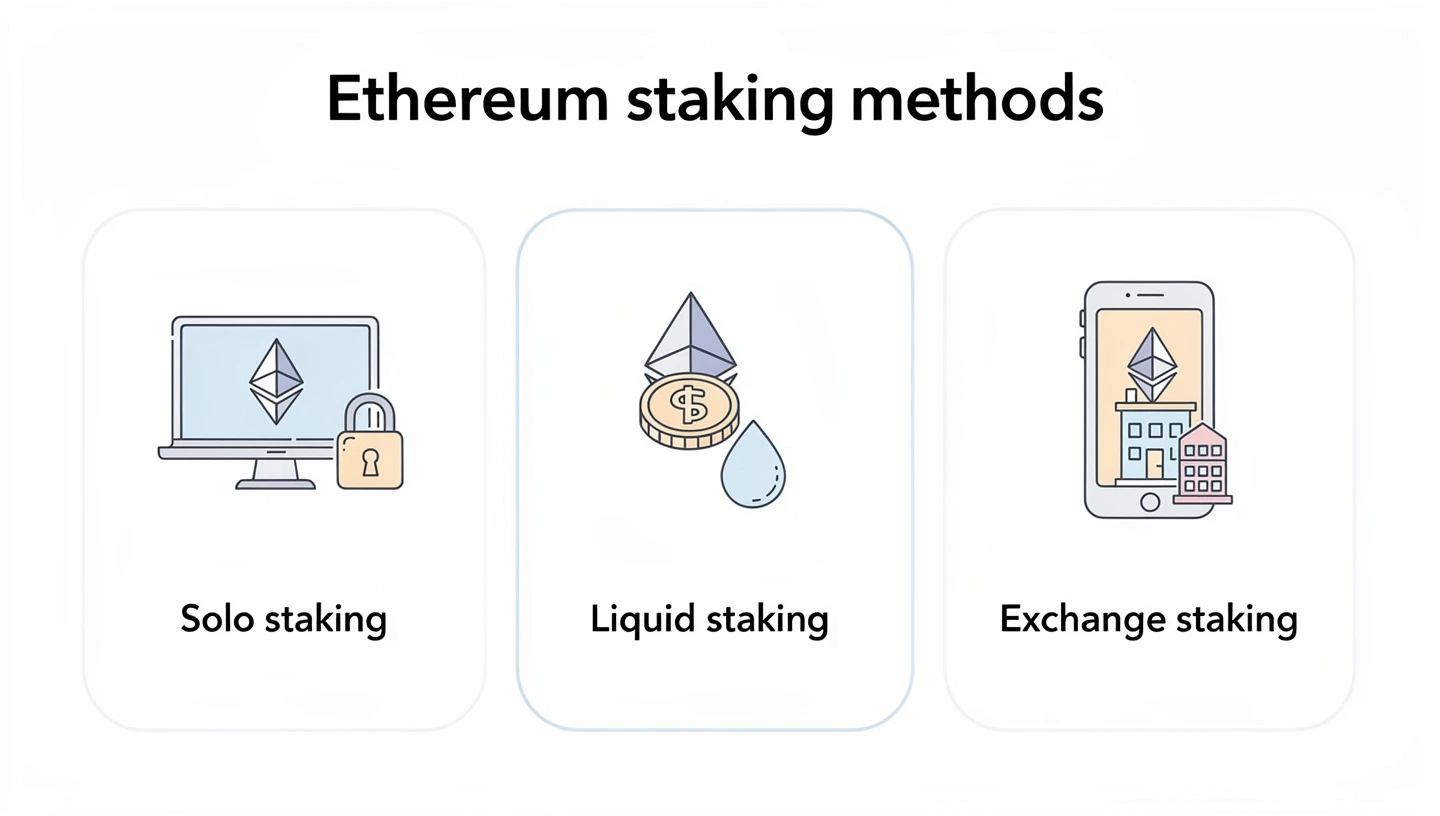
Each involves a different tradeoff between required capital, technical complexity, reward rate, and control over your funds.
| Method | Min ETH | Est. APY | Fee | Custody | Liquid |
|---|---|---|---|---|---|
| Solo staking | 32 ETH | 3.5-5%+ | None | Self-custody | No |
| Liquid staking (Lido) | Any amount | 3-4.5% | 10% of rewards | Non-custodial | Yes (stETH) |
| Staking pool (Rocket Pool) | Any amount (or 8 ETH) | 3-4% | ~15% of rewards | Non-custodial | Yes (rETH) |
| Exchange staking | From $1 | 2.5-4% | 10-25% of rewards | Custodial | Varies |
Solo staking
Solo staking means running your own validator node on the Ethereum network. You deposit exactly 32 ETH into the Ethereum deposit contract, set up an execution client and a consensus client on dedicated hardware, and keep the node online around the clock. Because there is no intermediary, all staking rewards go directly to you with no protocol fee deducted.
The hardware requirements for solo staking are a machine with at least 16 GB of RAM, a 2 TB SSD, and a stable internet connection with sufficient upload speed. Client software options include Geth or Nethermind as execution clients and Lighthouse, Prysm, or Teku as consensus clients. The official starting point is the Ethereum Staking Launchpad.
Solo stakers can also run MEV-Boost, a piece of software that connects your validator to a network of block builders. These builders compete to produce the most profitable blocks, and the winning builder shares a portion of that value with your validator. Enabling MEV-Boost adds approximately 0.5 to 1% to annual rewards on top of base staking rewards.
The main risks of solo staking are slashing (a penalty for validator misbehaviour such as signing conflicting blocks) and the inactivity leak (a gradual balance reduction if your node goes offline for extended periods). Running a well-maintained node with standard client software and avoiding restarts during attestation duties keeps both risks low. How Ethereum coordinates its validators is covered in the guide on how Ethereum works.
Liquid staking
Liquid staking lets you deposit any amount of ETH into a staking protocol and receive a liquid staking token in return. That token represents your staked ETH plus accumulated rewards. You can use it in DeFi, sell it, or hold it while your underlying ETH earns staking rewards.
Lido is the largest liquid staking protocol, holding over $15 billion in staked ETH. When you deposit ETH into Lido, you receive stETH. Lido charges 10% of all staking rewards as a protocol fee, split between node operators and the Lido treasury. Rocket Pool is the main decentralised alternative. Depositing ETH into Rocket Pool gives you rETH. Rocket Pool charges approximately 15% of rewards. Unlike Lido, Rocket Pool operates a permissionless validator set where anyone can run a node by depositing 8 ETH and RPL collateral as a minipool operator.
Exchange staking
Exchange staking is the simplest method. You deposit ETH on a centralised exchange and click stake. The exchange handles everything: running the validators, managing keys, and crediting your account with staking rewards. Coinbase, Kraken, and Binance all offer ETH staking.
The tradeoffs are significant. Exchange fees run from 10% to 25% of all rewards, the highest of any method. Coinbase charges 25%. Kraken charges around 15%. In a custodial arrangement, the exchange holds the validator keys. If the exchange fails, your ETH may be inaccessible. This is the same counterparty risk that applies to leaving ETH on an exchange in general.
Staking pools and Rocket Pool minipools
A staking pool aggregates ETH from many participants so that a group can collectively meet the 32 ETH threshold required to run a validator. Anyone in the pool earns proportional rewards based on their contribution.
Rocket Pool also offers a minipool option for those with 8 ETH. A minipool operator deposits 8 ETH of their own and is matched with 24 ETH from the Rocket Pool staking pool to run a full validator. The operator also deposits RPL tokens as collateral. This option earns higher rewards than simply depositing ETH for rETH, because the minipool operator earns both the base staking APY on their 8 ETH and a commission on the pooled ETH they help validate. This makes Rocket Pool minipools the highest-yield option for holders with 8 to 31 ETH who want to run a node without the full 32 ETH requirement.
How to stake ETH on Lido: step-by-step
Staking on Lido is the most accessible form of liquid staking.
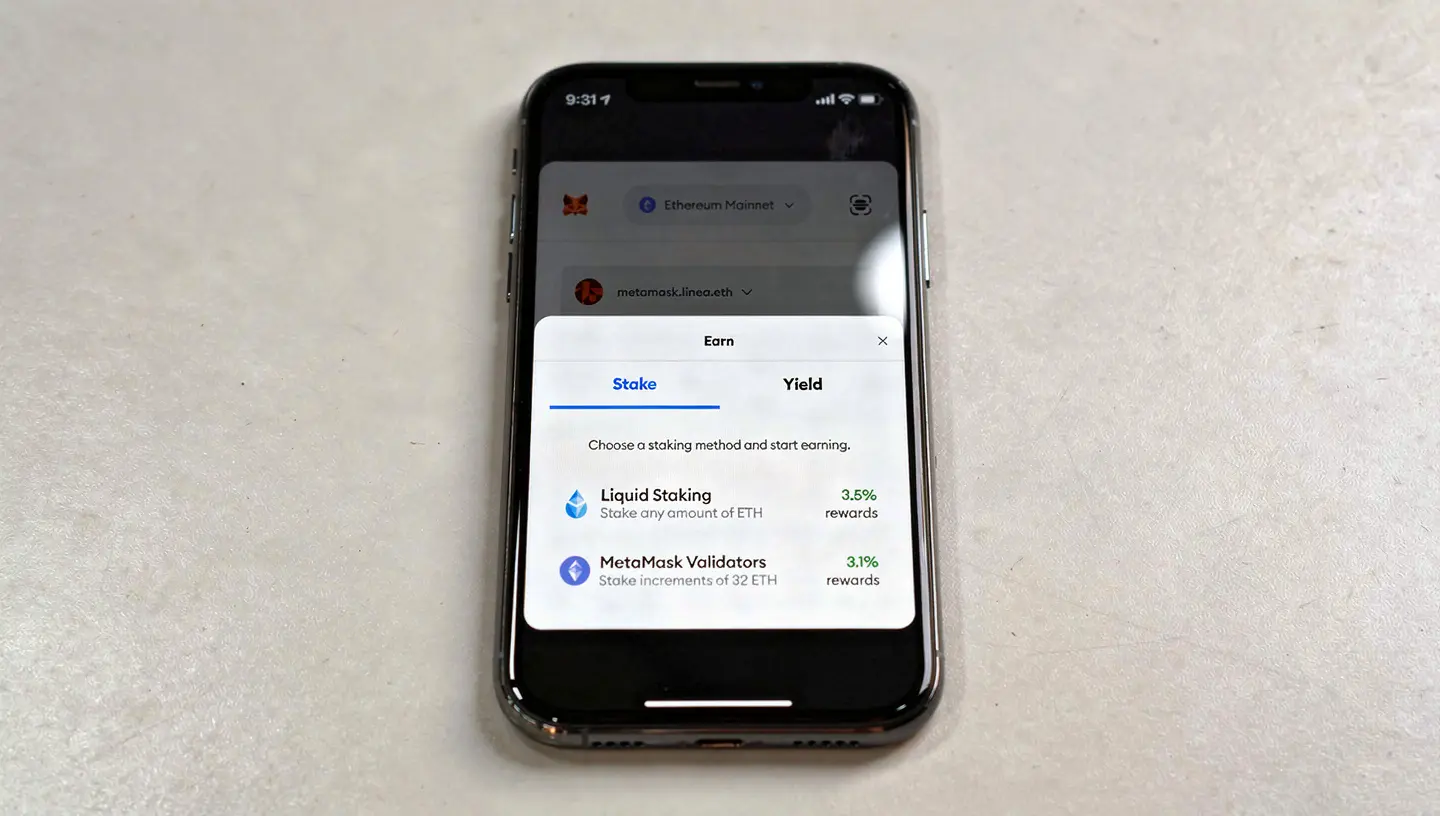
You need a MetaMask wallet with ETH in it, plus a small amount of ETH for the gas fee on the deposit transaction.
- Open your wallet. Make sure MetaMask or your preferred Web3 wallet is installed and funded with the ETH you want to stake.
- Go to stake.lido.fi. Navigate directly to the official Lido staking interface. Verify the URL before connecting.
- Connect your wallet. Click Connect Wallet and approve the connection request in MetaMask.
- Enter the amount. Type the amount of ETH you want to stake. There is no minimum beyond the gas fee for the transaction.
- Submit the transaction. Click Stake and confirm the transaction in MetaMask. The gas fee for a Lido deposit runs approximately $1 to $3.
- Receive stETH. After the transaction confirms, your wallet shows a stETH balance. This balance increases automatically each day as staking rewards accrue. You do not need to claim rewards separately.
For information on acquiring ETH before staking, the guide on how to buy Ethereum covers the process in full.
How to stake ETH on a centralised exchange
Staking on a centralised exchange requires no wallet setup and no technical knowledge.
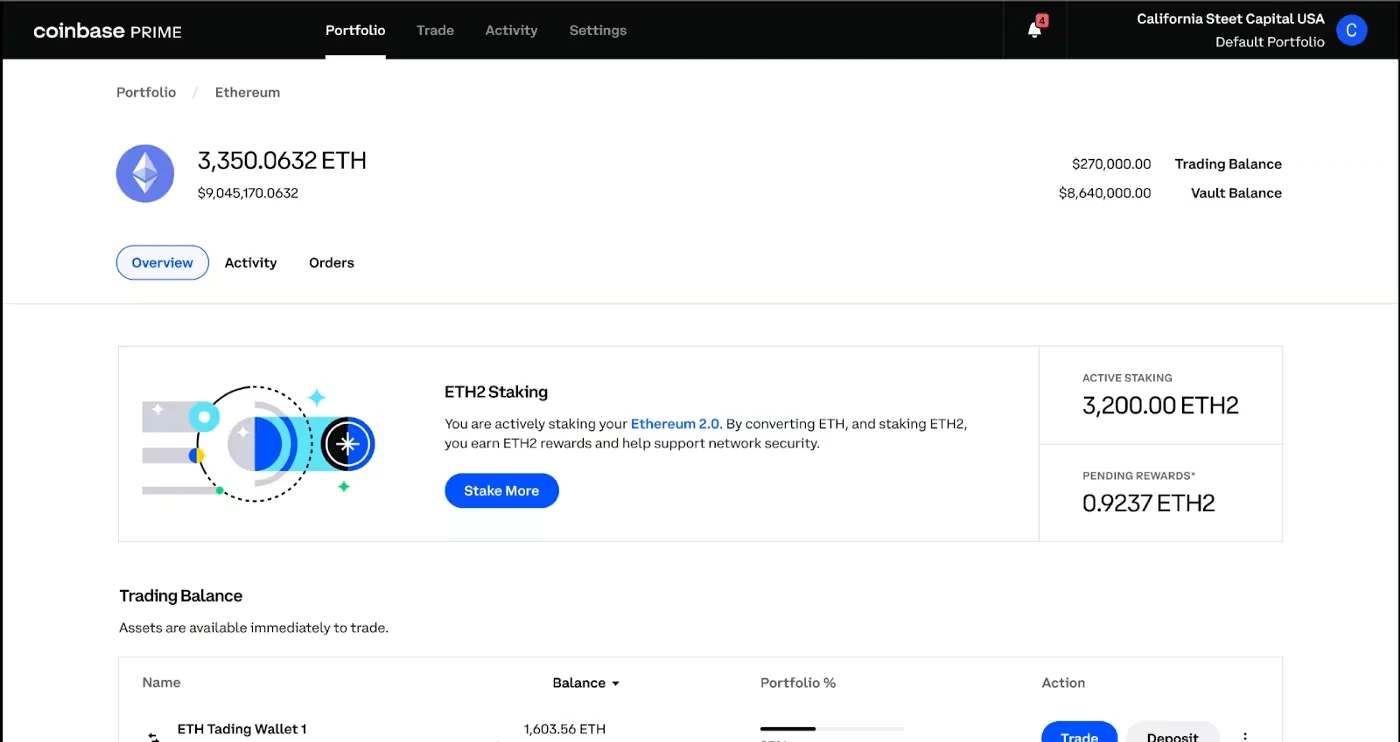
All management is handled by the exchange.
- Log in to your exchange account. Open your account on Coinbase, Kraken, or another exchange that offers ETH staking.
- Navigate to the staking section. Find the Earn, Staking, or Rewards section. Select ETH from the list of stakeable assets.
- Enter the amount and confirm. Enter how much ETH you want to stake and confirm. Some exchanges have minimum amounts; Coinbase accepts from $1.
- Track your rewards. The exchange credits staking rewards to your account, typically daily or weekly. Reward rates vary by exchange and fluctuate with network conditions.
If you later decide to move your staked ETH off the exchange, the guide on how to sell Ethereum explains the withdrawal and conversion process.
Ethereum staking rewards: what to expect in 2026
Ethereum staking rewards come from three distinct sources. The first is new ETH issued per block to the validator that proposes it. The second is priority fees paid by users to speed up their transactions. The third is MEV, which validators capture by selecting and reordering transactions to extract additional value.
The base staking APY for a validator holding 32 ETH runs at approximately 3.5% in 2026. This translates to roughly 0.3 ETH per year per validator from issuance alone. Adding priority fees and MEV can push total rewards to 4.5-5% for active solo stakers running MEV-Boost.
The APY is not fixed. It falls as more ETH is staked, because the total issuance is divided among a larger number of validators. When the total staked supply increases, each individual validator earns a smaller share of the same reward pool. This is why the staking APY in 2026 is lower than it was in 2022 when fewer validators were active. Conversely, periods of high network activity boost priority fees and increase rewards above the base rate.
Compounding is possible with liquid staking tokens. Because stETH automatically accrues rewards daily, holding it is equivalent to continuously reinvesting rewards. For solo stakers, rewards accumulate in the validator balance and can be withdrawn via partial withdrawal sweeps that run automatically. The gas costs associated with any staking deposit or reward claim are covered in the guide on Ethereum gas fees.
stETH vs wstETH: what is the difference?
When you stake ETH on Lido, you receive stETH. This is a rebasing token: your stETH balance increases each day as staking rewards accrue. If you deposit 10 ETH, your wallet shows 10 stETH on day one, and the balance grows automatically over time. The daily rebase is how Lido distributes rewards without requiring any action from holders.
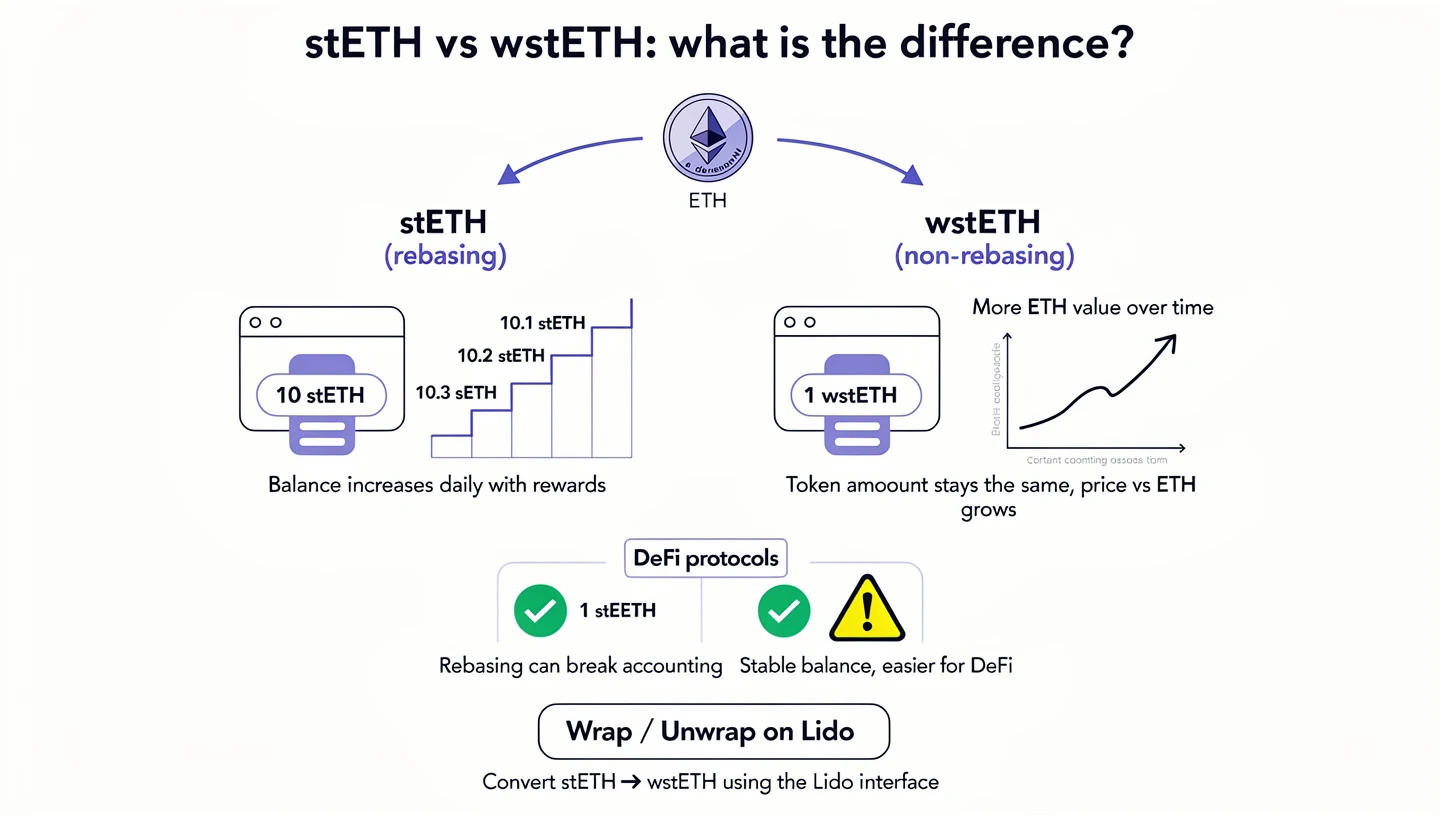
wstETH (wrapped stETH) is a non-rebasing version of the same asset. Instead of your balance increasing, the price of wstETH appreciates relative to ETH. If you hold 1 wstETH today, it will be worth more ETH in one year than it is now, but the number of wstETH tokens in your wallet stays the same.
The practical difference matters most in DeFi. Many DeFi protocols, including most lending platforms, do not handle rebasing tokens well. The automatic balance change can break accounting assumptions and create issues with collateral calculations. wstETH avoids this problem, which is why most DeFi integrations use wstETH rather than stETH. To convert between them, use the wrap function in the Lido interface. How smart contracts handle these token standards is explained in the guide on what smart contracts are.
Using staked ETH in DeFi
One of the main advantages of liquid staking over other methods is that the liquid staking token can be deployed in DeFi while the underlying ETH continues to earn staking rewards. This lets you earn yield from multiple sources at once.
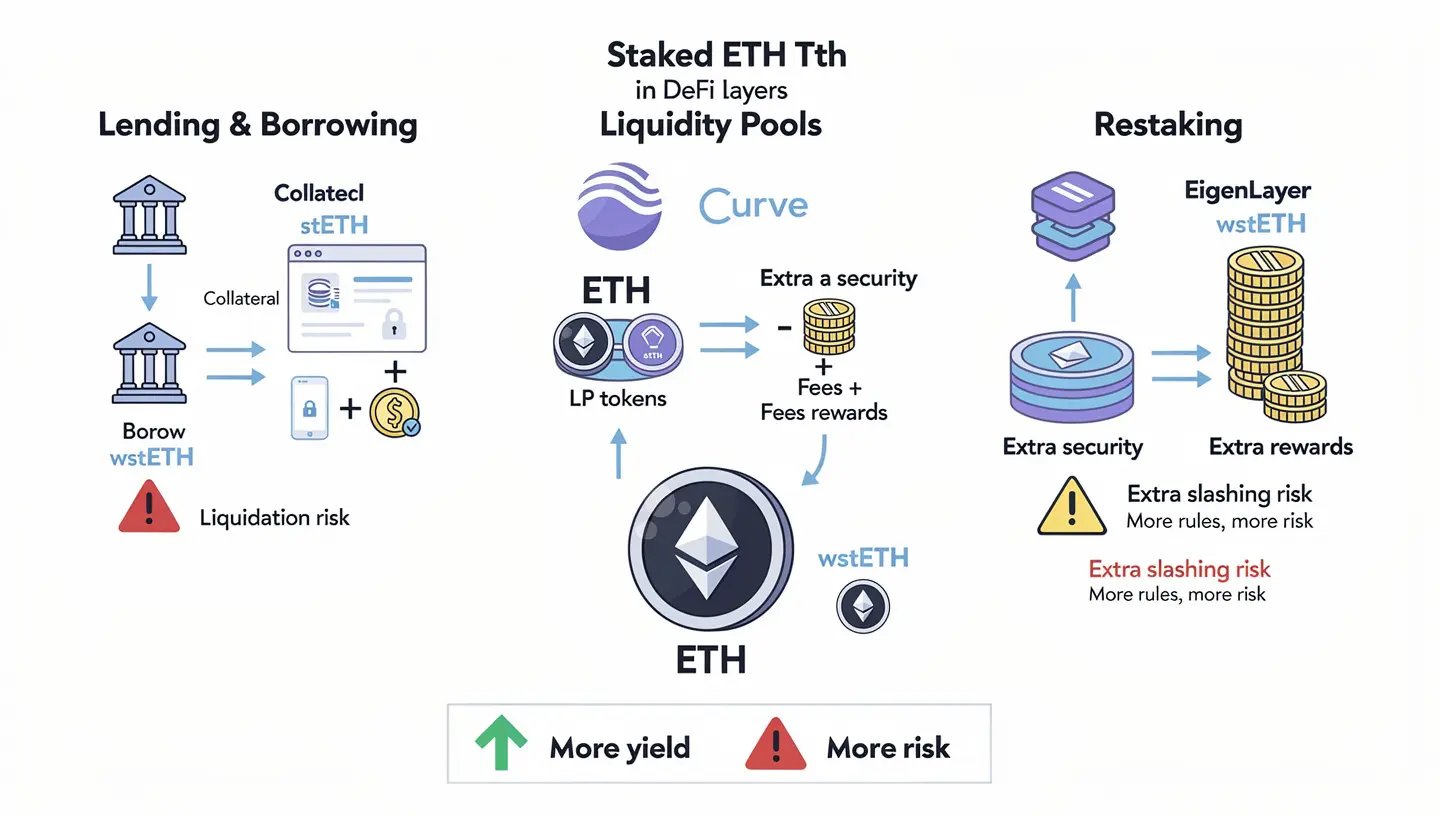
On Aave, you can deposit wstETH as collateral to borrow other assets or to earn lending interest on top of base staking rewards. On Curve Finance, the stETH/ETH pool allows you to provide liquidity and earn trading fees in addition to rewards. These strategies add yield but also add risk: each additional protocol layer adds smart contract exposure, and using wstETH as collateral introduces liquidation risk if the wstETH/ETH price diverges.
Restaking through protocols like EigenLayer goes further. It allows you to use your staked ETH or liquid staking tokens to provide security to additional protocols, earning extra rewards on top of base staking APY. The additional yield comes with additional risk: restaking protocols can apply their own slashing conditions, meaning your ETH could be penalised by more than one set of rules simultaneously. The role of ETH as the asset underlying all of this is explained in the guide on what ETH is.
Risks of staking Ethereum
Every method of staking ETH carries some risk. The type and severity of risk differs depending on the method you choose.
Slashing risk
Slashing is a penalty applied to validators that commit provably malicious acts, such as signing two different blocks for the same slot or signing attestations that contradict each other. A slashed validator immediately loses a portion of its staked ETH and is removed from the active validator set. If many validators are slashed in the same period, the correlation penalty increases the loss further.
Slashing is primarily a risk for solo stakers and minipool operators. Running standard client software and avoiding duplicate key configurations keeps the risk low. Validators that simply go offline without double-signing are subject to the inactivity leak, not slashing. Liquid staking and exchange staking users carry no direct slashing exposure.
Smart contract risk
Liquid staking protocols like Lido and Rocket Pool are smart contracts. If a contract contains a vulnerability that is exploited, deposited ETH could be at risk. Both protocols have been audited multiple times and have operated without major incidents for several years, but no smart contract is completely without risk. The more DeFi layers you add on top of your staked ETH, the more smart contract exposure you accumulate. How the Ethereum Virtual Machine executes these contracts is explained in the guide on the Ethereum Virtual Machine.
Liquidity risk and the withdrawal queue
When you unstake ETH from a validator, either solo or via a pool, the ETH enters a withdrawal queue. The Ethereum protocol rate-limits exits to protect network security. In 2026, the typical wait in the withdrawal queue is under five days for most solo exits, significantly shorter than the weeks-long queues seen in 2023 shortly after the Shanghai upgrade enabled withdrawals.
Liquid staking tokens can be sold on a DEX at any time without waiting in a withdrawal queue, which is why stETH and rETH trade at prices very close to ETH. During periods of market stress, however, stETH has briefly traded at a discount to ETH, most notably in June 2022 when Celsius Network liquidated large positions. Holders who needed to sell at that moment received less than one ETH per stETH.
Centralisation risk
Lido controls approximately 30% of all staked ETH on Ethereum. A single protocol holding that share of the validator set is a centralization concern for the network. If Lido governance were compromised or if the protocol were subject to regulatory pressure, it could affect a significant portion of the validator set simultaneously. Rocket Pool operates with a more decentralised validator set and represents an alternative for users who want liquid staking with less protocol concentration.
Regulatory risk
The regulatory treatment of staking continues to evolve in most jurisdictions. Some regulators have taken the position that staking services offered by exchanges constitute securities offerings. Tax treatment of staking rewards varies by country and can change with new guidance. Holding your own validator keys via solo staking avoids counterparty and regulatory risk from staking providers, but it does not remove the tax obligation on rewards earned.
Tax treatment of Ethereum staking rewards
Staking rewards are treated as taxable income at the time of receipt in most major jurisdictions, including the United States and the United Kingdom.
In the United States, the IRS treats staking rewards as ordinary income. The value of the ETH received as a reward is included in your gross income at the spot price on the day it is received. For example, if you earn 0.05 ETH in rewards on a day when ETH trades at $2,500, that is $125 of ordinary income for tax purposes, regardless of whether you sell or hold the ETH. When you later sell that ETH, any additional gain or loss relative to the $2,500 cost basis is a capital gains event.
In the United Kingdom, HMRC treats staking rewards as miscellaneous income or trading income depending on the scale and regularity of the activity. The income is valued at the spot price on the date of receipt. Disposal triggers capital gains tax on any appreciation since the date of receipt.
Exchanges are required to report staking income in many jurisdictions. The IRS now requires crypto exchanges to issue 1099-DA forms to US customers. Tax rules vary significantly between countries and change regularly. Consult a qualified tax adviser for guidance specific to your situation. The broader role of ETH in the Ethereum network is covered in the guide on what Ethereum is.
FAQ
How much ETH do I need to start staking?
The minimum depends on the method. Solo staking requires exactly 32 ETH. Rocket Pool minipools require 8 ETH plus RPL collateral. Liquid staking through Lido or Rocket Pool accepts any amount above the gas fee. Exchange staking on Coinbase accepts from $1 worth of ETH. For most beginners, liquid staking is the most accessible starting point because there is no minimum and no technical setup required.
What is the current Ethereum staking APY?
The base staking APY in 2026 runs between 3.5% and 5% depending on the method. Solo stakers running MEV-Boost earn at the higher end of this range. Liquid staking through Lido typically yields around 3 to 4.5% after the 10% protocol fee. Exchange staking yields 2.5 to 4% after exchange commissions. APY fluctuates with network activity and with the total amount of ETH staked across all validators.
Can I unstake my ETH at any time?
Yes, since the Shanghai upgrade in April 2023. Solo validators exit through a withdrawal queue, which in 2026 takes under five days in most cases. Liquid staking token holders can sell stETH or rETH on a DEX immediately without waiting in any queue. Exchange staking policies vary: some exchanges offer instant unstaking, others have lock-up periods of several days.
What is the difference between stETH and wstETH?
stETH is a rebasing token: your balance increases daily as staking rewards accrue. wstETH is the wrapped, non-rebasing version: the number of tokens stays the same but the price appreciates over time. wstETH is preferred for DeFi because most lending and liquidity protocols do not handle rebasing tokens correctly. To convert between them, use the wrap function on the Lido interface.
Is Ethereum staking safe?
Staking through established protocols with audited smart contracts carries lower risk than many other crypto activities. The main risks are smart contract vulnerabilities in liquid staking protocols, slashing for solo validator operators who misconfigure their setup, and the possibility of a liquid staking token depegging during extreme market conditions. Exchange staking adds counterparty risk from the exchange itself.
How long does it take to start earning staking rewards?
With liquid staking on Lido, rewards begin accruing from the next daily rebase after your deposit confirms, typically within 24 hours. With exchange staking, the first reward credit usually arrives within one to seven days depending on the platform. Solo validators enter an activation queue after depositing 32 ETH. The wait in 2026 is typically under 24 hours given current queue lengths.
What happens to my staked ETH if Lido gets hacked?
If a critical vulnerability in the Lido smart contracts were exploited, deposited ETH could be at risk. Lido has been audited by multiple independent security firms and has operated without a major exploit since its launch in 2020, but no smart contract carries zero risk. To reduce smart contract exposure, some holders split their liquid staking position across multiple protocols such as Lido and Rocket Pool rather than concentrating in one.
Do I pay tax on Ethereum staking rewards?
In most countries, including the US and UK, staking rewards are taxable as income at the time of receipt. The taxable amount is the market value of the ETH received on the day it was credited to your account. When you later sell that ETH, any additional gain is a capital gains event. Tax rules differ by jurisdiction and change with new regulatory guidance. Always consult a tax adviser for your specific situation. The guide on who created Ethereum provides context on how the network was designed as an open system without central control over staking participation.