Selling Ethereum (ETH) takes a few minutes on any major crypto exchange. You place a sell order, convert ETH to fiat currency, and withdraw the proceeds to your bank account. This guide covers every step in order, compares withdrawal methods and fees, explains the tax implications, and covers alternatives to selling on a centralised exchange.
How to sell Ethereum: step-by-step
The standard process for selling Ethereum runs through a centralised crypto exchange in four steps. If your ETH is already on an exchange, you can skip to Step 3. If it is in a personal wallet, start at Step 2. You can check the current ETH price before selling on CoinGecko.
Step 1: choose where to sell ETH
The right platform depends on three things: whether it is regulated in your country, what it charges in fees, and whether it has enough liquidity to handle your order size without moving the price against you.

Coinbase is the most straightforward option for US and UK sellers. It is publicly listed and regulated by FinCEN in the United States and holds an FCA registration in the UK. The tradeoff is higher fees: 1.49% on standard sells, or a flat fee of $2.99 on amounts below $73. Kraken charges 0.26% as a taker fee and 0.16% as a maker fee on its Pro interface, making it significantly cheaper for anyone selling more than a few hundred dollars. Binance charges 0.1% on spot trades, the lowest of the three, but is unavailable in several US states. If you need to acquire ETH before selling, the guide on how to buy Ethereum covers the full purchase process.
Step 2: transfer ETH to the exchange (if needed)
If your ETH is in a personal wallet such as MetaMask or a hardware wallet, you need to deposit ETH to the exchange before you can sell it. Log in to your exchange account and navigate to the deposit section. Select Ethereum and copy the wallet address shown.
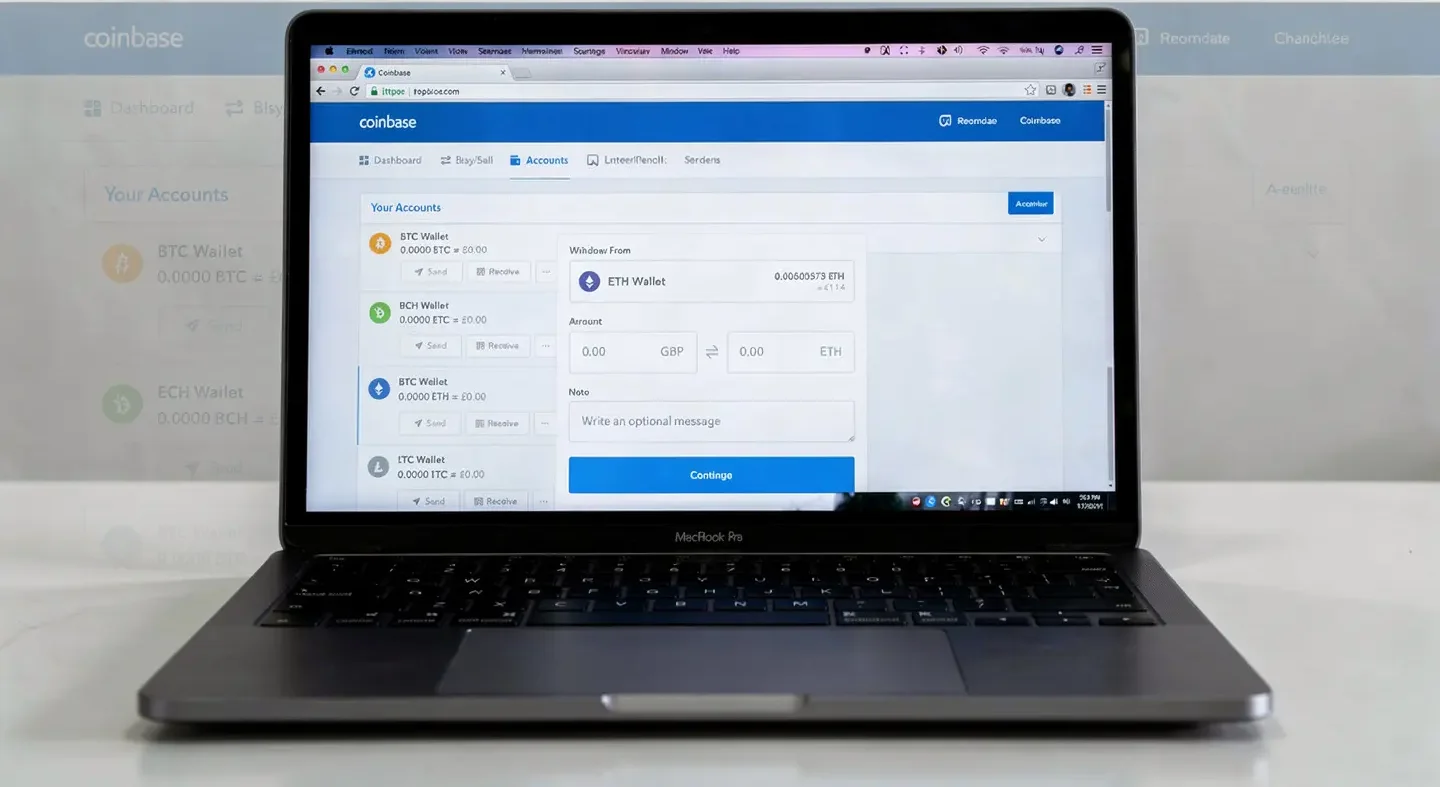
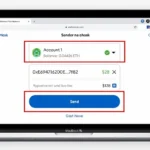
In your wallet, paste that wallet address as the recipient and select the ERC-20 (Ethereum Mainnet) network. This step is critical. Sending ETH on the wrong network, such as BNB Chain or Polygon, to an exchange deposit address expecting Ethereum Mainnet will result in a permanent loss of funds. Most exchanges cannot recover assets sent on the wrong network. Before sending a large amount, send a small test transaction of $10 to $20 first to confirm the address is correct and the network is right.
The gas fee for a standard ETH transfer runs between $0.01 and $0.50 in 2026. After sending, the transfer needs approximately 12 block confirmations before the exchange credits your account, which takes two to five minutes. The full mechanics behind gas fees are covered in the guide on Ethereum gas fees.
Step 3: place a sell order
Once your ETH is available on the exchange, navigate to the trading section and select the ETH/USD or ETH/USDT trading pair. Most platforms show both a simple sell interface and an advanced one. The simple interface uses a market order by default.
A market order fills immediately at the best available price. It is the simplest option and works well for standard amounts during normal market conditions. A limit order lets you set a minimum price at which you are willing to sell Ethereum. The order sits open until the market reaches that price or you cancel it. For larger amounts or when you have a specific price target in mind, a limit order gives you more control. Enter the amount of ETH you want to sell, review the estimated proceeds and total fee, and confirm the order.
Step 4: withdraw fiat to your bank account
After your sell order fills, the fiat proceeds sit in your exchange account. To complete the cash out, navigate to the withdraw section and select your bank account.
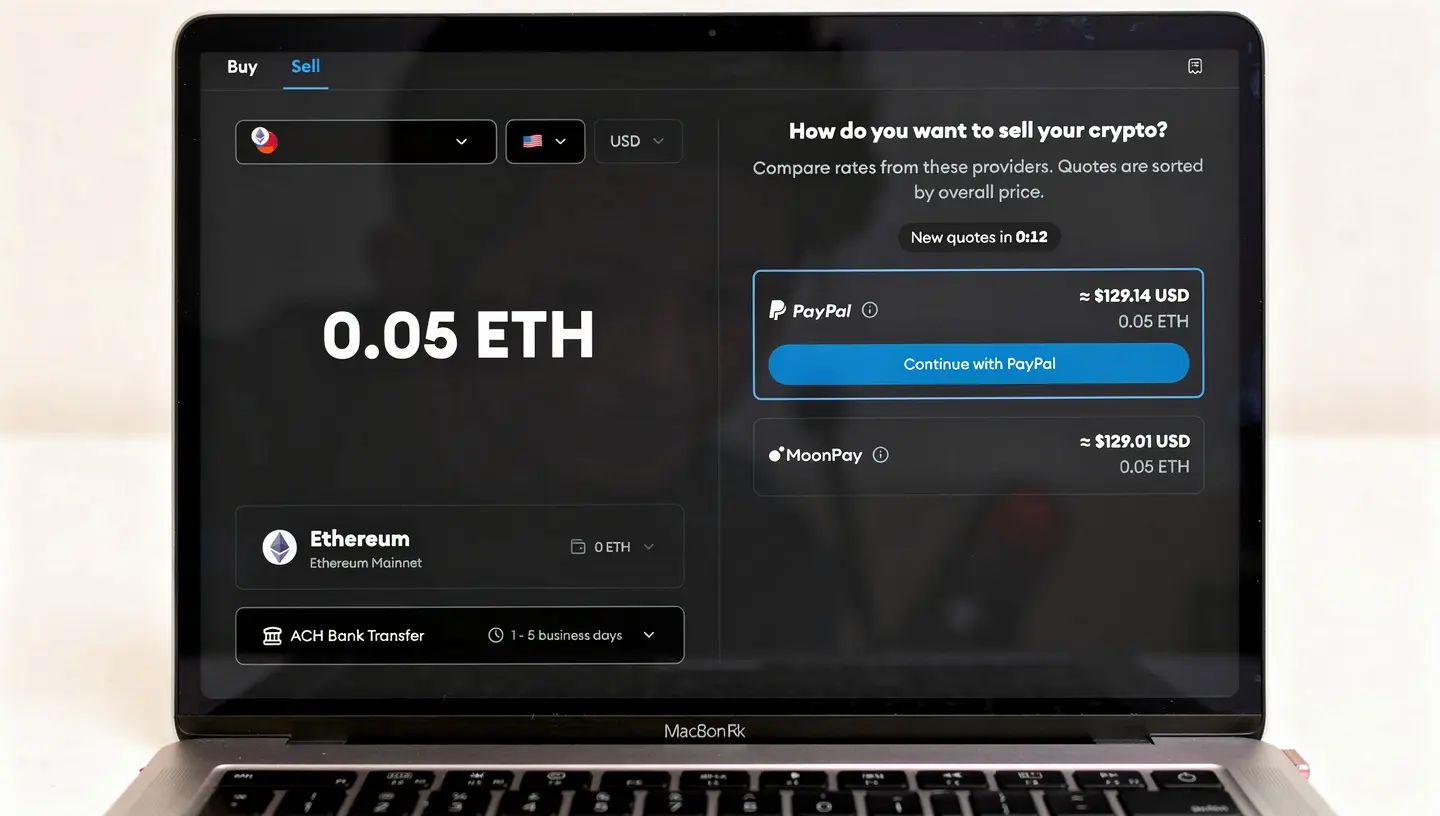
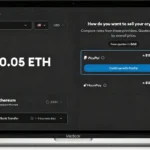
In the United States, an ACH bank transfer is free on Coinbase and Kraken and arrives in one to three business days. In Europe, SEPA transfers are also free or close to it and arrive in one to two days. Wire transfers are faster but carry a fee: Coinbase charges $25 for a domestic wire, Kraken charges around $5 for domestic wire. PayPal is available as a withdrawal method on Coinbase and is instant, though the funds land in PayPal rather than directly in your bank. Set a withdrawal limit if the exchange requires it and confirm the bank account details before submitting.
How to cash out Ethereum: withdrawal options compared
Once you have sold ETH on an exchange, several methods are available to move the fiat to your bank. The right choice depends on how quickly you need the funds and how much you are willing to pay in withdrawal fees.
| Method | Speed | Fee | Available on |
|---|---|---|---|
| ACH bank transfer | 1-3 business days | Free | Coinbase, Kraken, Binance US |
| SEPA bank transfer | 1-2 business days | Free or under €1 | Kraken, Binance, Coinbase (EU) |
| Wire transfer | Same day to 1 day | $5-$25 | Coinbase, Kraken |
| PayPal | Instant | Free (to PayPal) | Coinbase, MoonPay |
| Debit card (MoonPay) | Instant | 4.5% | MoonPay |
| Crypto ATM | Instant cash | 5-15% | Physical locations |
For most sellers, a free bank transfer is the right choice. The one to three day wait is a minor inconvenience for the cost saving. PayPal is instant but the funds remain in PayPal until you transfer them to a bank separately, which adds another step. The debit card option through MoonPay is convenient but the 4.5% fee makes it expensive for large amounts.
Fees when you sell Ethereum
Every platform charges fees in more than one way when you sell ETH. Understanding each type before you sell prevents the total cost from being higher than you expected.
| Fee type | What it is | Coinbase | Kraken | Binance |
|---|---|---|---|---|
| Trading fee | Charged per sell order | 1.49% | 0.26% taker | 0.1% |
| Spread | Gap between buy and sell price | 0.5-1% | 0.1-0.2% | ~0.01% |
| Withdrawal fee (ACH) | Sending fiat to bank | Free | Free | Free |
| Withdrawal fee (wire) | Sending fiat by wire | $25 | ~$5 | Varies |
| Gas fee | Sending ETH from personal wallet | $0.01-$0.50 (network, not exchange) | ||
The spread is the cost most sellers overlook. When you place a market order to sell Ethereum, the price you receive is slightly below the mid-market rate. On Coinbase standard, that spread is typically 0.5-1% on ETH. On Kraken Pro, it is 0.1-0.2%. On Binance, the spread on ETH/USDT is close to 0.01% given the depth of the order book.
The total cost of selling $5,000 of ETH on Coinbase standard, including the 1.49% trading fee and a 0.75% spread, comes to roughly $112. The same sale on Kraken Pro, with a 0.26% taker fee and a 0.15% spread, costs around $20. That difference grows with the size of the sale.
How long does it take to sell Ethereum?
The total time from holding ETH in a personal wallet to having fiat in your bank account involves three separate stages, each with its own timeline.
- Transferring ETH to the exchange: approximately two to five minutes. Each Ethereum block takes 12 seconds. Most exchanges credit your account after 12 to 30 confirmations.
- Placing and filling the sell order: a few seconds for a market order. A limit order stays open until the market hits your price, which could be minutes, hours, or days.
- Withdrawing fiat to your bank: ACH one to three business days, SEPA one to two business days, wire transfer same day to one day, PayPal instant.
From ETH in a personal wallet to cash in a bank account, the typical total is one to four business days. If your ETH is already on the exchange, the process reduces to a sell order plus the bank transfer time. How Ethereum processes transactions at the network level is covered in the guide on how Ethereum works.
Tax implications when you sell Ethereum
Selling ETH is a taxable event in most countries. The moment you sell Ethereum for fiat, for a stablecoin, or swap it for another crypto asset, you trigger a potential capital gains liability. The gain or loss is calculated against your cost basis, which is the price you paid for the ETH.
A straightforward example: you bought ETH for $1,000 and sold it for $2,500. Your capital gain is $1,500. That $1,500 is what gets taxed, not the full $2,500 you received.
In the United States, the rate depends on how long you held the ETH. Short-term capital gains apply if you held for less than 12 months and are taxed at your ordinary income rate, which can be as high as 37%. Long-term capital gains apply if you held for more than 12 months, with rates of 0%, 15%, or 20% depending on your income bracket. The IRS now requires crypto exchanges to issue 1099-DA forms to US customers reporting disposals.
In the United Kingdom, selling ETH is treated as a disposal under HMRC rules. The annual capital gains tax-free allowance is £3,000 in 2026. Gains above that are taxed at 18% for basic rate taxpayers and 24% for higher rate taxpayers on crypto assets.
If you sell ETH at a loss, that loss can offset capital gains from other assets in the same tax year, reducing your overall tax bill. This is sometimes called loss harvesting. Staking rewards are taxed separately as income in most jurisdictions at the time of receipt. The guide on Ethereum proof of stake covers how staking rewards are generated. Tax rules vary by jurisdiction and change regularly. Consult a tax adviser before making decisions based on your specific situation.
Selling ETH to a stablecoin instead of fiat
Not every seller needs fiat in a bank account immediately. If you want to exit ETH volatility without withdrawing to a bank, converting to a stablecoin such as USDC or USDT is an alternative worth understanding.
Selling ETH for USDC or USDT on a centralised exchange or on a DEX like Uniswap keeps the value on-chain. There is no bank withdrawal fee. The funds remain accessible for DeFi protocols, NFT purchases, or a future ETH repurchase without going through the fiat on/off ramp again. How smart contracts make stablecoin swaps possible is explained in the guide on what smart contracts are.
There are two important considerations. First, swapping ETH for USDC or USDT is still a taxable event in most jurisdictions, including the US and UK, because it counts as a disposal of ETH. The tax treatment is the same as selling for USD. Second, stablecoins carry a small risk: USDT and USDC are pegged to the dollar but that peg is maintained by the issuer, not by code. Both have maintained their pegs consistently but historical depegging events, including USDC temporarily trading at $0.87 in March 2023 during the Silicon Valley Bank collapse, show the risk is not zero.
Converting to a stablecoin makes most sense in three situations: you want to avoid ETH price volatility in the short term, you plan to redeploy the capital soon, or you want to earn yield on the idle value through a lending protocol while you wait.
When to sell Ethereum
There is no reliable method for timing the market. ETH has fallen more than 80% during bear markets and recovered to new highs in subsequent cycles. Most sellers who attempt to time a perfect exit end up either selling too early or holding through a full drawdown. Three approaches help structure the decision without depending on price prediction. The history of how Ethereum was built to operate without central control is covered in the guide on who created Ethereum.
Price targets set in advance remove emotion from the process. You decide before ETH reaches a certain price that you will sell a portion at that level. The order can be placed as a limit order now and will execute automatically if the price is reached. The risk is that the market passes your target quickly and you regret not selling more, or it never reaches your target.
Partial sales spread the exit across multiple price levels. For example, selling 25% of a position at $3,000, another 25% at $4,000, another 25% at $5,000, and keeping the final 25% indefinitely. This approach guarantees that you do not sell everything at the bottom or the top of a given range. It also means you always have ETH left if the price continues to rise. Partial sales using the DCA method in reverse are a practical way to manage large positions without requiring a single timing decision.
Portfolio rebalancing is a rules-based approach that works independently of price prediction. You set a target allocation for ETH as a percentage of your total net worth, for example 10%. When ETH rises to represent 20%, you sell enough to bring it back to 10%. When it falls to 5%, you buy more. The rule drives the decision, not the price. The role ETH plays within the broader network, and why demand for it fluctuates, is covered in the guide on what ETH is.
Other ways to sell Ethereum
A centralised exchange is the most common route, but it is not the only one. Three alternatives serve specific situations where a standard exchange account is not available or practical.
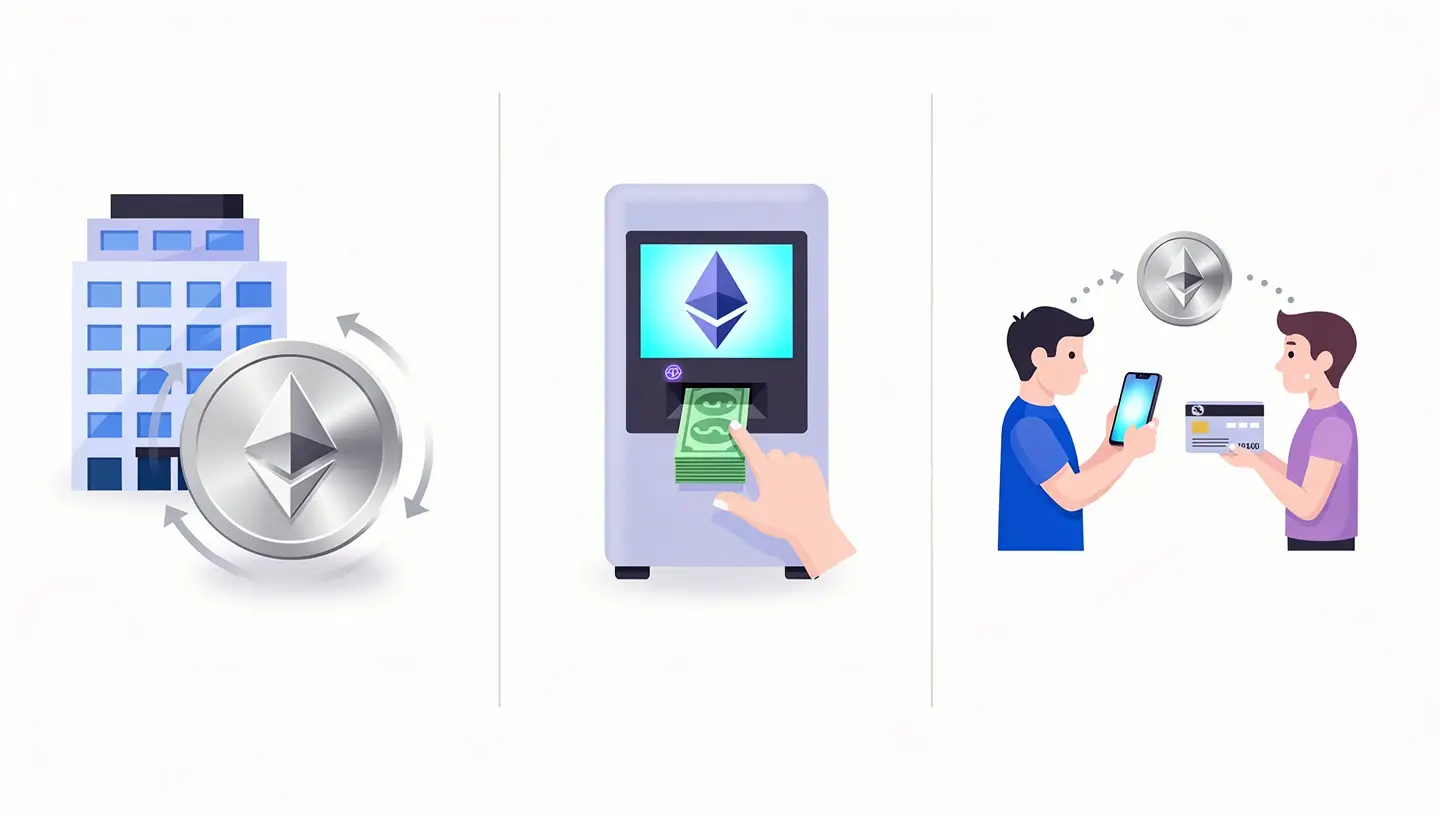
Crypto ATMs
A crypto ATM allows you to sell ETH for cash at a physical machine and receive banknotes on the spot. You send ETH from your wallet to the ATM address, and the machine dispenses cash. Use CoinATMRadar to find a crypto ATM near you that supports ETH sells, as not all machines support selling, and not all support ETH specifically.
The main drawback is cost. Crypto ATM fees typically run from 5% to 15% per transaction, far higher than any centralised exchange. Most machines have a per-transaction limit of $500 to $10,000. Some require a phone number or government ID for transactions above a certain threshold. A crypto ATM makes sense when you need physical cash immediately and the fee is acceptable for the convenience.
Peer-to-peer (P2P) trading
Peer-to-peer platforms connect ETH sellers directly with buyers. LocalCryptos and Bisq are two platforms that support P2P trades with escrow protection. The seller lists an offer; a buyer accepts; the ETH is locked in escrow and released to the buyer once payment is confirmed. P2P platforms typically offer more payment flexibility than exchanges, including cash, bank transfers, or gift cards.
The tradeoff is lower liquidity and slower settlement compared to a crypto exchange. Counterparty risk exists even with escrow: always verify payment before releasing ETH from escrow, and use platforms with a reputation system. Some peer-to-peer platforms have reduced or no KYC requirements, which makes them an option for sellers in jurisdictions with limited exchange access, though regulatory requirements vary by country.
Selling large amounts OTC
Selling a large amount of ETH on a standard exchange order book causes slippage: as your order works through the available bids, the price falls with each fill. A $200,000 sell order on a mid-tier exchange could achieve a price 2-3% below the prevailing rate by the time it fills. On a high-volume exchange like Binance, slippage on ETH is minimal for most retail-sized orders, but it becomes meaningful above $50,000.
For amounts above $50,000, an over-the-counter (OTC) desk offers a quoted price for the entire block. The OTC desk takes the market risk of unwinding the position and charges a small spread in return. Coinbase Prime, Kraken OTC, Cumberland, and Genesis Trading are established OTC desks for institutional and large retail sellers. Minimums typically start at $100,000 for most desks. The liquidity and price certainty of an OTC trade outweighs the convenience of self-service for large positions. Current ETH market depth data is available on Etherscan.
FAQ
How do I sell Ethereum for cash?
The fastest route to physical cash from ETH is a crypto ATM, where you send ETH and receive banknotes immediately, though fees run 5-15%. The cheapest route is to sell on a centralised exchange such as Coinbase or Kraken, then withdraw via ACH or SEPA bank transfer, which takes one to three business days at no additional cost. For instant fiat, a wire transfer is available on most major exchanges for a fee of $5-$25.
How long does it take to sell Ethereum?
If your ETH is already on an exchange, placing a market order takes seconds. Withdrawing the fiat to a bank account via ACH takes one to three business days. If your ETH is in a personal wallet, add two to five minutes for the on-chain transfer to the exchange and 12 to 30 block confirmations. From personal wallet to bank account, the typical total is one to four business days.
What fees do I pay when I sell ETH?
Selling ETH on a centralised exchange involves a trading fee, a spread, and a withdrawal fee. On Coinbase standard, the trading fee is 1.49% and the spread is 0.5-1%. On Kraken Pro, the taker fee is 0.26% and the spread is 0.1-0.2%. Withdrawing via ACH is free on both platforms. If your ETH is in a personal wallet, a gas fee of $0.01-$0.50 applies for the on-chain transfer to the exchange before you can sell.
Do I pay tax when I sell Ethereum?
In most countries, including the US and UK, selling ETH is a taxable event. You pay capital gains tax on the profit, calculated as the sale price minus the cost basis. In the US, long-term gains on ETH held more than 12 months are taxed at 0%, 15%, or 20% depending on income. Short-term gains are taxed at ordinary income rates. In the UK, gains above the £3,000 annual allowance are taxed at 18% or 24%. Consult a tax adviser for your specific situation.
Can I sell Ethereum without KYC?
Yes, through two routes. On a decentralised exchange such as Uniswap, you can swap ETH for a stablecoin directly from your wallet with no account or KYC required. On some peer-to-peer platforms such as Bisq, you can sell directly to a buyer with no identity verification. Both options involve tradeoffs: DEX sells do not convert ETH to fiat, and P2P platforms are less liquid and slower than centralised exchanges.
What is the difference between selling ETH and cashing out?
Selling ETH means converting it to fiat currency on a crypto exchange. The fiat then sits in your exchange account. Cashing out refers to the second step: withdrawing that fiat to your bank account. Both steps are required to move from ETH to money in your bank. Some guides use the terms interchangeably, which creates confusion. The sell order and the bank withdrawal are separate actions with separate fees and timelines.
Can I sell Ethereum directly from MetaMask?
MetaMask has a built-in sell feature in some regions that connects to third-party providers such as MoonPay or Transak. You select ETH, choose the amount, and the provider converts it and sends fiat to your bank or card. Fees vary by provider but are typically higher than selling on a dedicated exchange. The feature is available in select countries. Alternatively, you can send ETH from MetaMask to a centralised exchange and sell it there at lower fees. If you are new to MetaMask, the guide on what Ethereum is provides useful context.
What happens if I send ETH to the wrong network?
If you send ETH to an exchange deposit address using the wrong network, for example BNB Chain instead of Ethereum Mainnet, the funds will not arrive in your exchange account. Whether they can be recovered depends on the exchange. Some exchanges can recover assets sent on the wrong network for a fee, which can be $100 or more. Others cannot recover them at all. Always verify the network matches the one shown on the exchange deposit page before sending. Sending a small test amount first is the most reliable way to avoid this mistake. More on how Ethereum networks and transactions work can be found in the guide on the Ethereum Virtual Machine.