Transferring Ethereum (ETH) from one wallet to another requires three things: the recipient wallet address, enough ETH in your sending wallet to cover the amount plus the gas fee, and a wallet or exchange with a send function. ETH transfers are processed directly on the Ethereum blockchain, settle in minutes, and are irreversible once confirmed. There is no bank to call if something goes wrong.
What you need before you transfer ETH
Before opening your wallet and hitting send, check that you have all three of the following in place. Missing any one of them will either prevent the transfer or cause it to fail.
- A sending wallet with sufficient ETH. Your wallet needs enough ETH to cover both the amount you are sending and the gas fee. You cannot send 100% of your ETH balance because the gas fee is deducted from the same balance.
- The recipient wallet address. This is a 42-character string starting with 0x, or an ENS name ending in .eth such as alice.eth. Double-check every address before sending.
- Gas fee budget. A standard ETH transfer costs approximately $0.01 to $0.50 in 2026, depending on network demand. An ERC-20 token transfer costs more because it involves a smart contract call: 45,000 gas units or more, compared to 21,000 gas units for a plain ETH transfer.
How to transfer Ethereum: step-by-step
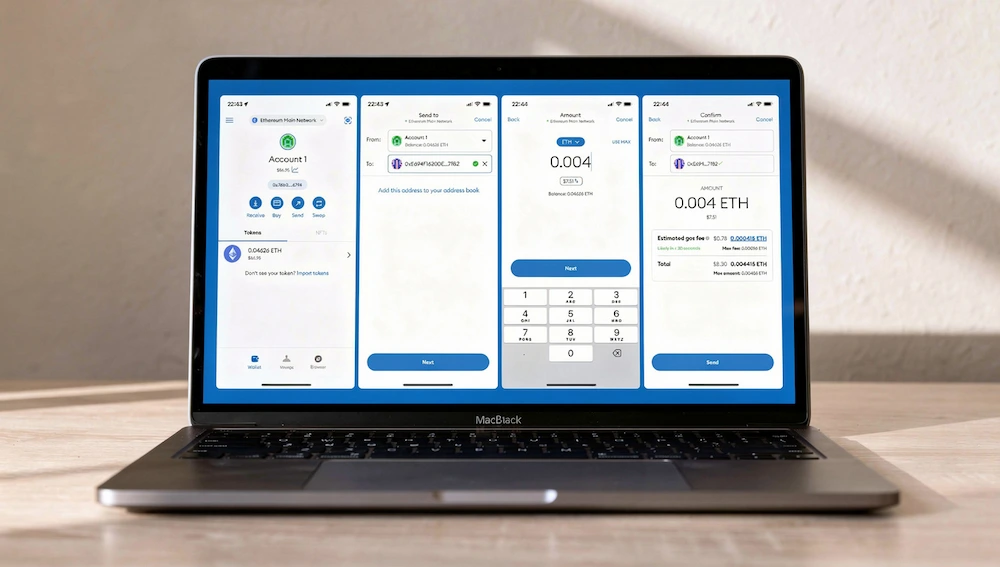
The process for transferring Ethereum is the same whether you are sending ETH from MetaMask to another personal wallet, from a hardware wallet to an exchange, or from an exchange to a self-custody wallet. Follow these six steps in order. For background on why Ethereum was built to allow permissionless peer-to-peer transfers, the guide on who created Ethereum covers the founding vision.
Step 1: open your wallet and select send
Open your wallet. In MetaMask, click the Send button on the main screen. In Ledger Live, navigate to the Ethereum account and select Send. In Trust Wallet and most other software wallets, find ETH in your asset list and select the send or transfer option. If you are sending from an exchange, navigate to the withdraw section and select Ethereum as the asset.
Step 2: enter the recipient wallet address
Paste the recipient wallet address into the address field. A valid Ethereum wallet address is 42 characters long and begins with 0x. After pasting, check the first six and last six characters of the pasted address against the original. Do not assume the paste was accurate.
Clipboard hijacking is a type of malware that monitors your clipboard and automatically replaces any cryptocurrency address you copy with a different address controlled by the attacker. The substituted address looks similar in length and format, so it is easy to miss. The only reliable defence is to verify the pasted wallet address character by character at both ends, or to use a QR code.
Scanning a QR code is safer than copy-pasting because it reads the address directly from the image rather than passing through the clipboard. Most wallets display a QR code for the receiving address, and most sending wallets have a camera button to scan it.
If the recipient has an ENS name, you can enter that instead of the 0x address. An ENS name such as alice.eth resolves to the underlying wallet address on supported wallets including MetaMask, Rainbow, and most hardware wallets. This reduces the risk of entering a mistyped address. ETH transactions are irreversible. Once confirmed on the blockchain, there is no mechanism to reverse or cancel them.
Step 3: select the correct network
Select the Ethereum Mainnet network for the transfer. In MetaMask, the active network is shown in the top-left corner of the interface. Make sure it reads Ethereum Mainnet and not Polygon, BNB Smart Chain, Arbitrum, or any other network.
Sending ETH from a personal wallet to an exchange deposit address on the wrong network is one of the most common transfer mistakes. Exchange deposit addresses expect a specific network. If you send ETH using BNB Smart Chain to a deposit address labelled Ethereum (ERC-20), the funds will not arrive. Recovery is possible in some cases but requires contacting the exchange support team, and many exchanges charge a recovery fee of $50 to $150. Some cannot recover the funds at all.
If you want to send ETH to a Layer 2 network such as Arbitrum or Base, do not send directly. Use a bridge instead. The guide on how Ethereum works explains the relationship between Mainnet and Layer 2 networks.
Step 4: enter the amount
Enter the amount of ETH you want to send. Most wallets allow you to enter the value in ETH or in your local currency equivalent. The “Send max” option fills in the maximum amount you can send after deducting the estimated gas fee. Use this option carefully if you need an exact amount to arrive.
Always leave a small ETH reserve in your wallet for future gas fees. A minimum of 0.001 to 0.005 ETH is sufficient for most standard transfers. Without this reserve, you will not be able to send anything from that wallet until you add more ETH.
Step 5: set the gas fee
Most wallets offer three speed options: slow, medium, and fast. These correspond to different priority fees paid to validators for including your transaction in a block. A higher priority fee means faster inclusion. A lower one means you wait longer but pay less.
The gas fee formula is: gas used × (base fee + priority fee). For a standard ETH transfer, the gas used is 21,000 units. At a base fee of 3 gwei and a priority fee of 1 gwei, the calculation is: 21,000 × 4 gwei = 84,000 gwei = 0.000084 ETH, which is approximately $0.21 at an ETH price of $2,500. The gas fee goes to the validators who process the transaction, not to the exchange or wallet provider. The full mechanics of how gas fees are calculated are covered in the guide on Ethereum gas fees.
For non-urgent transfers, selecting slow saves money. For time-sensitive transfers, fast ensures faster confirmation. You can also set the gas fee manually in wallets that allow custom settings, but the default options are accurate for most situations.
Step 6: review and confirm
Before confirming, check each field one final time:
- Recipient wallet address: verify the first and last six characters again
- Amount: confirm it matches what you intend to send
- Total gas fee: confirm you have enough ETH to cover it
- Network: confirm it shows Ethereum Mainnet
On a hardware wallet, confirming requires pressing a physical button on the device. The private key never leaves the hardware wallet. On MetaMask, click the Confirm button. Once you confirm, the transaction is signed with your private key and broadcast to the Ethereum network. It enters the mempool and waits for a validator to include it in a block. After that point, the transaction cannot be stopped.
How to receive ETH
To receive ETH, share your wallet address with the sender. In MetaMask, click the account name at the top to copy it, or click Receive to display the QR code. In Ledger Live, open the Ethereum account and click Receive to verify the address on the device screen and display the QR code. ETH is the native currency used to pay for all operations on the network. The guide on what ETH is explains its role in more detail.
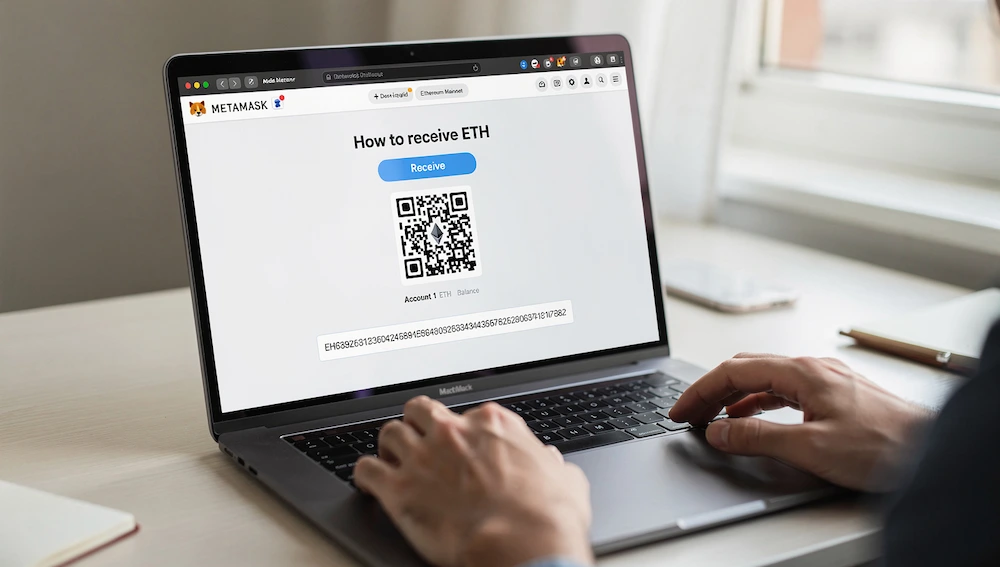
Your Ethereum wallet address works for all ERC-20 tokens on Ethereum Mainnet as well as plain ETH. The same address also exists on Layer 2 networks like Arbitrum and Base, but those are separate balances on separate networks. Receiving ETH sent on Arbitrum to your Ethereum Mainnet address requires the sender to use the correct network.
When receiving ETH from an exchange to a personal wallet, give the exchange your personal wallet address as the withdrawal destination and confirm the exchange is sending on the Ethereum (ERC-20) network, not a Layer 2 or another chain. When receiving ETH into an exchange account, use the exchange deposit address labelled Ethereum or ERC-20, not a generic crypto address. How validators confirm and record incoming transactions on the Ethereum network is explained in the guide on Ethereum proof of stake.
How long does an ETH transfer take?
An ETH transfer involves three stages, each with its own timeline.
- Signing and broadcasting: a few seconds after you confirm in your wallet.
- Block inclusion: typically 12 to 30 seconds at normal gas prices. Each Ethereum block takes 12 seconds. A transaction with a sufficient priority fee is usually included within one to two blocks.
- Confirmations: most wallets and exchanges require 12 to 30 block confirmations before crediting the funds. At 12 seconds per block, 12 confirmations takes approximately 2.4 minutes.
Wallet-to-wallet transfers typically complete in 15 seconds to 2 minutes. Transfers to exchanges take longer because exchanges require more confirmations before showing the balance, typically 2 to 5 minutes. A transfer will show as pending until it collects enough confirmations.
If a transaction stays pending for more than 15 minutes, the gas fee was likely set too low and the transaction is stuck in the mempool. In MetaMask, you can speed up a stuck transaction by clicking the Speed Up option, which resubmits it with a higher gas fee. You can also cancel it by clicking Cancel, which sends a replacement transaction with 0 ETH and a higher gas fee to the same address. The replacement must use the same nonce to override the original.
How to track an ETH transfer on Etherscan
After confirming a transaction, your wallet displays a transaction hash (also called a tx hash). This is a unique 66-character identifier that starts with 0x and links directly to the transaction record on the Ethereum blockchain. Copy it.
Open Etherscan, paste the transaction hash into the search bar, and press enter. The transaction page shows:
- Status: Pending, Success, or Failed
- From and To addresses
- Value: the amount of ETH transferred
- Transaction fee: the total gas fee paid
- Gas price and gas used
- Block: the block number the transaction was included in
- Confirmations: how many blocks have been added since
- Timestamp: the exact time of inclusion
If the status shows Pending, the transaction is still in the mempool. If it shows Success, the transfer is complete. If it shows Failed, the transaction was attempted but did not execute, and any gas fee consumed up to the point of failure was charged. Etherscan is a block explorer, a public read-only interface to the Ethereum blockchain. Anyone can look up any transaction hash on it.
Gas fees for ETH transfers: what you pay in 2026
Gas fees on Ethereum Mainnet in 2026 are significantly lower than they were at peak congestion in 2021. A standard ETH transfer now costs well under $0.25 at typical base fees. The cost varies by transaction type because different operations consume different amounts of gas.
| Transfer type | Gas used | Est. cost in 2026 |
|---|---|---|
| ETH wallet-to-wallet transfer | 21,000 | ~$0.09 |
| ERC-20 token transfer | 45,000-65,000 | ~$0.20-$0.28 |
| Uniswap token swap | 100,000-150,000 | ~$0.45-$0.68 |
| Smart contract deployment | Varies | $1.00-$10.00+ |
Gas costs above are estimates based on a base fee of around 3-4 gwei and an ETH price near $2,500. Actual costs change with network demand. During high activity periods such as a major NFT mint or sharp market move, base fees can spike to 20-100 gwei within minutes.
How to reduce gas fees on ETH transfers
Three methods consistently reduce what you pay in gas fees.
Use a gas tracker. The Etherscan Gas Tracker shows the current base fee and the estimated cost of slow, average, and fast transactions in real time. Before sending a non-urgent transfer, check the gas tracker and wait if the base fee is elevated. Even a 10-minute wait during a congestion spike can cut the fee by 50% or more.
Send during off-peak hours. Ethereum gas fees follow a pattern driven by global usage. Fees are typically lowest on weekends, particularly Saturday and Sunday in UTC time, and between midnight and 8 AM UTC on weekdays. These windows see lower trading activity and fewer DeFi protocol interactions.
Use a Layer 2 network. For frequent transfers, moving activity to a Layer 2 network such as Arbitrum or Base reduces per-transaction costs to fractions of a cent. You pay a one-time bridge fee to move ETH from Mainnet to the Layer 2, but all subsequent transfers within that network cost significantly less. After the Dencun upgrade in March 2024, Layer 2 fees fell by 90 to 99 percent on most networks. How smart contracts power every transfer on Layer 2 is covered in the guide on what smart contracts are.
Transferring ETH vs transferring ERC-20 tokens
ETH and ERC-20 tokens use the same wallet address and the same Ethereum network, but the transfers work differently and cost different amounts in gas fees.
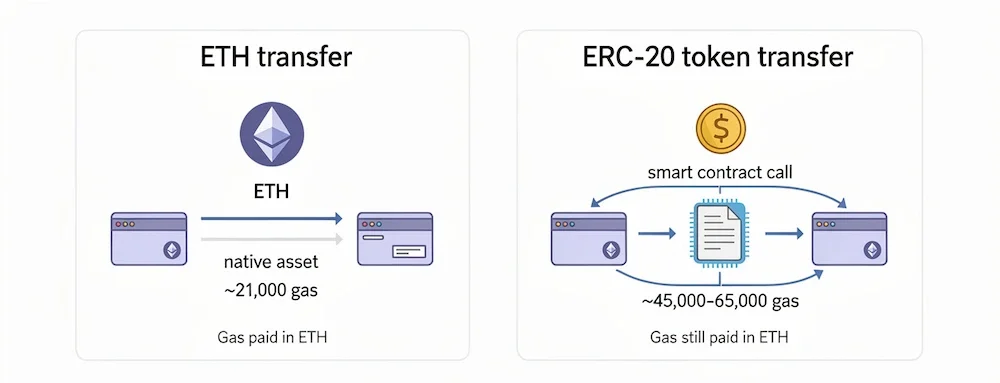
A plain ETH transfer sends the native asset of the Ethereum network directly from one address to another. It requires 21,000 gas units. An ERC-20 token transfer such as sending USDC, USDT, or DAI involves calling a function on a smart contract. That contract call requires 45,000 to 65,000 gas units, more than twice the cost of a plain ETH transfer.
The key point that confuses new users: even when you transfer an ERC-20 token, the gas fee is paid in ETH. You need ETH in your wallet to send USDC. You need ETH to send DAI. The Ethereum Virtual Machine charges for all computation in ETH regardless of which token you are moving. How the EVM processes every transaction on the network is covered in the guide on the Ethereum Virtual Machine.
Both ETH transfers and ERC-20 token transfers require the correct network. Sending either to an address on a different network, such as BNB Smart Chain or Polygon, will result in the funds not arriving in the expected account.
Common ETH transfer mistakes and how to avoid them
Most ETH transfer errors are permanent. The following mistakes account for the majority of lost funds in self-custody transfers.
- Sending to the wrong address. An ETH transaction sent to the wrong address is irreversible. There is no support team, no chargeback, and no recovery mechanism on a public blockchain. Always double-check the address before confirming.
- Clipboard hijacking. Malware on your device can replace a copied wallet address in your clipboard with an attacker’s address without any visible sign. After pasting, verify the first and last six characters against the original source. Use a QR code scan when available. Clipboard hijacking is silent and fast: the substitution happens in milliseconds.
- Wrong network. Sending ETH to an exchange deposit address using the wrong network, such as BNB Smart Chain instead of Ethereum Mainnet, means the funds arrive on a network the exchange did not expect. Recovery costs $50 to $150 at most exchanges. Some exchanges cannot recover them at all.
- Stuck transaction. A gas fee set too low leaves the transaction sitting in the mempool indefinitely. Use the Speed Up option in MetaMask to resubmit with a higher fee, or use Cancel to override it with a zero-value transaction at the same nonce.
- Insufficient ETH for gas. Sending your entire ETH balance leaves nothing for the gas fee and the transaction fails. Keep a minimum of 0.001 to 0.005 ETH in reserve for gas.
- Skipping a test transaction. Before sending a large amount to a new address for the first time, send a small test transaction first, typically $5 to $10 worth of ETH. Confirm it arrives on Etherscan and in the recipient wallet. Then send the remainder. A test transaction costs $0.09 or less and can prevent a much larger loss. If you later decide to sell ETH after transferring it to an exchange, the guide on how to sell Ethereum covers that process.
FAQ
How long does an ETH transfer take?
A wallet-to-wallet ETH transfer typically completes in 15 seconds to 2 minutes. Each Ethereum block takes 12 seconds, and most transfers are included within one to three blocks. Transfers to exchanges take longer because exchanges require more block confirmations before crediting your account, typically 12 to 30 confirmations, which adds two to five minutes. A transfer with a very low gas fee may stay pending longer if the mempool is congested.
How much does it cost to transfer ETH?
A standard ETH wallet-to-wallet transfer costs approximately $0.05 to $0.25 in 2026 at typical gas prices. The exact cost depends on the current base fee in gwei and network demand. An ERC-20 token transfer costs more, around $0.20 to $0.30, because it involves a smart contract call that uses more gas. Gas fees spike during high-activity periods and fall during off-peak hours such as weekends and early morning UTC. If you need to buy ETH before transferring it, the guide on how to buy Ethereum covers the process.
Can I transfer ETH to the wrong address?
Yes, and it is irreversible. If you send ETH to an incorrect address, the funds are gone. There is no undo function, no customer support that can reverse it, and no way to recall a confirmed transaction on a public blockchain. Always verify the recipient address character by character before confirming, and send a small test amount to a new address before sending a large transfer.
What happens if I send ETH on the wrong network?
If you send ETH to an exchange deposit address using the wrong network, the funds will not appear in your account. The exchange deposit page specifies which network it expects. Sending on BNB Smart Chain to an Ethereum deposit address is a common example. Some exchanges can recover these funds for a fee of $50 to $150. Others cannot recover them. Always confirm the network label on the deposit page before sending.
What is a transaction hash (tx hash)?
A transaction hash is a unique 66-character identifier assigned to every Ethereum transaction. It starts with 0x and is generated when your transaction is broadcast to the network. You can paste it into Etherscan to check the status of your transfer, see the from and to addresses, confirm the amount, and view how many block confirmations it has received. Your wallet displays the transaction hash immediately after you confirm a send.
Can I cancel or speed up an ETH transfer?
You can attempt to cancel or speed up a transaction only if it is still pending in the mempool. Once it is included in a block, it is final. In MetaMask, click the pending transaction and select Speed Up to resubmit it with a higher gas fee, or Cancel to replace it with a zero-value transaction to your own address. Both actions require using the same nonce as the original transaction and a higher gas fee than the stuck transaction.
Do I need ETH to send ERC-20 tokens?
Yes. Every transaction on the Ethereum network, including ERC-20 token transfers, requires ETH to pay the gas fee. Even if you are sending USDC, USDT, or any other ERC-20 token, the gas fee is charged in ETH. This is because the Ethereum Virtual Machine processes all computation on the network and charges for it in the network’s native currency. If your wallet has USDC but no ETH, you cannot send the USDC until you add ETH for gas.
What is the difference between a wallet address and a deposit address?
A wallet address is the public address of a self-custody wallet that you control, such as a MetaMask or hardware wallet address. You hold the private key. A deposit address is an address generated by a centralised exchange such as Coinbase or Kraken for receiving funds into your exchange account. The exchange holds the private key for deposit addresses. Both are valid Ethereum addresses in the same 0x format, but only a wallet address gives you direct control over the funds. When withdrawing from an exchange to self-custody, always use your personal wallet address, not another exchange deposit address, unless you specifically intend to send to that exchange. The guide on what Ethereum is provides useful context on how addresses and ownership work on the network.