Most people use the words interchangeably. Exchanges list it as ETH. News headlines call it Ethereum. But the two are not the same thing, and the ether vs ethereum distinction matters the moment you start using the network.
The short version: Ethereum is the network. Ether is the currency that runs on it. You buy one. You build on the other. When you pay a transaction fee, you pay in Ether. When a developer deploys a smart contract, they deploy it to Ethereum.
This guide covers what Ether is, what it does, how it breaks into smaller units, and why the two names exist in the first place.
Ethereum is the network. Ether (ETH) is the token.
Ethereum is a programmable blockchain. It is a platform, like an operating system, on which developers build applications. Those applications run smart contracts, handle financial transactions, and issue their own tokens. Ethereum itself is not something you buy or sell. It is something you use.
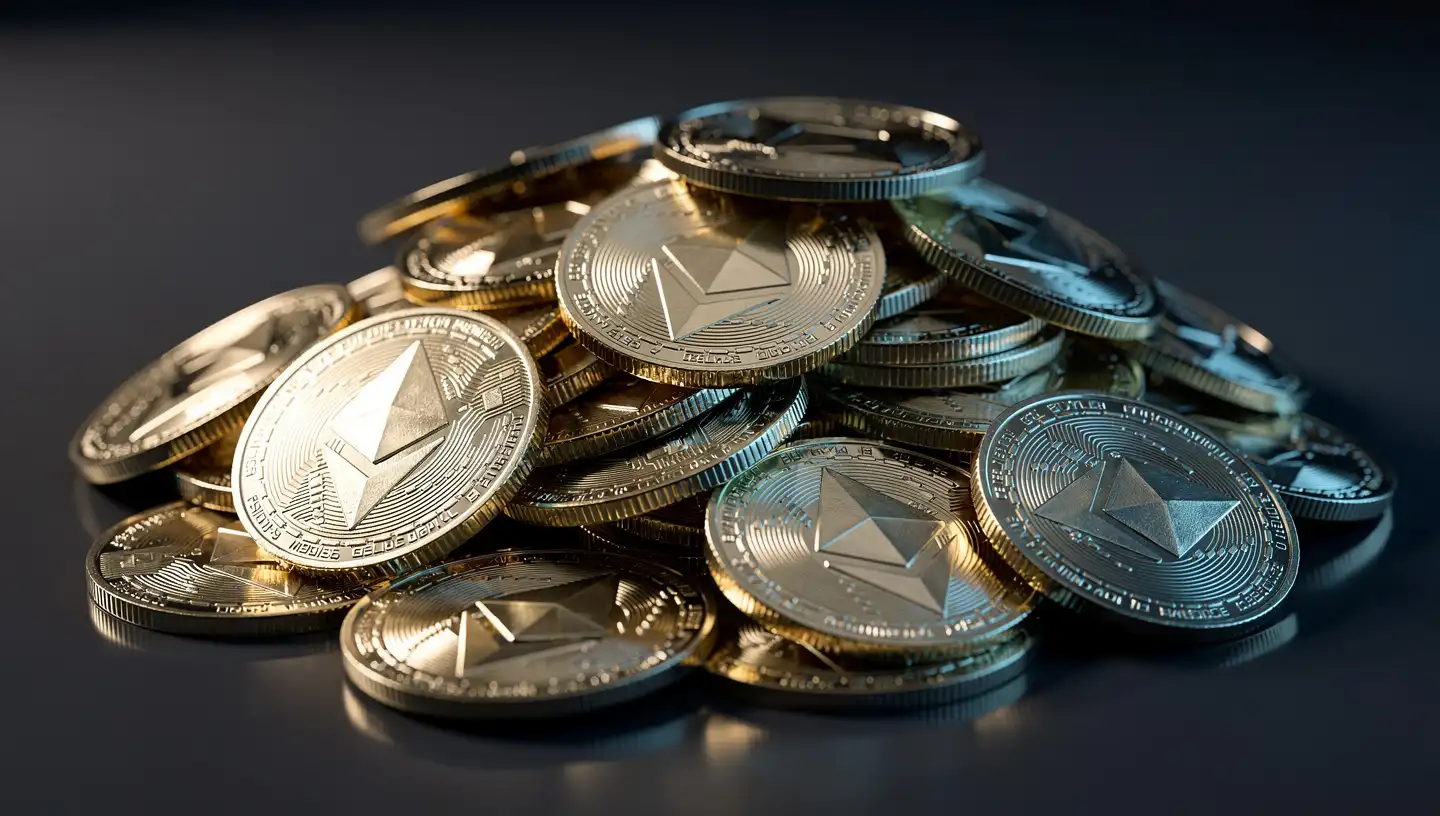
Ether, ticker symbol ETH, is the native cryptocurrency of that network. It is what you actually purchase when you open an account on Coinbase or Kraken and hit buy. Every transaction on Ethereum requires it to pay for the computing power used. Without it, the network does not move.
Ethereum is the name of the network. Ether is the native cryptocurrency token that runs on it. In day-to-day usage, most people say ETH, or just Ethereum. That is technically imprecise, but it is how the language has settled across the industry. You can read how Ethereum works in our separate article.
A useful way to think about it: Ethereum is the highway. Ether is the toll you pay to drive on it. The highway does not belong to you. The toll does. Read more about the creation of Ethereum in the article who created Ethereum?
What is Ether used for?
Ether serves three main purposes on the Ethereum network.
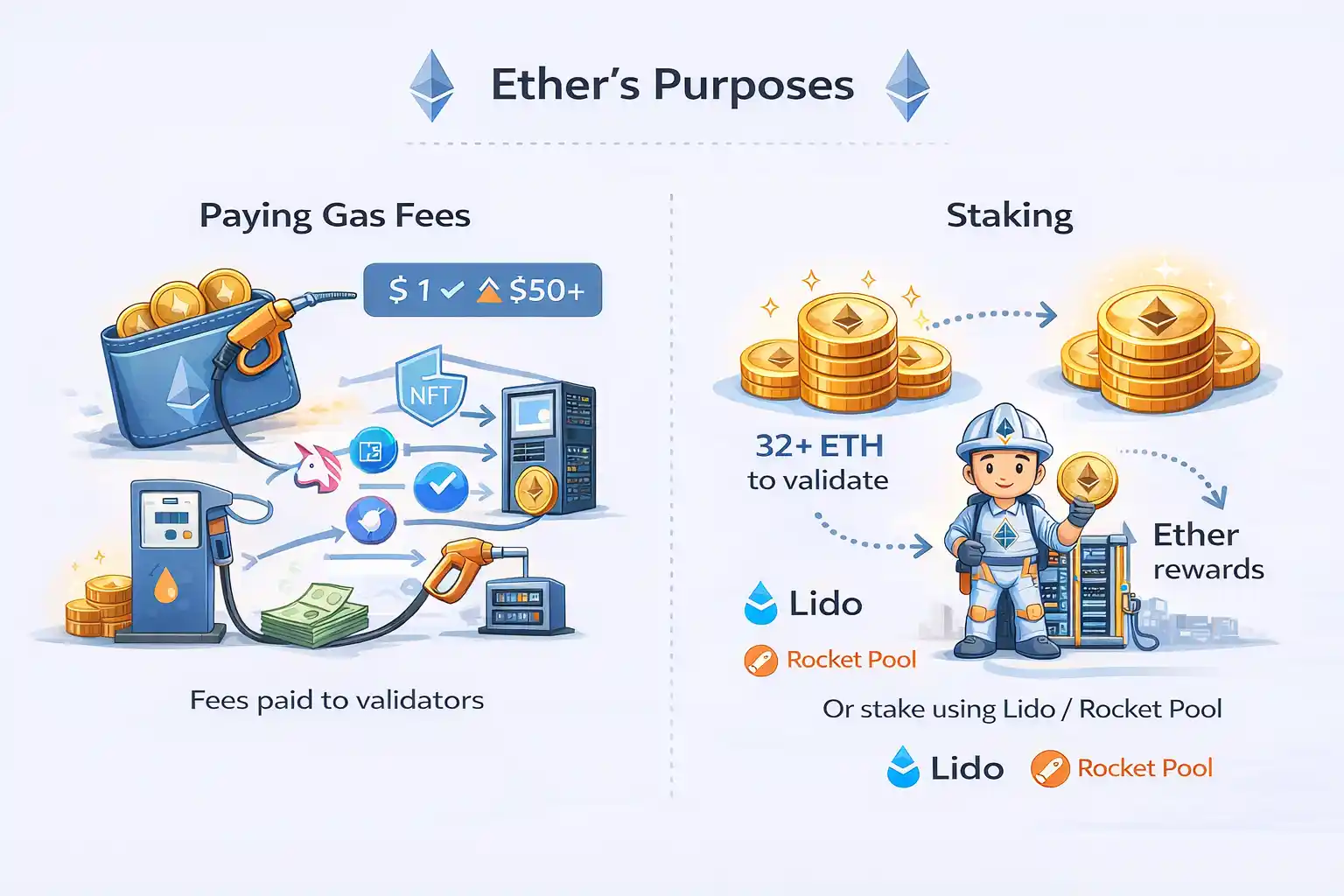
Paying gas fees
Every action on Ethereum costs a fee. Sending the token to another address, swapping on Uniswap, minting an NFT, voting in a DAO: all of it requires computing power, and that computing power is paid for in Ether. These fees are called gas fees. The term “gas” comes from the idea that Ether fuels the network the way petrol fuels a car.
Gas fees go to the validators who process and confirm transactions. They are not fixed. They rise when the network is busy and fall when it is quiet. In 2021, during peak DeFi and NFT activity, a single token swap cost $50 or more in gas. On a slow Sunday in 2024, the same swap cost under a dollar. You can check live prices on Etherscan’s gas tracker.
Staking
Since The Merge in September 2022, Ethereum runs on proof of stake. Validators lock up the token as collateral to earn the right to process transactions and propose new blocks. In return, they earn rewards paid in Ether.
Solo validators need a minimum of 32 ETH. After the Pectra upgrade in May 2025, a single validator can hold up to 2,048 ETH, which allows compounding rewards without spinning up additional nodes. If you do not have 32, liquid staking services like Lido and Rocket Pool accept any amount.
Transferring value
Ether works like any other digital currency. A holder can send it to any wallet address anywhere in the world, at any time, without a bank or payment processor in between. A transfer from Bosnia to Japan settles in under a minute and costs a few cents in gas. No intermediary, no business hours, no foreign exchange markup.
It also functions as a store of value. ETH is the second-largest cryptocurrency by market cap after Bitcoin, and a significant portion of the total supply sits in cold storage or in staking contracts rather than circulating actively.
Ether is not the only token on Ethereum
This is where many beginners get confused. Ethereum hosts thousands of other tokens: USDC, DAI, UNI, LINK, and thousands more. All of these run on the Ethereum network, but none of them are Ether.
Most of these tokens follow a standard called ERC-20. The ERC-20 standard defines a common set of rules that a token must follow to work on Ethereum. Because they all follow the same rules, they are compatible with wallets, exchanges, and DeFi protocols without any extra work.
Ether itself is not an ERC-20 token. It predates the standard and sits at a lower level of the protocol. This is why some DeFi applications use Wrapped ETH (WETH): a version of Ether converted into ERC-20 format so it can interact with protocols that only accept ERC-20 tokens. WETH is always worth exactly 1 ETH. It can be wrapped and unwrapped at any time.
The practical takeaway: gas fees are always paid in Ether. When interacting with a DeFi protocol or buying an NFT, the payment may be either Ether or another token, depending on what the application accepts.
How Ether is divided: wei and gwei explained
Ether is divisible to 18 decimal places. That level of precision exists so the network can handle tiny transactions and precise fee calculations without rounding errors.
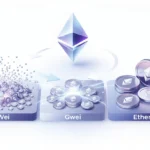
The smallest unit of Ether is called a wei. One ETH equals 1,000,000,000,000,000,000 wei, or 10 to the power of 18. Wei is named after Wei Dai, a cryptographer from the 1990s cypherpunk movement who developed an early concept called b-money, which laid some of the groundwork for smart contracts.
Gas fees are almost never quoted in wei. The numbers are too large to be readable. Instead, gas prices appear in gwei, short for gigawei. One gwei equals one billion wei, or 0.000000001 ETH. If gas costs 20 gwei per unit, a standard transfer of 21,000 gas units costs 420,000 gwei, which equals 0.00042 ETH.
Think of gwei the way you think of cents. Nobody prices a coffee at 0.04 dollars. They say 4 cents. Gwei does the same job for Ethereum gas prices.
| Unit | Value in ETH | When you see it |
|---|---|---|
| Wei | 0.000000000000000001 ETH | Smart contract calculations, backend code |
| Gwei | 0.000000001 ETH | Gas fee pricing, MetaMask, Etherscan |
| ETH | 1 ETH | Buying, selling, staking, transferring |
Why does Ether have value?
Ether is not backed by a government or a physical asset. Its value comes from the network it powers and the demand to use that network.
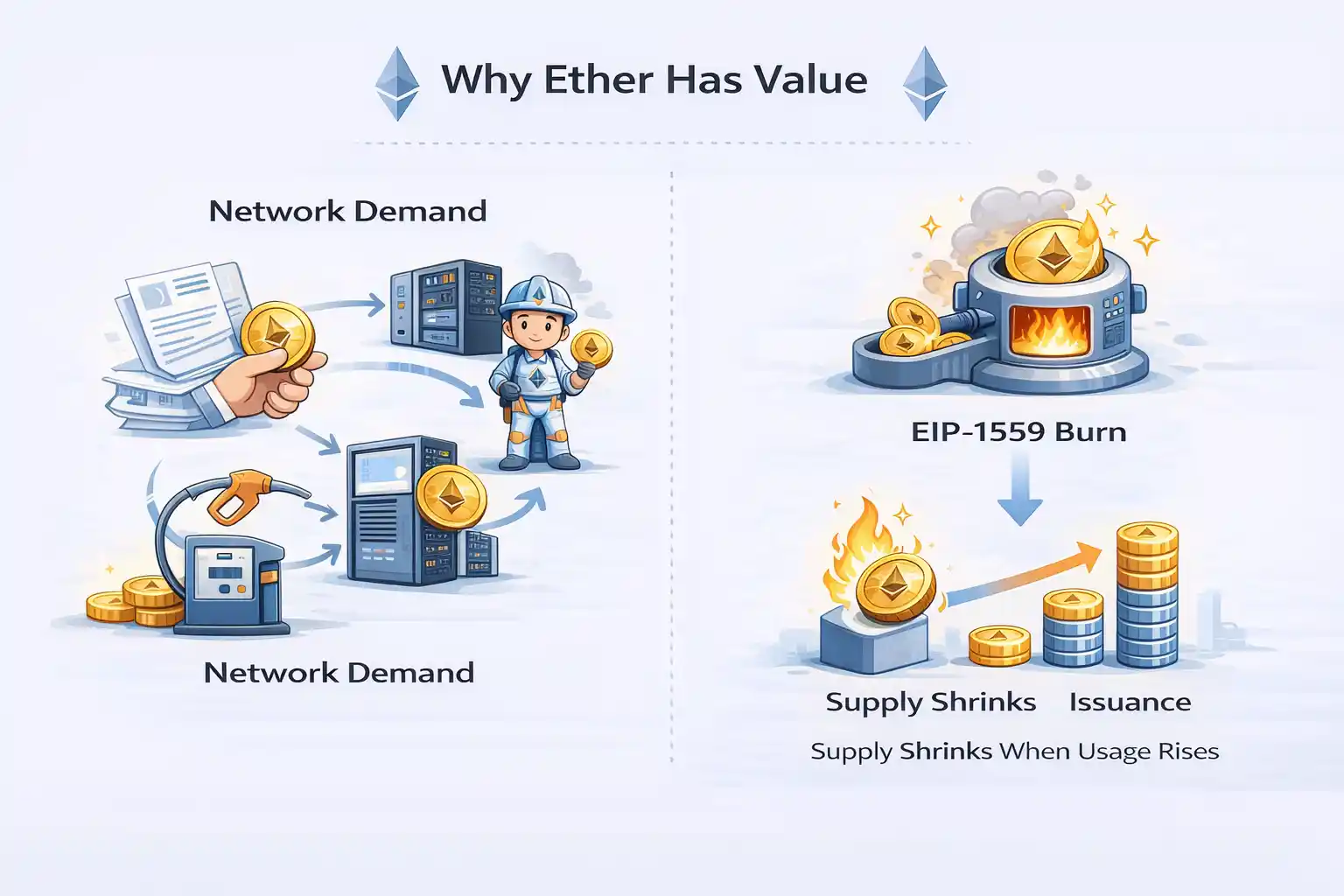
Every transaction on Ethereum requires the token to pay gas. Every smart contract deployment requires it. Every validator must hold it as collateral. As long as developers build on Ethereum and users interact with it, there is demand for Ether. The more applications run on the network, the more is needed to interact with them.
Since August 2021, a portion of every gas fee has been burned: permanently removed from circulation. This was introduced by EIP-1559 as part of the London upgrade. During periods of high network activity, the amount burned exceeds the amount issued as staking rewards. During those stretches, the total supply shrinks. Since The Merge, over 1.5 million ETH has been burned in total.
The token has no hard supply cap, unlike Bitcoin’s fixed limit of 21 million coins. But the burn mechanism means the supply is not simply growing without limit. It depends on how busy the network is.
How Ether is issued
New Ether enters circulation as staking rewards. Validators who propose and attest to new blocks receive it as payment for their work. The current annual issuance rate is around 0.5 to 0.8% of total supply, far lower than it was under proof of work before The Merge.
Before The Merge, Ethereum miners received 2 ETH per block as a reward. The switch to proof of stake cut issuance by roughly 90%. Combined with the EIP-1559 burn, Ethereum has run at net deflation during several high-activity periods since 2022.
Is Ethereum the same as Ether when you buy it?
On every exchange, the asset is listed as ETH. Coinbase, Kraken, Binance, and every other platform use that ticker. When the screen shows ETH/USD, that is Ether priced in US dollars.
When someone says “I bought Ethereum,” they mean they bought Ether. When someone says “the Ethereum price went up,” they mean the price of the token went up. That informal usage is accepted across the industry. The only time the distinction matters is when precision is needed: the token is ETH, the network is Ethereum.
For a step-by-step walkthrough of buying your first ETH, our guide on how to buy Ethereum covers which exchanges to use and how to store it safely after purchase.
FAQ
What is the difference between Ethereum and Ether?
Ethereum is the blockchain network. Ether (ETH) is the native token that runs on it. You buy and sell Ether. You build applications on Ethereum. The two names are often used interchangeably in everyday conversation, but they refer to different things.
Is ETH the same as Ether?
Yes. ETH is the ticker symbol for Ether. When you see ETH on an exchange or in your wallet, that is Ether. The full name is Ether; the abbreviation is ETH.
Can you buy Ethereum without buying Ether?
No. The Ethereum network is not a purchasable asset. What you buy on an exchange is Ether, the token. Buying ETH gives you no ownership stake in the Ethereum network itself, just the token.
What is gwei?
Gwei is a denomination of Ether used to express gas fees. One gwei equals 0.000000001 ETH. Gas prices are quoted in gwei because the numbers are easier to read: 15 gwei is clearer than “0.000000015 ETH.”
What is the smallest unit of Ether?
The smallest unit is called a wei. One ETH equals 10 to the power of 18 wei, or 1,000,000,000,000,000,000 wei. Wei is named after the cryptographer Wei Dai. In practice, most users never interact directly with wei. Gwei is the unit used for gas fees, and ETH is used for everything else.
What is Wrapped ETH (WETH)?
Wrapped ETH (WETH) is Ether converted into ERC-20 format. Some DeFi protocols only accept ERC-20 tokens and cannot interact with native ETH directly. Wrapping ETH locks it in a smart contract and issues WETH in return, at a 1:1 ratio. You can unwrap it back to ETH at any time. WETH always equals 1 ETH in value.
Why is Ether called gas?
It is not. Gas is the fee paid in Ether to execute transactions. The word “gas” describes the fee itself, not the token. When you pay gas fees, you are spending Ether. The analogy is that just as a car needs petrol to run, Ethereum needs ETH to process transactions, so those fees were named gas.
Does Ethereum have a maximum supply?
No. There is no hard cap on ETH supply, unlike Bitcoin’s 21 million limit. New ETH is issued as staking rewards. However, the EIP-1559 burn mechanism removes a portion of every gas fee from circulation permanently. During high-activity periods, more ETH is burned than issued, making the supply deflationary in practice.