Every transaction on Ethereum carries a cost. That cost is called an Ethereum gas fee. You pay it when you send ETH, when you swap tokens, when you interact with a smart contract, and when you mint an NFT. The fee goes to the validators who process your transaction and secure the network.
Gas fees are one of the most discussed aspects of Ethereum. They can be a few cents on a quiet afternoon or over a hundred dollars during peak network demand. Understanding how they work, why they exist, and how they change is useful whether you use Ethereum daily or are still deciding whether to start.
What are Ethereum gas fees?
Ethereum gas fees are the transaction fees users pay to process transactions on the Ethereum network. Gas fees are quoted in gwei, a smaller denomination of ETH, and are paid in Ethereum native currency.
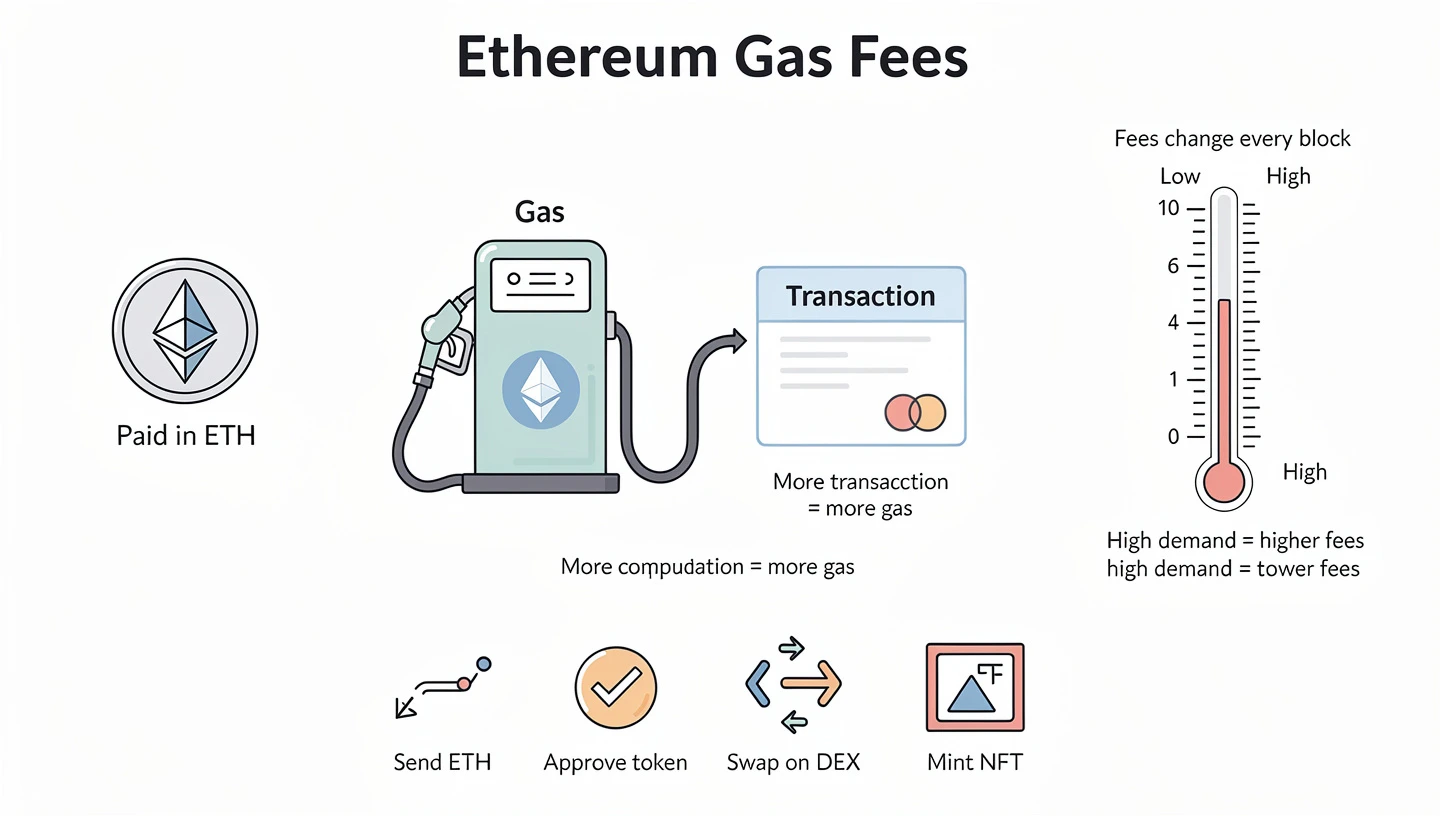
Ethereum gas fees are not fixed. They change with every block, rising when network demand is high and falling when it is low. The fee you pay on a quiet Tuesday afternoon can be ten times lower than the fee during a popular NFT mint on a Saturday evening. Gas fees apply to every on-chain action: sending ETH, approving a token, swapping on a decentralised exchange, and minting an NFT.
The term “gas” comes from an analogy: just as a car engine requires gasoline to run, the Ethereum network requires gas to execute operations. The more computational work a transaction demands, the more gas it consumes. Sending ETH requires less gas than calling a complex smart contract, for the same reason a city drive uses less fuel than a long motorway journey.
Gas fees are paid in ETH, the native currency of the Ethereum network. You cannot pay gas fees in any other token, regardless of which asset you are transacting with. If you want to swap a stablecoin, you still need ETH in your wallet to cover the gas cost.
Why do Ethereum gas fees exist?
Gas fees are not arbitrary. They exist because of three specific requirements of a decentralised network.
Paying for computation
Every transaction on Ethereum is executed by thousands of nodes simultaneously. Each node performs the same computational work: validating the transaction, updating the network state, and storing the result. That computation has a cost. Gas fees ensure that cost is paid by the person requesting the computation, not absorbed by the network at large.
Without a fee attached to computation, the network would have no mechanism to allocate scarce block space. Every transaction consumes resources. Gas fees make those resources finite and priced.
Preventing spam
By attaching a cost to every transaction, gas fees prevent anyone from flooding the network with worthless requests at no expense. On a network where transactions are free, a single actor could submit millions of transactions, congest the network, and effectively deny service to everyone else.
Gas fees make that attack expensive. The more transactions an actor submits, the more ETH they spend. This makes spam and denial-of-service attacks economically impractical at any meaningful scale.
Compensating validators
Validators stake ETH to participate in the Ethereum network. They propose blocks, attest to other blocks, and keep the network running. Gas fees are part of their compensation. Specifically, the priority fee, also called the tip, goes directly to the validator who includes a transaction in a block.
Without that compensation, validators would have no direct incentive to include transactions at all, since staking rewards are paid regardless of how many transactions a block contains. The priority fee is what makes validators prefer full blocks over empty ones.
What is gwei? Wei, gwei and ETH explained
Gas prices on Ethereum are quoted in gwei, not in ETH. The reason is practical: gas prices expressed in ETH produce unwieldy numbers. Saying a transaction costs 0.000000050 ETH is harder to read than saying it costs 50 gwei.
The denomination hierarchy
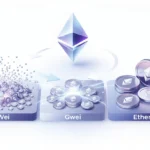
ETH has a full denomination hierarchy, similar to how pounds have pence or dollars have cents, except the units are much smaller. The hierarchy from smallest to largest runs as follows:
Wei is the smallest unit of ETH. One ETH equals 1,000,000,000,000,000,000 wei. Wei is named after Wei Dai, the cryptographer who created b-money, an early digital currency that influenced Bitcoin.
Gwei is short for gigawei, meaning one billion wei. One gwei equals 0.000000001 ETH. Gas prices are almost always quoted in gwei because the numbers are manageable. A gas price of 15 gwei means each unit of gas costs 0.000000015 ETH.
ETH is the native currency of the Ethereum network. All gas fees are ultimately paid in ETH, converted from the gwei figure shown in your wallet.
How to read a gas price
When your wallet shows a gas price of 20 gwei, it means each unit of gas costs 20 gwei. A standard ETH transfer uses 21,000 units of gas. The gas cost alone for that transfer is therefore 21,000 multiplied by 20 gwei, which equals 420,000 gwei, or 0.00042 ETH. At an ETH price of $2,000, that is $0.84 for a simple transfer.
During the NFT peak of 2021, gas prices regularly exceeded 200 gwei. That same transfer would have cost over $8 at those prices, and a complex DeFi transaction could cost over $200.
How Ethereum gas fees are calculated
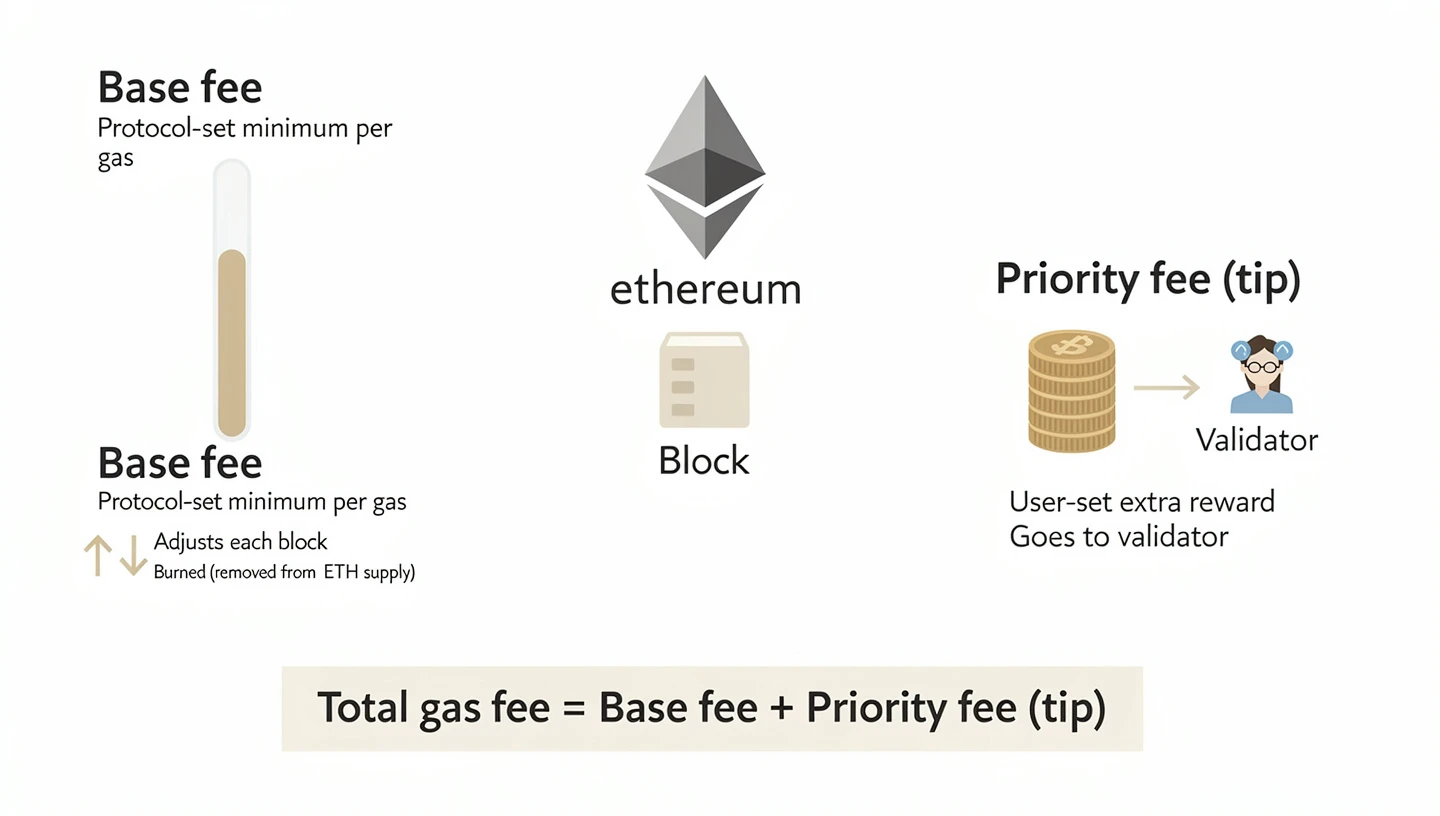
Since the London upgrade in August 2021, also known as EIP-1559, Ethereum gas fees have two components: the base fee and the priority fee. Understanding both is necessary to understand your total transaction cost.
The base fee
The base fee is set by the protocol, not by the user. It is the minimum amount a transaction must pay to be eligible for inclusion in a block. If your transaction does not offer at least the base fee, validators will not include it.
The base fee adjusts automatically with every block based on how full the previous block was. If the previous block used more than the target amount of gas, the base fee rises. If it used less, the base fee falls. This keeps block usage close to the target over time.
The base fee is burned: it is removed from the ETH supply permanently. It does not go to validators. This burn mechanism was introduced by EIP-1559 and means that during periods of high network activity, more ETH is removed from circulation than is issued as staking rewards.
The priority fee (tip)
The priority fee, also called the tip, is an optional payment on top of the base fee. It goes directly to the validator who includes the transaction in a block. Users set their own priority fee.
A higher tip makes a transaction more attractive to validators. If network demand is high and block space is limited, validators fill blocks with the highest-tipped transactions first. A low tip during congestion means your transaction waits in the mempool until demand drops.
For routine transfers during low-demand periods, a tip of 1 to 2 gwei is sufficient. During high-demand periods, users who need fast confirmation may set tips of 10 gwei or more.
The gas limit
The gas limit is the maximum number of gas units you are willing to pay for a transaction. It is a ceiling, not the amount you actually pay. If your transaction uses less gas than the limit, you are refunded the difference. If it uses more than the limit, the transaction fails.
Wallets set the gas limit automatically based on the type of transaction. A standard ETH transfer always uses exactly 21,000 units of gas and needs a limit of at least 21,000. A token swap on a decentralised exchange is more complex and may require a limit of 100,000 to 200,000 units depending on the contract.
Setting the gas limit too low is the most common reason transactions fail. The transaction runs out of gas before completing, the state reverts, and the gas consumed up to that point is still charged.
The formula: base fee, tip and gas limit
The total gas fee you pay is calculated as follows:
Total fee = gas used x (base fee + priority fee)
An example: you send ETH when the base fee is 15 gwei and you set a priority fee of 2 gwei. A standard ETH transfer uses 21,000 units of gas. The total fee is 21,000 x (15 + 2) = 357,000 gwei, or 0.000357 ETH. The 315,000 gwei base fee portion is burned. The 42,000 gwei tip goes to the validator.
You can also set a maxFeePerGas, the absolute maximum you are willing to pay per unit of gas. If the base fee plus your tip exceeds this figure, the transaction waits. If the base fee is lower than expected by the time the transaction is included, you are refunded the difference.
How much gas does each operation use?
Not all transactions consume the same amount of gas. Each operation on the Ethereum Virtual Machine has a fixed gas cost. The more operations a transaction requires, the more gas it consumes.
A standard ETH transfer always uses 21,000 units of gas. It is the simplest possible transaction: move ETH from one address to another.
An ERC-20 token transfer uses approximately 45,000 units. It is more complex because it calls a smart contract, which reads from storage, updates two balances, and emits an event.
A token swap on Uniswap uses 100,000 to 150,000 units depending on the number of pools involved. The contract must read prices, calculate output amounts, update multiple storage slots, and transfer two tokens.
Deploying a new smart contract costs a minimum of 32,000 units plus additional gas for every byte of bytecode stored. A typical DeFi contract deployment costs several million units of gas.
How the base fee adjusts: the 12.5% mechanism
The base fee adjustment mechanism was designed to keep blocks at roughly 50% of their maximum capacity on average. Each block has a target of 15 million gas units and a maximum of 30 million.
If a block uses more than the 15 million target, the base fee for the next block increases by up to 12.5%. If a block uses less than the target, the base fee decreases by up to 12.5%. The adjustment is proportional to how far the block was from the target.
This mechanism has an important property: if every block were completely full, the base fee would double approximately every 10 blocks. At that rate, gas prices would rise so fast that demand would drop before blocks could remain full indefinitely. The 12.5% cap is the mechanism that prevents sustained congestion from becoming permanent.
In practice, this means gas fee spikes are self-limiting. A sudden surge in demand raises the base fee sharply, which price out marginal transactions, which reduces demand, which lets the base fee fall again. The whole cycle often resolves within minutes to hours.
Why do you still pay gas when a transaction fails?
A failed transaction still costs gas. Many users find this frustrating, but the reason is direct.
When you submit a transaction, the Ethereum network begins processing it immediately. Validators include it in a block. Every node on the network executes it. That computational work happens regardless of whether the transaction ultimately succeeds or fails. The network consumed resources. Those resources have to be paid for.
Gas consumed up to the point of failure is charged. Gas not consumed is refunded. If you set a gas limit of 100,000 and the transaction fails at 60,000 gas, you pay for 60,000 units and receive a refund for the remaining 40,000.
The most common causes of failed transactions are: a gas limit set too low, a contract state that changed between submission and execution, and slippage set too tight on a swap.
Why gas fees spike
Gas fees rise when demand for block space exceeds supply. This is called network congestion. Each block can hold a maximum of 30 million gas units. When more transactions are competing for that space than the block can accommodate, users raise their priority fees to get included ahead of others. The base fee rises in response to full blocks, and the cycle drives fees higher until demand subsides.
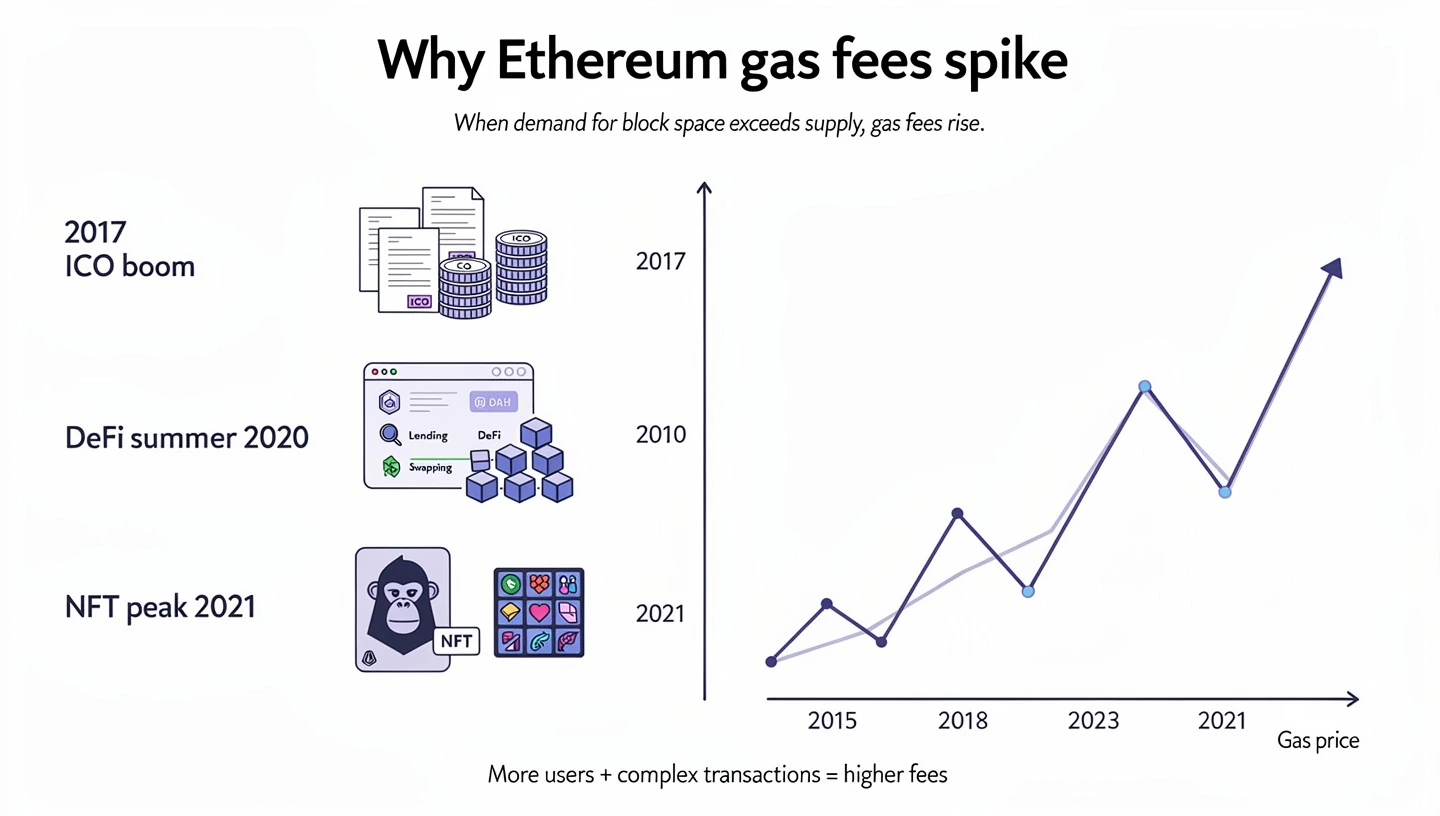
Several specific periods in Ethereum history produced severe and sustained fee spikes.
The 2017 ICO boom
In 2017, hundreds of projects launched initial coin offerings on Ethereum. Investors sent ETH to contract addresses to receive new tokens in return. During popular sales, thousands of users submitted transactions simultaneously, each trying to get in before the sale sold out. Gas prices reached levels that made small transactions uneconomical. Network congestion lasted for days at a time during peak periods.
DeFi summer 2020
In the summer of 2020, yield farming protocols launched on Ethereum in rapid succession. Compound, Uniswap, Aave, and dozens of smaller protocols attracted billions of dollars in liquidity within weeks. DeFi transactions are complex and consume significantly more gas than simple transfers. Average gas prices rose from under 10 gwei in early 2020 to over 100 gwei by September. Users paid $10 to $50 for routine swaps.
The NFT peak of 2021
The NFT market of 2021 produced the most extreme gas fee conditions in Ethereum history. During the Bored Ape Yacht Club mint, the Otherside land sale, and several other high-demand launches, gas prices exceeded 1,000 gwei. Users paid over $200 to complete a single swap transaction. Failed transactions, caused by gas limits set too low amid rapidly changing conditions, cost users tens of millions of dollars in aggregate.
The Otherside land sale in May 2022 alone caused over $150 million in gas fees to be paid in a single evening.
Why The Merge did not lower gas fees
The Merge in September 2022 switched Ethereum from proof of work to proof of stake. It reduced the network energy consumption by over 99%. It did not lower gas fees. To understand the full history of how Ethereum was designed and the decisions that shaped it, read the account of who created Ethereum.
The reason is direct: gas fees are determined by demand for block space, not by the consensus mechanism. The Merge did not change the amount of block space available per block, the 12-second block time, or the mechanism that determines the base fee. A user submitting a transaction after The Merge faced the same gas pricing rules as before.
The Merge was designed to reduce energy consumption and lay the groundwork for future scaling upgrades. It was not designed to reduce gas fees, and Ethereum developers never claimed it would.
The Dencun upgrade and EIP-4844
The Dencun upgrade in March 2024 introduced EIP-4844, also called proto-danksharding. This upgrade added a new data storage format called blobs to Ethereum blocks. Blobs are cheaper to store than regular transaction data and are automatically deleted after approximately 18 days.
Layer 2 networks, which settle batches of transactions to Ethereum mainnet, immediately benefited. Before Dencun, Layer 2 fees were low but still noticeable. After Dencun, fees on networks like Arbitrum, Optimism, and Base dropped by 90 to 99 percent in many cases. Routine transactions on these networks now cost fractions of a cent.
Dencun did not directly lower mainnet gas fees for Ethereum users who transact on Layer 1. Its impact was felt primarily through the significantly lower cost of using Layer 2 networks.
When are Ethereum gas fees lowest?
Ethereum gas fees follow a pattern driven by global internet usage. Fees are typically lowest when fewer people are transacting, which corresponds to off-peak hours in the largest markets.
Gas fees tend to be lowest on weekends, particularly Saturday and Sunday in UTC time, when institutional trading activity and DeFi protocol interactions are at their lowest. Within any given day, midnight to 8 AM UTC typically sees the lowest base fees, outside peak hours in both the US and Europe.
Gas fees tend to be highest during European and American business hours, particularly between 1 PM and 9 PM UTC, when traders in both regions are active simultaneously.
These patterns are tendencies, not guarantees. A major protocol launch, a sharp market move, or a popular NFT mint can drive fees up at any hour. Checking a gas tracker before submitting a non-urgent transaction takes seconds and can save a meaningful amount.
How to pay less in gas fees
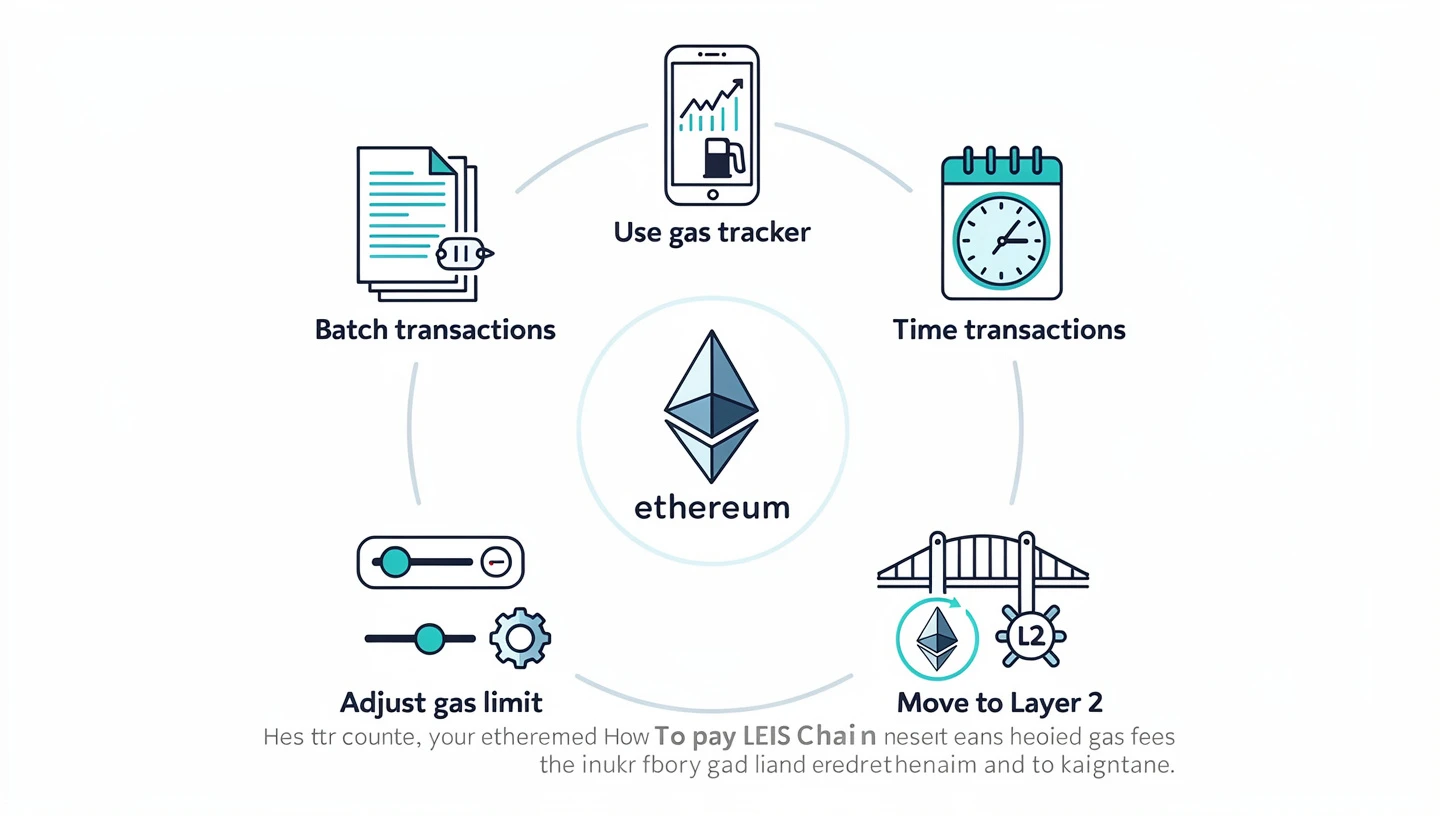
Paying less in Ethereum gas fees is a matter of timing, tooling, and choosing where to transact.
Use a gas tracker
A gas tracker shows the current base fee and the priority fees being paid for slow, standard, and fast transactions in real time. Before submitting a non-urgent transaction, check a gas tracker. If the base fee is elevated, waiting 10 to 20 minutes can sometimes save 30 to 50 percent. Etherscan Gas Tracker and ultrasound.money both show live base fee data alongside historical trends.
Time your transactions
As described above, weekends and early morning UTC hours consistently produce lower gas fees. If you are not in a hurry, scheduling non-urgent transactions for these windows costs nothing and reduces fees. Sending an ETH transfer at 3 AM UTC on a Sunday often costs half what the same transfer would cost at 3 PM UTC on a Wednesday.
Move to Layer 2
Layer 2 networks process transactions off the Ethereum mainnet and settle compressed batches of transactions back to mainnet at intervals. Because hundreds or thousands of transactions share the cost of a single mainnet settlement, the per-transaction cost drops significantly.
Networks like Arbitrum, Optimism, and Base offer the same assets and many of the same protocols as Ethereum mainnet. After the Dencun upgrade, fees on these networks fell to fractions of a cent for standard transactions. For users who transact frequently, moving activity to a Layer 2 is the single most effective way to reduce gas costs. To understand how Ethereum works at the base layer and how Layer 2 networks connect to it, read the guide on how Ethereum works.
Adjust the gas limit manually
Most wallets set the gas limit automatically. For users comfortable doing so, setting a gas limit manually based on the known requirements of a transaction can prevent overpaying. A standard ETH transfer never requires more than 21,000 units of gas. Setting a limit of exactly 21,000 ensures no excess gas is reserved, though modern wallets refund unused gas regardless.
Where manual adjustment matters more is when submitting complex transactions. Some wallets overestimate gas limits significantly for safety. Checking the estimated gas use and setting a tighter limit reduces the ETH reserved for the transaction, though setting it too low risks a failed transaction.
Batch transactions
Some protocols and wallets allow batching: combining multiple actions into a single transaction. Instead of approving a token and then swapping it in two separate transactions, a batched transaction does both at once. Each approval transaction costs approximately 45,000 units of gas on its own. Batching eliminates the base overhead of separate transactions and pays that cost only once.
Account abstraction wallets, including those built on the ERC-4337 standard, make batching more accessible by allowing users to combine arbitrary actions without needing to write contract code.
Ethereum gas fees vs other blockchains
Ethereum mainnet has historically had the highest transaction fees of any major smart contract platform. That is partly a function of its success: high demand for limited block space drives fees up. It is also a function of deliberate design choices that prioritise security and decentralisation over throughput.
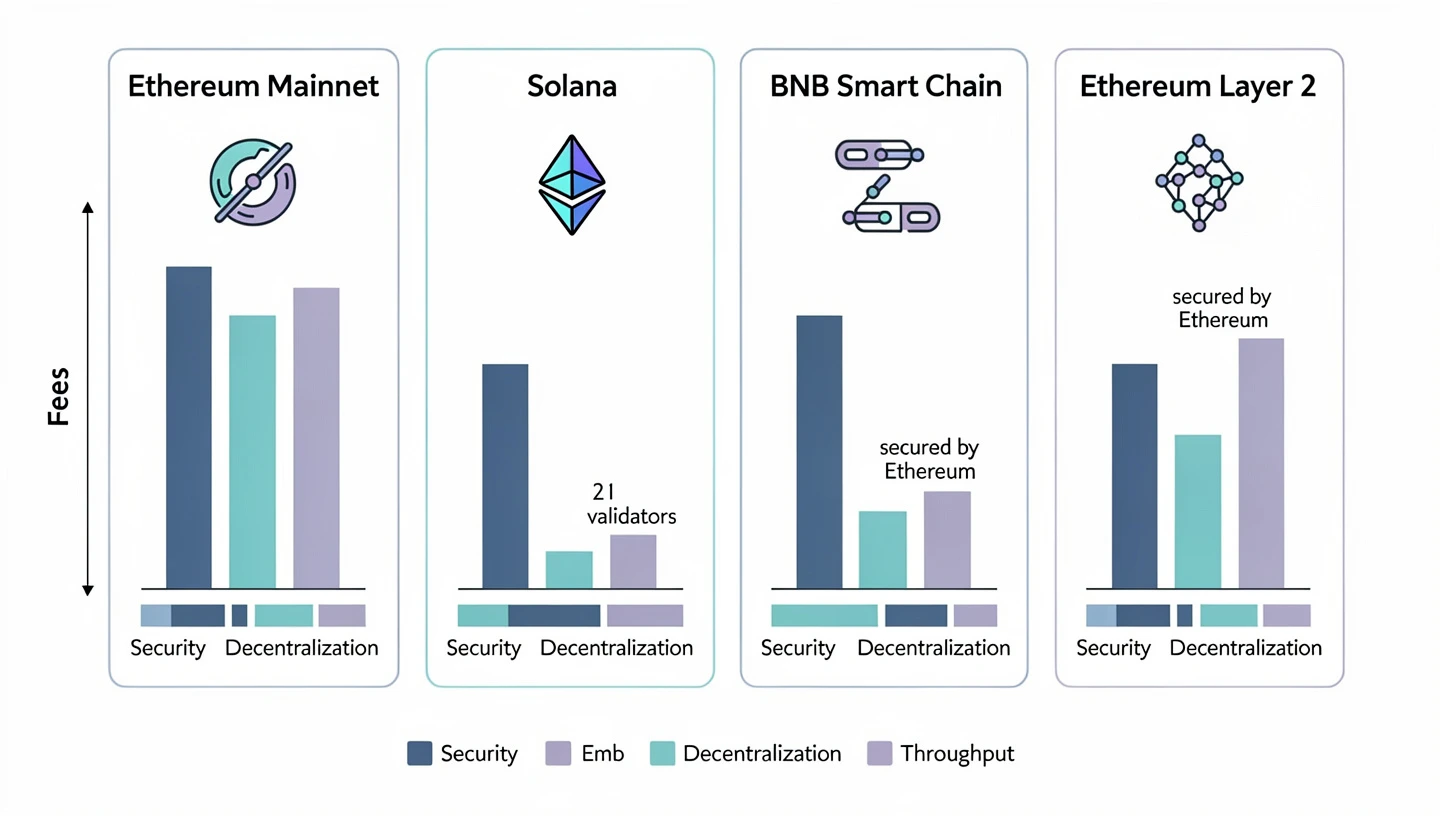
Solana processes transactions at significantly lower cost, with fees typically under $0.001. Its architecture prioritises throughput at the base layer, with block times of 400 milliseconds and higher hardware requirements for validators. The tradeoff is a smaller, more centralised validator set than Ethereum.
BNB Smart Chain is EVM-compatible and uses a proof-of-staked-authority model with 21 validators. Fees are low, typically under $0.10, but the network is significantly more centralised than Ethereum.
Ethereum Layer 2 networks sit between these extremes. They offer fees comparable to or lower than Solana while inheriting the security guarantees of the Ethereum mainnet they settle to. For most users, a Layer 2 network provides the most practical combination of low fees and Ethereum-level security.
FAQ
What are Ethereum gas fees?
Ethereum gas fees are the transaction fees users pay to process transactions and execute smart contracts on the Ethereum network. Gas fees are paid in ETH, denominated in gwei. The fee is determined by multiplying the gas used by the sum of the base fee and the priority fee.
Why do Ethereum gas fees exist?
Gas fees exist for three reasons. First, every transaction requires computational resources from thousands of nodes, and those resources must be paid for. Second, attaching a cost to each transaction prevents spam and stops anyone from flooding the network with worthless requests at no cost. Third, gas fees compensate validators who stake ETH to secure the network and process transactions.
What is gwei?
Gwei is the unit used to quote Ethereum gas prices. One gwei equals one billionth of one ETH (0.000000001 ETH). The full denomination hierarchy runs from wei at the bottom, through gwei in the middle, to ETH at the top. Gas prices quoted in gwei are easier to read than the equivalent figure in ETH.
How are Ethereum gas fees calculated?
The total Ethereum gas fee is calculated with this formula: gas used multiplied by (base fee plus priority fee). The base fee is set by the protocol and burned. The priority fee is a tip paid directly to the validator. A standard ETH transfer uses 21,000 units of gas. A token swap on a decentralised exchange uses 45,000 to 150,000 units depending on the contract.
Why do I still pay gas when a transaction fails?
When a transaction fails, the Ethereum network has already consumed computational resources processing it up to the point of failure. Validators performed work. Nodes executed the transaction. That work still has to be paid for. The gas consumed up to the point of failure is charged. Any gas not consumed is refunded.
When are Ethereum gas fees lowest?
Ethereum gas fees are typically lowest on weekends, particularly Saturday and Sunday in UTC time, and during early morning UTC hours between midnight and 8 AM. These windows see lower network demand because fewer traders and DeFi protocols are active. Using a gas tracker to check the base fee before submitting a transaction takes seconds and can save a meaningful amount.
Did The Merge lower Ethereum gas fees?
No. The Merge in September 2022 switched Ethereum from proof of work to proof of stake, which cut energy consumption by over 99%. It did not change the amount of block space available or the mechanism that determines gas prices. Gas fees are determined by demand for block space, not by the consensus mechanism. The Merge was not designed to reduce gas fees.
How can I pay less in Ethereum gas fees?
The most effective ways to pay less in gas fees are: use a gas tracker to check current base fees before transacting; time transactions for weekends or early morning UTC; move activity to a Layer 2 network such as Arbitrum or Base where fees are often 90 to 99 percent lower; and avoid transacting during high-demand periods such as major NFT mints or sharp market moves.