On September 15, 2022, Ethereum switched off its mining hardware and replaced it with a system secured by staked ETH. That switch is called The Merge. It changed how the network reaches consensus, how new ETH enters circulation, and how much energy the network consumes. This guide explains what Ethereum proof of stake is, how it works at a technical level, what The Merge actually did, and what came after it.
What is Ethereum proof of stake?
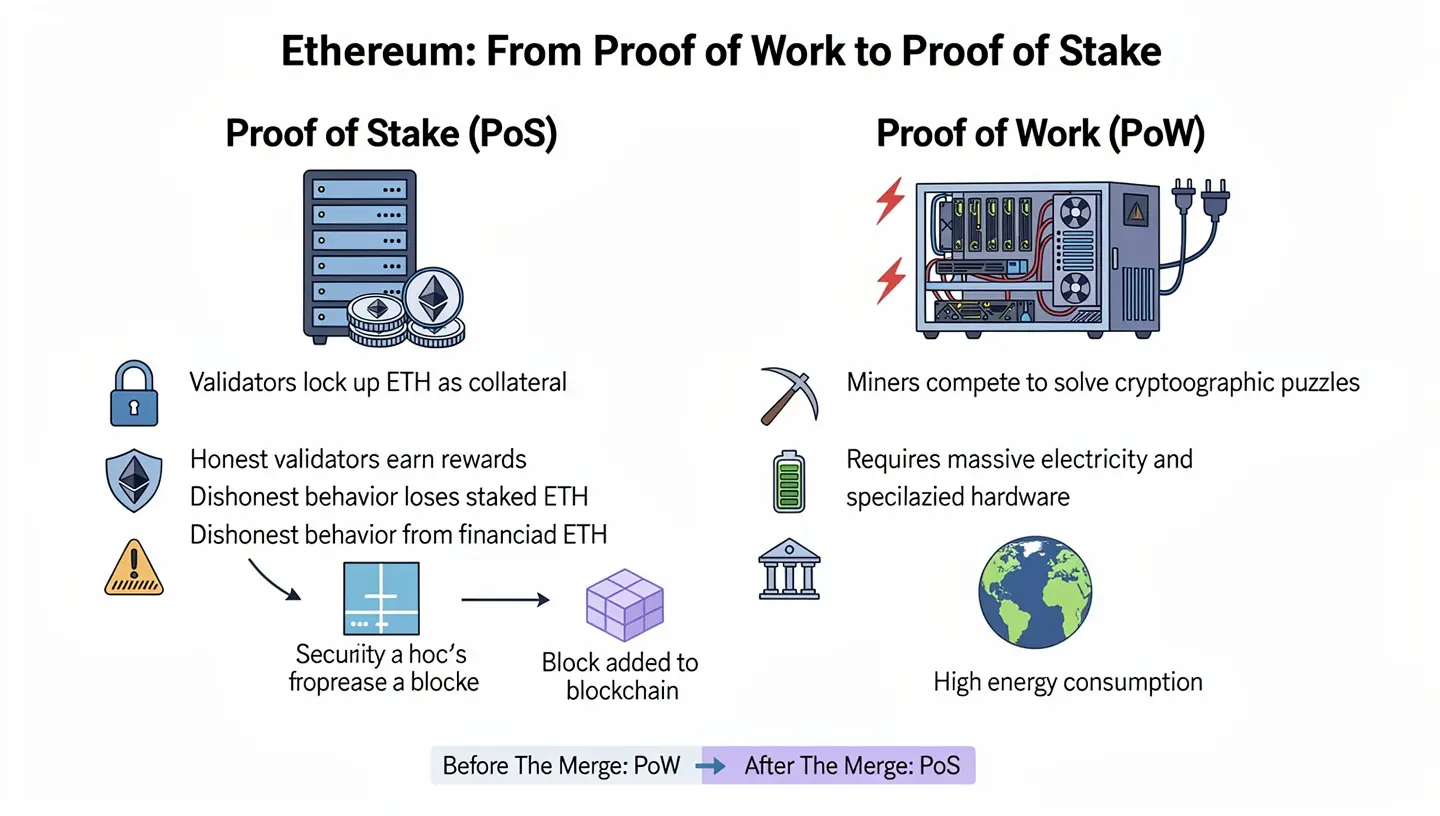
Proof of stake is the consensus mechanism Ethereum uses to agree on which transactions are valid and in what order they are added to the blockchain. Under proof of stake, the network is secured by validators who lock up ETH as collateral. That locked ETH is their stake in the network. If a validator behaves honestly, it earns rewards. If it behaves dishonestly, it loses part of its stake. The financial cost of attacking the network replaces the physical cost of electricity that proof of work required.
Before The Merge, Ethereum used proof of work, the same consensus mechanism Bitcoin uses today. Understanding what Ethereum is helps explain why switching the consensus mechanism was such a significant change for the network.
How proof of stake differs from proof of work
Under proof of work, miners compete to solve a cryptographic puzzle. The first miner to solve it wins the right to add the next block and collect the block reward. Solving that puzzle requires enormous amounts of electricity and specialised hardware. GPU farms and ASIC machines run continuously, consuming power whether or not a block is being produced. Before The Merge, Ethereum consumed roughly as much electricity as the entire country of Argentina.
Under proof of stake, there is no puzzle to solve. Validators are selected to propose blocks based on their staked ETH and a randomness mechanism. No GPU arms race. No ASIC manufacturing. The cost of participation is financial rather than physical. A validator who misbehaves loses ETH. That financial penalty replaces the physical cost of wasted electricity as the deterrent against attacks.
What was the Ethereum Merge?
The Merge was the event on September 15, 2022 when the original Ethereum Mainnet execution layer merged with the Beacon Chain consensus layer. From that point forward, the Beacon Chain became the engine driving block production. Mining was permanently retired. The Merge did not create a new blockchain. All transaction history, all smart contracts, all ETH balances carried over without interruption. The network switched consensus mechanisms mid-flight.
The Beacon Chain: the foundation laid before The Merge
The Beacon Chain launched on December 1, 2020, as a separate proof-of-stake blockchain running in parallel with the existing proof-of-work Ethereum Mainnet. It did not process Mainnet transactions. Instead, it built and tested the proof-of-stake infrastructure that The Merge would eventually use. The Beacon Chain was the first time Ethereum validators existed at all. For 21 months, the two chains ran simultaneously, with the Beacon Chain accumulating validators and testing finality while the proof-of-work chain continued to process all transactions.
To launch the Beacon Chain, a minimum of 16,384 validators had to deposit 32 ETH each into the deposit contract. That threshold was reached on November 24, 2020, triggering the genesis block one week later. The full technical specification for the Beacon Chain is documented at ethereum.org.
The execution layer and the consensus layer explained
After The Merge, Ethereum operates as two connected layers. The execution layer handles everything users interact with directly: transactions, smart contract logic, account balances, and the state of every application on the network. It is what existed as Ethereum Mainnet from 2015 onward.
The consensus layer handles everything related to agreement: which validator proposes the next block, which validators attest to it, how finality is reached, and the rules around slashing. To learn more about how the two layers work together, the guide on how Ethereum works covers the full architecture.
The old terms Eth1 and Eth2 have been retired. There is one Ethereum network. The execution layer and the consensus layer together form it.
How Ethereum proof of stake works
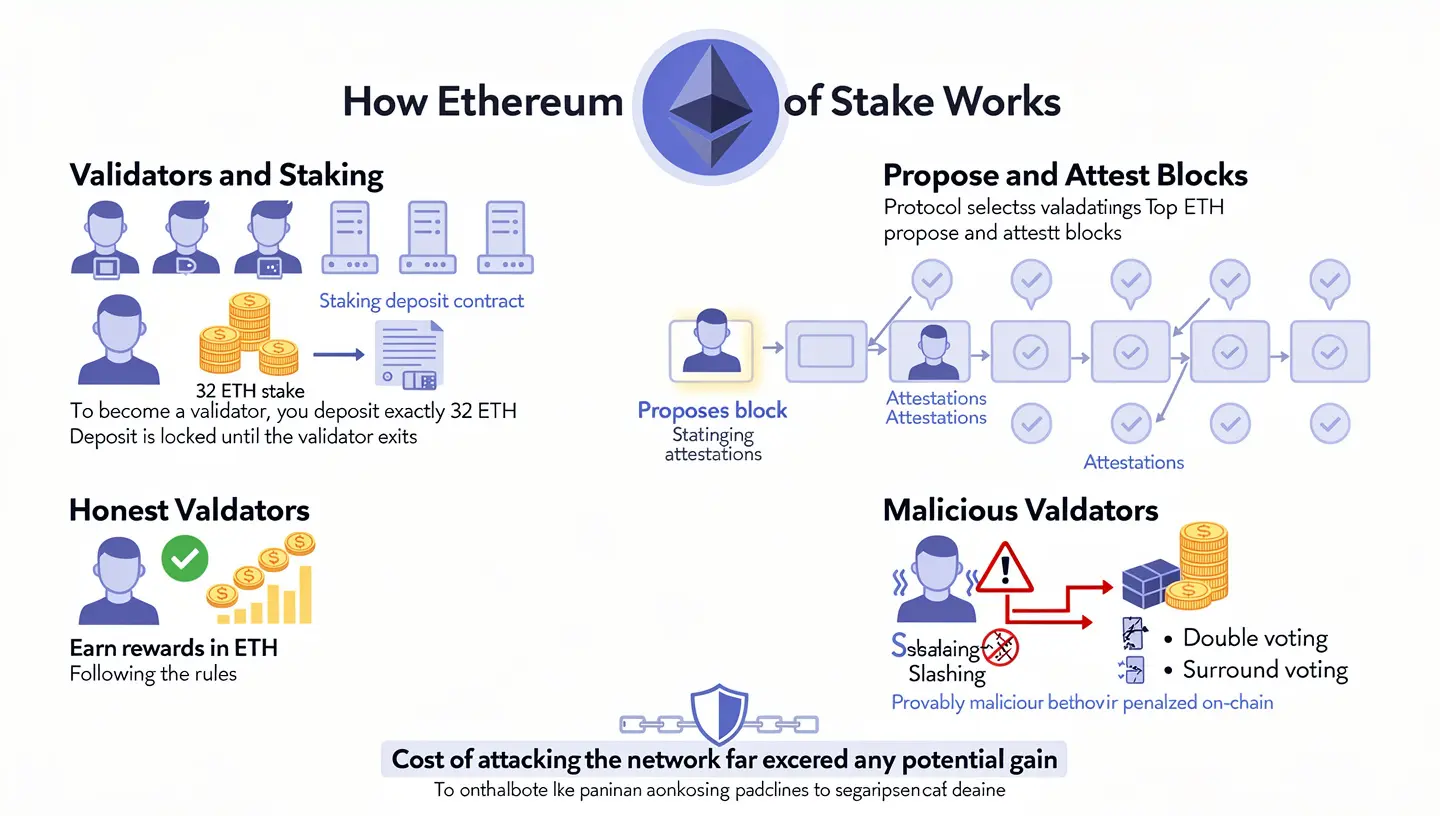
Under proof of stake, the network is secured by validators who have deposited ETH into the staking contract. The protocol selects validators to propose and attest to blocks. Honest validators earn rewards in ETH. Validators who break the rules lose a portion of their staked ETH through a process called slashing. The entire system is designed so that the cost of attacking the network far exceeds any potential gain.
Validators, stakes, and the 32 ETH requirement
To become a validator, a user deposits exactly 32 ETH into the staking deposit contract. That deposit is locked and cannot be withdrawn until the validator exits. The 32 ETH minimum was not chosen arbitrarily. It is large enough to make the financial penalty for misbehaviour meaningful, but not so large that only institutions can participate.
Each validator node performs two main duties. First, it proposes blocks when selected. Second, it sends attestations confirming that blocks proposed by other validators are valid. Time on the Beacon Chain is divided into slots of 12 seconds each. Every 32 slots form an epoch, roughly 6.4 minutes. In each slot, one validator is selected to propose a block, and a committee of validators is assigned to attest to it. Completing these duties on time earns rewards. Missing them results in small penalties.
How validators are randomly selected: RANDAO explained
The protocol assigns validators to slots using a system called RANDAO, which generates on-chain randomness by combining contributions from many validators. No single validator can predict far in advance when it will be selected to propose a block. Each validator contributes a value when it proposes a block, and those values are mixed together to produce the randomness used for future slot assignments.
This unpredictability is a security feature. Because a validator cannot know its upcoming proposer slot until very close to the moment, an attacker cannot target a specific validator at a specific time. Committees of roughly 128 validators are randomly selected to attest to each block. To corrupt a single committee, an attacker would need to control a large fraction of the total validator set. With over one million active validators on Ethereum, that committee size makes targeted manipulation statistically impractical.
Slashing: the penalty that keeps validators honest
Slashing is the protocol-enforced penalty for provably malicious behaviour. There are two main actions that trigger slashing: double voting (signing two different blocks for the same slot) and surround voting (signing attestations that contradict each other in a way that could enable a reorg). Both are detectable on-chain.
When a validator is slashed, it immediately loses at least one thirty-second of its stake. It is then removed from the active validator set after a delay of roughly 36 days, during which it continues to lose ETH. The penalty also scales with correlation: if many validators are slashed in the same period, the penalties are larger. This correlation penalty makes a coordinated attack significantly more expensive than a single incident.
A separate mechanism handles unintentional absence. The inactivity leak applies when a validator goes offline for an extended period during a time when the chain is failing to finalise. The offline validator slowly loses ETH until its balance drops to 16 ETH, at which point it is removed from the validator set. The inactivity leak ensures the network can recover even if a large portion of validators go offline simultaneously.
What changed after The Merge
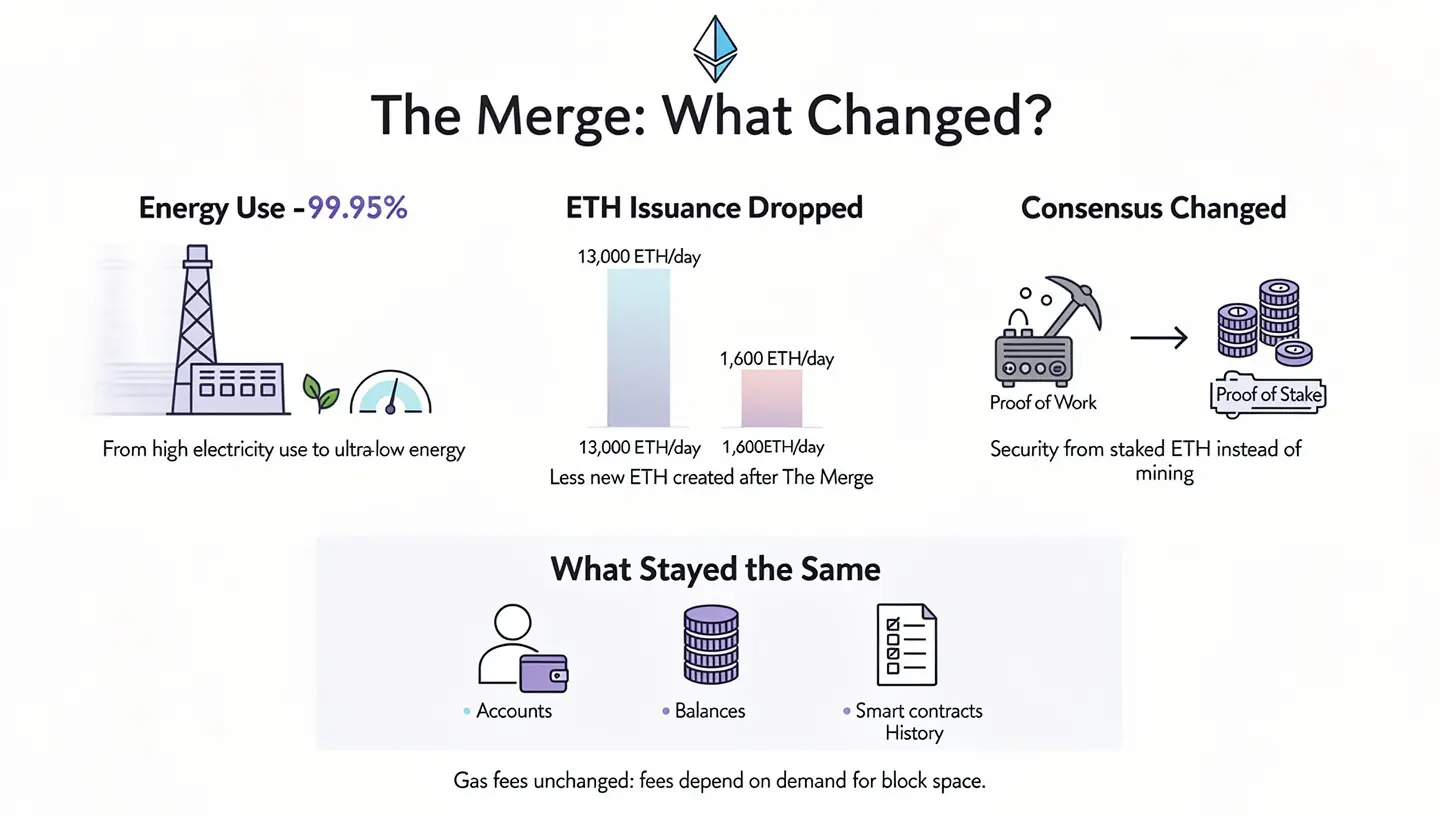
The Merge produced three changes that are observable and measurable: energy consumption fell dramatically, ETH issuance dropped sharply, and the consensus mechanism switched from computational work to staked capital. Everything else stayed the same. Accounts, balances, smart contracts, and transaction history were unaffected.
Energy consumption fell by 99.95%
Under proof of work, energy consumption was not a side effect. It was the mechanism. Making it expensive to mine blocks made it expensive to attack the chain. Miners burned electricity to prove they had done the work. That physical cost was the barrier to entry for attackers.
Proof of stake replaces that physical cost with financial collateral. The result was a reduction in Ethereum network energy consumption of approximately 99.95%. The Cambridge Centre for Alternative Finance estimated that Ethereum consumed electricity comparable to a mid-sized country before The Merge. The carbon footprint associated with running Ethereum nodes fell to a level comparable to a small business. The Beacon Chain achieved the same security guarantee through a fundamentally different mechanism: ETH at risk rather than electricity burned.
ETH issuance dropped: the triple halvening
Before The Merge, ETH issuance to miners ran at approximately 13,000 ETH per day. After The Merge, ETH issuance to validators dropped to approximately 1,600 ETH per day. That is a reduction of roughly 88 percent in new ETH entering circulation. Community observers called it the triple halvening because the reduction in new supply was roughly equivalent to three Bitcoin halvings occurring simultaneously. The term triple halvening captures the scale of the change: what took Bitcoin three separate four-year cycles to achieve, The Merge accomplished in a single upgrade.
The issuance drop combined with EIP-1559, which was introduced in August 2021, to change the supply dynamics of ETH. EIP-1559 burns the base fee paid on every transaction, permanently removing that ETH from circulation. In periods of high network activity, the amount of ETH burned can exceed the amount issued to validators, making Ethereum net deflationary. The tracker at ultrasound.money shows the live issuance and burn rate. To understand how ETH functions as the currency that pays for all of this activity, the guide on what ETH is explains its role in detail.
What did not change after The Merge
Gas fees did not fall after The Merge, and Ethereum developers never claimed they would. Gas fees are determined by demand for block space. The Merge changed the consensus mechanism, not the amount of block space available per block. High demand still produces high fees. Low demand still produces low fees. Anyone who told ETH holders that fees would drop after The Merge was mistaken.
Transaction speed changed only marginally. Block time under proof of work averaged around 13 seconds. Under proof of stake it is a fixed 12 seconds per slot. Finality, the point at which a block cannot be reversed without destroying enormous amounts of staked ETH, now arrives after two epochs, roughly 12 to 15 minutes. That is actually stronger finality than proof of work provided.
ETH holders did not need to take any action. No migration. No token swap. No new address. ETH is ETH before and after The Merge. Any service claiming to offer an ETH2 token swap was and remains a scam.
How to stake ETH: your options explained
Anyone who holds ETH can participate in securing the network through Ethereum staking. The options range from running a solo validator node to depositing ETH into a liquid staking protocol.
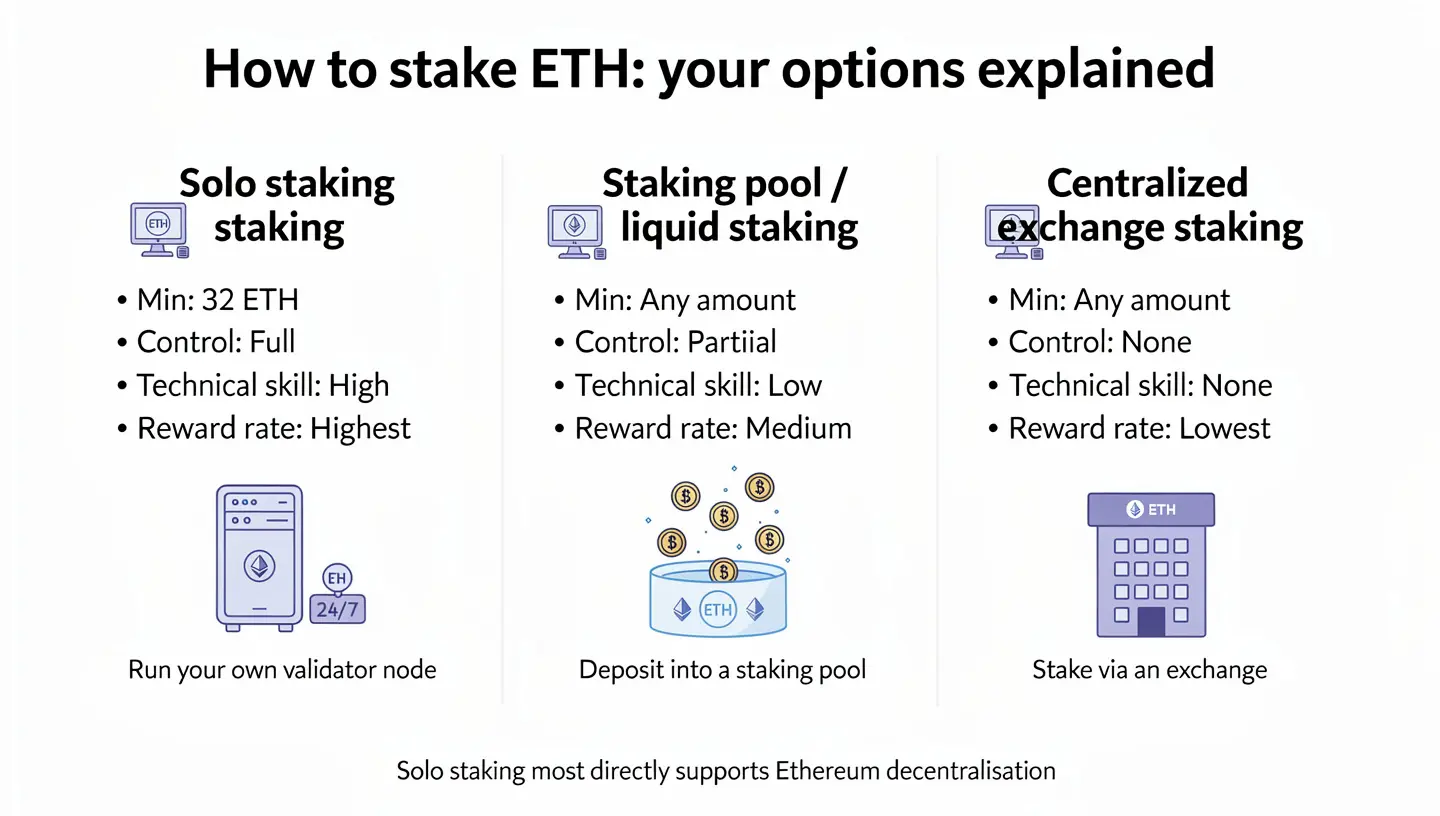
Each option involves a different tradeoff between control, reward rate, capital requirement, and technical complexity.
| Method | Min ETH | Control | Technical skill | Reward rate |
|---|---|---|---|---|
| Solo staking | 32 ETH | Full | High | Highest |
| Staking pool / liquid staking | Any amount | Partial | Low | Medium |
| Centralised exchange staking | Any amount | None | None | Lowest |
Solo staking: running your own validator
Solo staking means depositing 32 ETH and running a validator node yourself. The node requires a machine that is online 24 hours a day, seven days a week. Minimum hardware requirements are approximately 16 GB of RAM, a 2 TB SSD, and a stable internet connection. The client software, an execution client paired with a consensus client, handles everything from syncing the chain to submitting attestations on time.
The rewards for solo staking are the highest of any staking method because there is no intermediary taking a fee. The risk is also the most direct: if the node goes offline for an extended period, the inactivity leak mechanism slowly reduces the validator balance. Running a solo validator is the option that most directly supports the decentralisation of the network.
Staking pools and liquid staking
For ETH holders below the 32 ETH threshold, or those without the technical background to run a node, staking pools aggregate ETH from many participants and operate validators on their behalf. The participant receives a share of the staking rewards proportional to their deposit. Staking pools lower the barrier to entry significantly: a holder with 0.1 ETH can participate in Ethereum staking through a pool.
Liquid staking protocols take this a step further. When a user deposits ETH into a liquid staking protocol, they receive a receipt token in return. Lido issues stETH. Rocket Pool issues rETH. These tokens accrue staking rewards over time and can be used across DeFi protocols while the underlying ETH remains staked. Liquid staking lets a holder earn validator rewards without locking up capital that cannot be deployed elsewhere. To understand how smart contracts make this possible, the guide on what smart contracts are explains the mechanics.
One risk worth noting: Lido controls approximately 30 percent of all staked ETH as of 2024. That concentration means a single protocol has significant influence over a large share of the validator set, which raises centralisation concerns for the network.
Centralised exchange staking
Coinbase, Binance, and Kraken all offer staking services where the exchange handles the validator operation. The user deposits ETH and receives staking rewards minus the exchange fee. This is the simplest option but comes with a tradeoff: the exchange holds the private keys. The user does not control the validator. In a custodial arrangement, the exchange is the validator, not the depositor. The reward rate is typically the lowest of the three options because the exchange takes a cut.
What came after The Merge: the Ethereum roadmap
The Merge was not the final destination. It was a prerequisite for the upgrades that followed. Vitalik Buterin described the full Ethereum roadmap as a sequence of phases: the Merge, the Surge, the Scourge, the Verge, the Purge, and the Splurge.
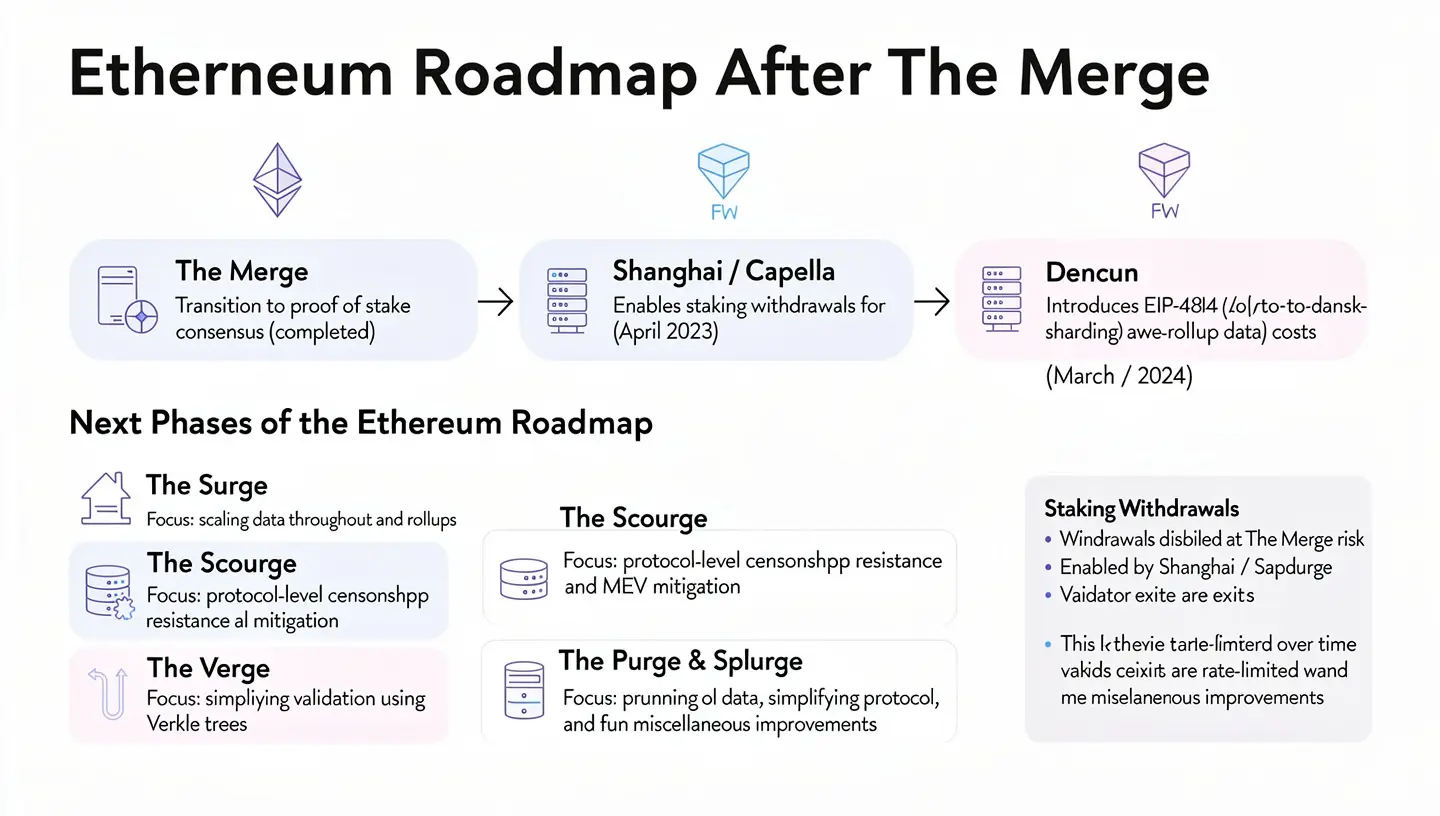
The Merge completed the transition to proof of stake. Each subsequent phase targets a different aspect of scaling, decentralisation, or simplification.
The Shanghai upgrade and staking withdrawals
The Merge deliberately excluded the ability to withdraw staked ETH. Keeping the scope narrow reduced the risk of a failed upgrade. Validators who staked ETH at The Merge or earlier had to wait until the Shanghai upgrade, also called Capella on the consensus layer, which activated in April 2023.
The Shanghai upgrade enabled staking withdrawals for the first time. There was significant concern before the upgrade that validators would rush to exit and sell, crashing the ETH price. That did not happen. Validator exits are rate-limited by the protocol: at the time of the Shanghai upgrade, roughly 57,600 ETH per day could exit via staking withdrawals, a figure that adjusts based on the total number of active validators. The queue system means a mass exit would take months, not days.
Dencun, EIP-4844, and what comes next
The Dencun upgrade in March 2024 introduced EIP-4844, which added a new data type called blobs to Ethereum blocks. Blobs are large chunks of data that Layer 2 networks use to post transaction batches to Ethereum Mainnet at significantly lower cost than using standard calldata. After Dencun, fees on rollup networks like Arbitrum, Optimism, and Base fell by 90 to 99 percent in many cases.
Full sharding, under the name danksharding, is still on the Ethereum roadmap. The Surge phase targets maximal scaling through sharding and rollups. The Verge targets statelessness through Verkle trees. The Purge targets simplification by removing historical data requirements. The Splurge covers everything else. The Merge unlocked all of these. Without proof of stake, none of the subsequent upgrades would be feasible at the scale Ethereum is targeting.
Ethereum proof of stake vs other blockchains
Not all proof-of-stake implementations are equal. The number of validators, the minimum stake, the hardware requirements for running a node, and the slashing rules all differ significantly between networks. These differences produce very different levels of decentralisation.
| Network | Active validators | Min stake | Consensus model | Decentralisation |
|---|---|---|---|---|
| Ethereum | 1,000,000+ | 32 ETH | Gasper (LMD-GHOST + Casper FFG) | High |
| Solana | ~1,500 active | No minimum | Tower BFT + Proof of History | Medium |
| BNB Chain | 21 | High BNB requirement | Proof of Staked Authority | Low |
| Cardano | ~3,000 stake pools | ADA delegation (no fixed min) | Ouroboros | Medium-High |
Solana has no minimum stake but validator hardware requirements are high, limiting who can run a node in practice. BNB Chain uses proof-of-staked-authority with 21 validators, making it faster but significantly more centralised than Ethereum. Cardano uses the Ouroboros protocol, which allows ADA holders to delegate stake to pool operators without running their own node. Ethereum stands apart primarily because of the scale of its validator set: over one million active validators make it the most decentralised proof-of-stake network by that measure.
For background on how the creator of Ethereum designed the network with long-term decentralisation in mind, the article on who created Ethereum covers Vitalik Buterin and the founding team in detail.
FAQ
What is Ethereum proof of stake?
Proof of stake is the consensus mechanism Ethereum has used since September 15, 2022. Under proof of stake, validators deposit 32 ETH as collateral and are selected to propose and attest to blocks. Honest validators earn ETH rewards. Validators that behave dishonestly lose a portion of their staked ETH through slashing. The staked ETH replaces electricity consumption as the cost that secures the network.
What is the Ethereum Merge?
The Merge was the upgrade on September 15, 2022 that joined the original Ethereum Mainnet execution layer with the Beacon Chain consensus layer. It switched Ethereum from proof of work to proof of stake. Mining was permanently retired. All transaction history, ETH balances, and smart contracts carried over without change. The Merge reduced Ethereum energy consumption by approximately 99.95 percent.
How does Ethereum proof of stake differ from proof of work?
Proof of work requires miners to expend electricity solving a computational puzzle to earn the right to produce a block. Proof of stake requires validators to lock up ETH as collateral. The security of proof of work comes from physical cost: electricity and hardware. The security of proof of stake comes from financial cost: ETH that can be slashed. Ethereum consumed electricity comparable to a mid-sized country under proof of work. Under proof of stake, energy consumption fell by 99.95 percent.
What is a validator on Ethereum?
A validator is a node that participates in Ethereum proof-of-stake consensus. To become a validator, a user deposits 32 ETH into the staking contract and runs client software that stays online and performs two duties: proposing blocks when selected and attesting to blocks proposed by others. Validators earn ETH rewards for completing these duties correctly and on time. They lose ETH through slashing if they behave dishonestly or through the inactivity leak if they go offline for extended periods.
Why do you need 32 ETH to stake?
The 32 ETH minimum was chosen to balance two competing goals. It needs to be large enough that the financial penalty for slashing is meaningful and deters attacks. It also needs to be small enough that individual participants, not only institutions, can run validators. At current prices, 32 ETH represents a significant financial commitment. That commitment is the economic security that makes attacking the network prohibitively expensive when multiplied across over one million active validators.
What is slashing in Ethereum proof of stake?
Slashing is the penalty applied to validators who commit provably malicious acts, such as double voting or signing contradictory attestations. A slashed validator immediately loses at least one thirty-second of its staked ETH and is removed from the active validator set after a delay of roughly 36 days. During that period it continues to lose ETH. If many validators are slashed in the same window, the correlation penalty increases the losses further. Slashing makes coordinated attacks on the network extremely costly.
Did The Merge lower Ethereum gas fees?
No. The Merge changed the consensus mechanism, not the amount of block space available per block. Gas fees on Ethereum are determined by demand for that block space. When demand is high, fees are high. The Merge was never designed to lower gas fees, and Ethereum developers made no such claim. Gas fees on Ethereum mainnet fell meaningfully only after the Dencun upgrade in 2024, which reduced the cost for Layer 2 networks to post data to Ethereum. For a full explanation of how gas fees work, see the guide on Ethereum gas fees.
What happened to Ethereum miners after The Merge?
Ethereum miners lost their block rewards the moment The Merge activated. Many shifted their GPU hardware to mine other proof-of-work networks. Ethereum Classic, which shares the same mining algorithm Ethereum used before The Merge, saw a significant increase in hashrate in the days following September 15, 2022. Some miners sold their GPU hardware. The GPU market saw a notable price drop in the months after The Merge as former Ethereum mining hardware entered the second-hand market.