ETH, also called Ether, is the native token of the Ethereum network. It is not just a cryptocurrency in the Bitcoin sense. ETH serves as fuel for every operation on Ethereum – from sending tokens and running applications to securing the network itself. Without ETH, nothing on Ethereum moves. Every transaction, every smart contract call, every NFT mint, every DeFi interaction requires ETH to pay the network. That single fact explains most of what ETH is used for and why its demand is tied directly to how much activity happens on the network.
ETH vs Ethereum: Why the Distinction Matters
People use “Ethereum” and “ETH” interchangeably, but they refer to different things. Understanding the difference helps clarify why ETH has value and what it actually does.
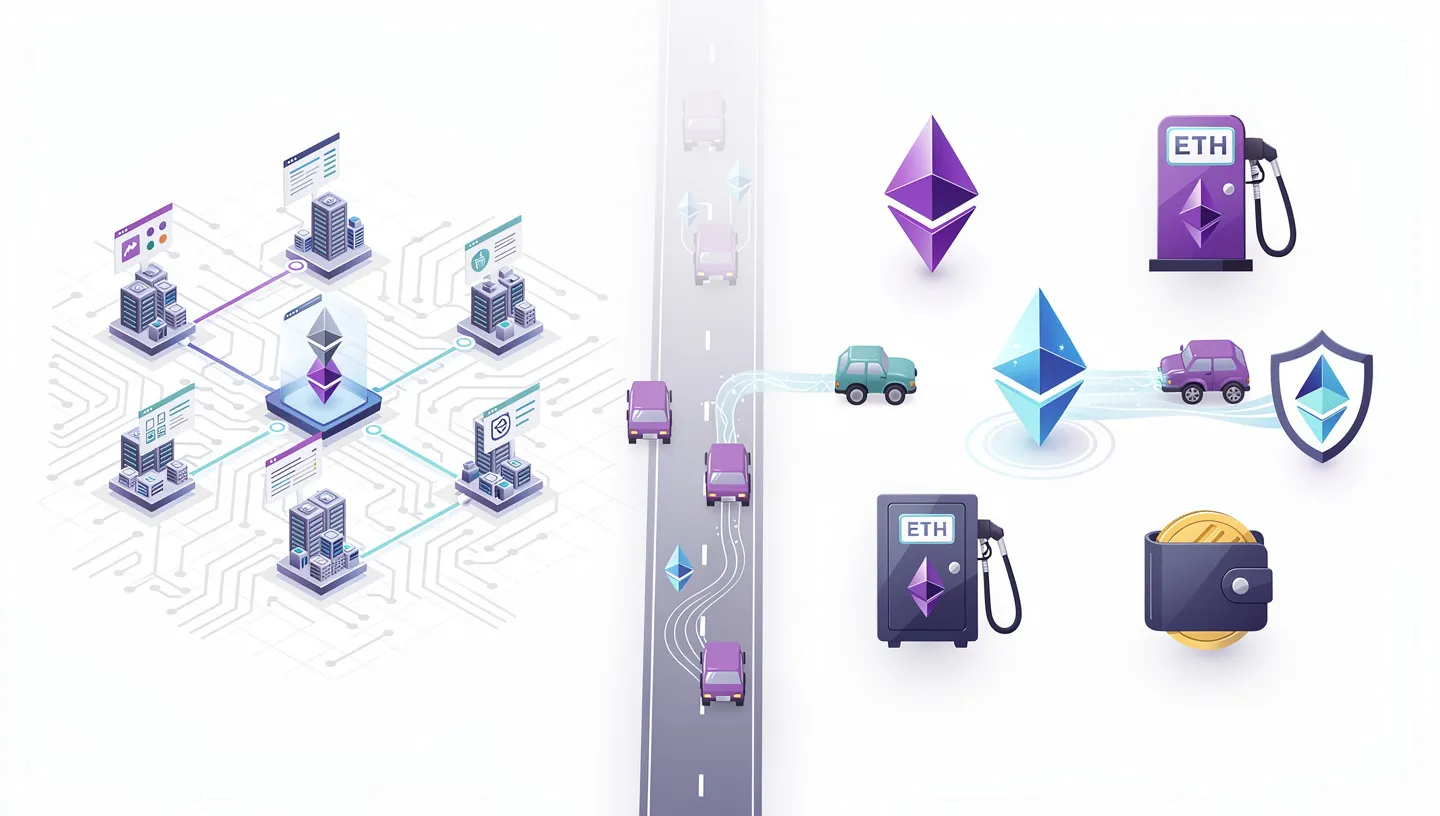
Ethereum is the network – ETH is the fuel
Ethereum is the platform: a public, programmable blockchain that anyone can build on. ETH is the token that powers it. Think of Ethereum as the highway and ETH as the fuel every vehicle needs to drive on it. No one builds an application on Ethereum and skips ETH – the two are inseparable. Developers deploy code on Ethereum. Users interact with that code. Every one of those interactions costs ETH. This relationship is what makes ETH structurally different from most other tokens, which can often be swapped out or ignored. ETH cannot be ignored on Ethereum because the protocol itself requires it.
What Ether actually is
Ether plays three distinct roles. First, it is the fee currency – you pay gas fees in ETH for every transaction. Second, it is the collateral currency – validators lock up ETH to participate in securing the network. Third, it functions as digital money – you can send it to anyone in the world, hold it, or spend it at merchants that accept it. Most tokens on Ethereum fill one role. ETH fills all three simultaneously, which is why understanding what Ether is is the starting point for understanding what the broader network does.
Paying Gas Fees: The Core Use of ETH
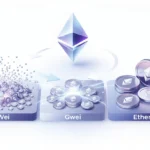
Gas fees are the primary use of ETH by volume. Every single operation on Ethereum – sending ETH, swapping tokens, minting an NFT, depositing into a lending protocol – requires gas. Gas is the unit that measures how much computational work a transaction requires. More complex operations require more gas. You pay for that gas in ETH.
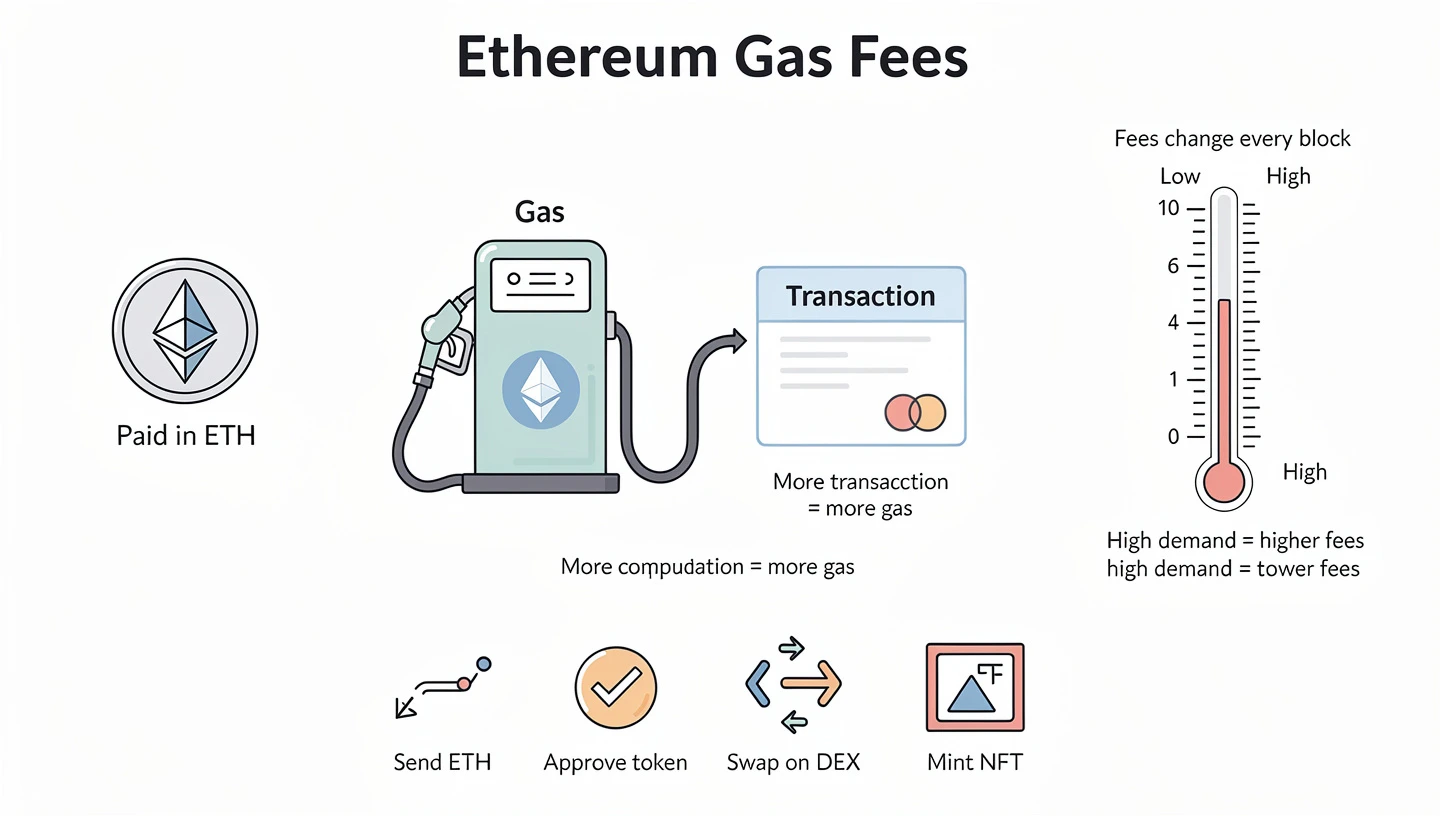
What gas fees are and why ETH pays them
The gas system exists to price computation fairly and prevent spam. If transactions were free, anyone could flood the network with junk data at no cost. Gas gives every transaction a real cost, which keeps the network running cleanly. The amount of ETH you pay depends on two things: how much gas your transaction uses and what the current gas price is. Gas prices move with network demand – during busy periods, prices rise because users compete to get their transactions included in the next block. During quiet periods, fees drop significantly.
Understanding how Ethereum gas fees work in practice helps you time transactions and choose between mainnet and cheaper layer-2 alternatives. The full mechanics – base fee, priority fee, and how EIP-1559 changed fee pricing – are worth knowing before you start transacting regularly.
How much does sending ETH actually cost?
Costs vary by transaction type. Here is a reference from current mainnet data:
| Transaction type | Estimated cost | Gas units used |
|---|---|---|
| Sending ETH to another address | ~$0.09 | 21,000 gas |
| Swapping tokens on a DEX | $0.56 – $0.67 | 100,000 – 150,000 gas |
| Complex DeFi or NFT interaction | $0.90 – $2.20 | 200,000 – 500,000 gas |
These numbers reflect mainnet costs during moderate activity. During peak congestion – major NFT launches, token airdrops, protocol liquidations – fees can spike well above these ranges. The solution most users reach for is layer-2 networks, which handle the same operations for a fraction of the cost.
Layer-2 networks and cheaper gas – how Arbitrum and Optimism fit in
Layer-2 networks like Arbitrum, Optimism, and Coinbase’s Base process transactions off the main Ethereum chain and post the data back to Ethereum for settlement. The result is fees below $0.01 for most operations while still inheriting Ethereum’s security. ETH remains the gas token on most layer-2 networks, so demand for ETH continues even when users move off mainnet for day-to-day transactions. If you want to move funds across networks, the guide on bridging ETH to layer 2 covers the mechanics and which bridges are considered established.
Staking: How ETH Secures the Network and Earns Rewards
Since The Merge in September 2022, Ethereum no longer uses mining to secure itself. It uses Proof of Stake, where validators lock up ETH as collateral. If they validate honestly, they earn rewards. If they try to cheat the network, a portion of their staked ETH gets destroyed through a mechanism called slashing. The requirement to put real money at risk is what keeps the system honest.
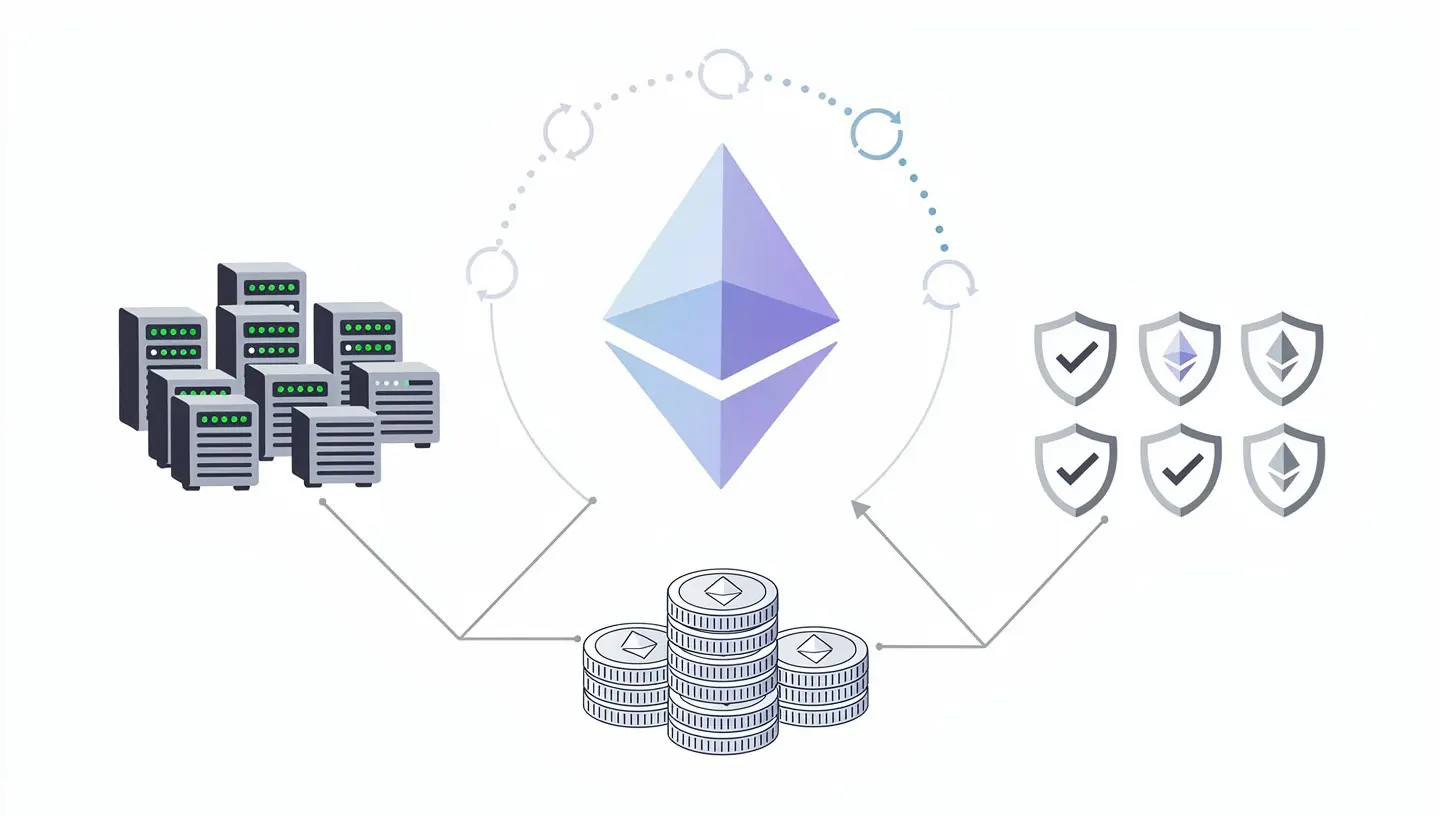
How staking replaced mining after the Merge
Under the old Proof of Work system, miners competed to solve mathematical puzzles using electricity and hardware. Under Proof of Stake, validators are selected to propose and attest to blocks based on how much ETH they have staked. The transition reduced Ethereum’s energy use by approximately 99.95%. It also changed how new ETH enters circulation – instead of going to miners, new ETH goes to validators as staking rewards. The full mechanics of the current consensus model are covered in the guide on Ethereum Proof of Stake.
Solo staking, liquid staking, and exchange staking – what each means
| Method | Minimum ETH | Annual yield | Technical effort | Control |
|---|---|---|---|---|
| Solo staking | 32 ETH | ~3.5% | High (node setup) | Full |
| Lido (stETH) | No minimum | ~3-4% | Low | None (trust protocol) |
| Rocket Pool (rETH) | 0.01 ETH | ~3-4% | Low | Partial |
| Exchange staking | No minimum | 2-4% | Very low | None (custodial) |
Solo staking requires 32 ETH and a computer running 24/7 with sufficient storage and memory to keep the validator node active. The technical barrier is real but the rewards go directly to you with no platform fees. Liquid staking protocols like Lido and Rocket Pool have no practical minimum and handle the technical side for you, charging a percentage of rewards as a fee. Exchange staking is the simplest entry point but means the exchange holds your ETH and your private keys – a custodial arrangement that carries platform risk.
stETH and rETH – liquid staking tokens explained
When you stake through Lido, you receive stETH – a token that represents your staked ETH and accumulates staking rewards over time. Rocket Pool gives you rETH, which works on the same principle. Both tokens can be used across DeFi while your underlying ETH remains staked. You can lend stETH as collateral, provide liquidity with it, or simply hold it while it grows. This solves the liquidity problem of locking ETH in a solo validator, where withdrawals go into a queue that can take days. Step-by-step instructions for each method are in the guide on how to stake Ethereum.
DeFi: What ETH Does in Decentralized Finance
DeFi – decentralized finance – is the category of applications that replicate financial services without banks, brokers, or payment processors. Lending, borrowing, trading, and earning interest all happen through smart contracts on Ethereum. ETH sits at the center of it: as the gas currency for every transaction, as collateral for loans, and as the base trading pair on most decentralized exchanges.
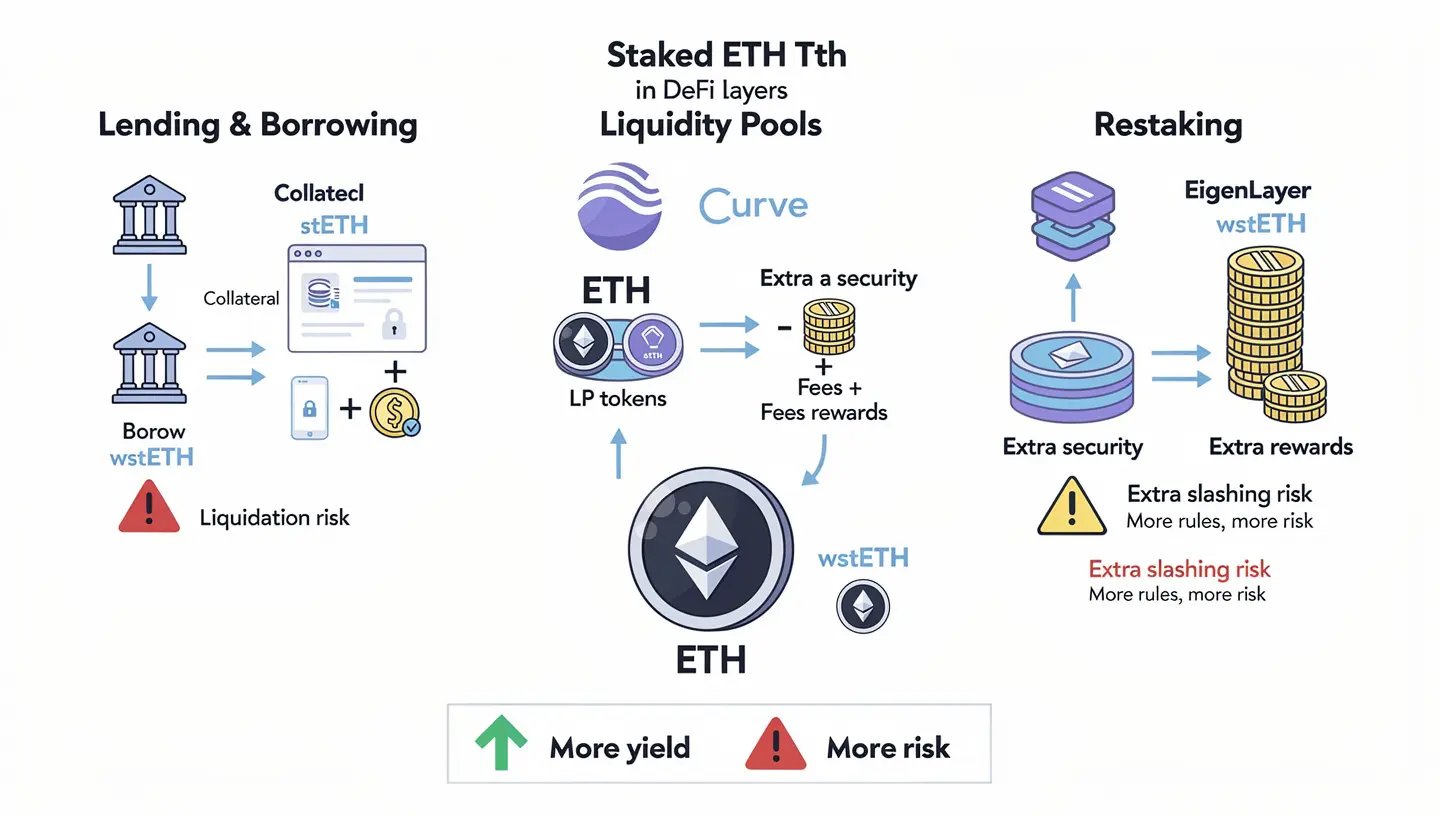
Lending and borrowing against ETH
Protocols like Aave, Compound, and Morpho let you deposit ETH as collateral and borrow stablecoins against it without selling your ETH. If you think ETH will appreciate, you can borrow USDC against it, use the USDC for expenses or other opportunities, and repay the loan later. The interest rate is set algorithmically based on supply and demand in the lending pool. No credit score, no paperwork, no approval process. You also earn interest when you deposit ETH or stablecoins into lending pools – other borrowers pay that interest to you.
Decentralized exchanges and token swaps
Platforms like Uniswap, Curve, and 1inch let you swap any ERC-20 token for any other without an intermediary taking custody of your assets. The swaps happen through liquidity pools – pools of token pairs funded by other users who earn a share of trading fees in return. ETH is the base pair for the majority of token pairs on Ethereum, which means most swaps involve ETH somewhere in the route even if you are swapping between two other tokens. The Ethereum Virtual Machine executes the swap logic, and understanding how it processes contract instructions helps explain why complex swaps cost more gas than simple transfers. The full picture is in the Ethereum Virtual Machine overview.
Yield farming and liquidity provision
Beyond lending and swapping, DeFi users earn yield by providing liquidity to trading pools. You deposit two tokens into a pool – say ETH and USDC – and earn a percentage of every trade that goes through that pool. This is called liquidity provision. The returns can be higher than staking, but the risks are also real. Impermanent loss occurs when the price of your deposited tokens moves significantly relative to each other, leaving you with less value than if you had simply held them. Smart contract risk is the other major factor – if the protocol’s code has a vulnerability, funds in the pool can be drained. Most serious DeFi users limit exposure to protocols with long track records and multiple independent audits.
Stablecoins on Ethereum: Why USDC and USDT Run on ETH
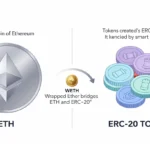
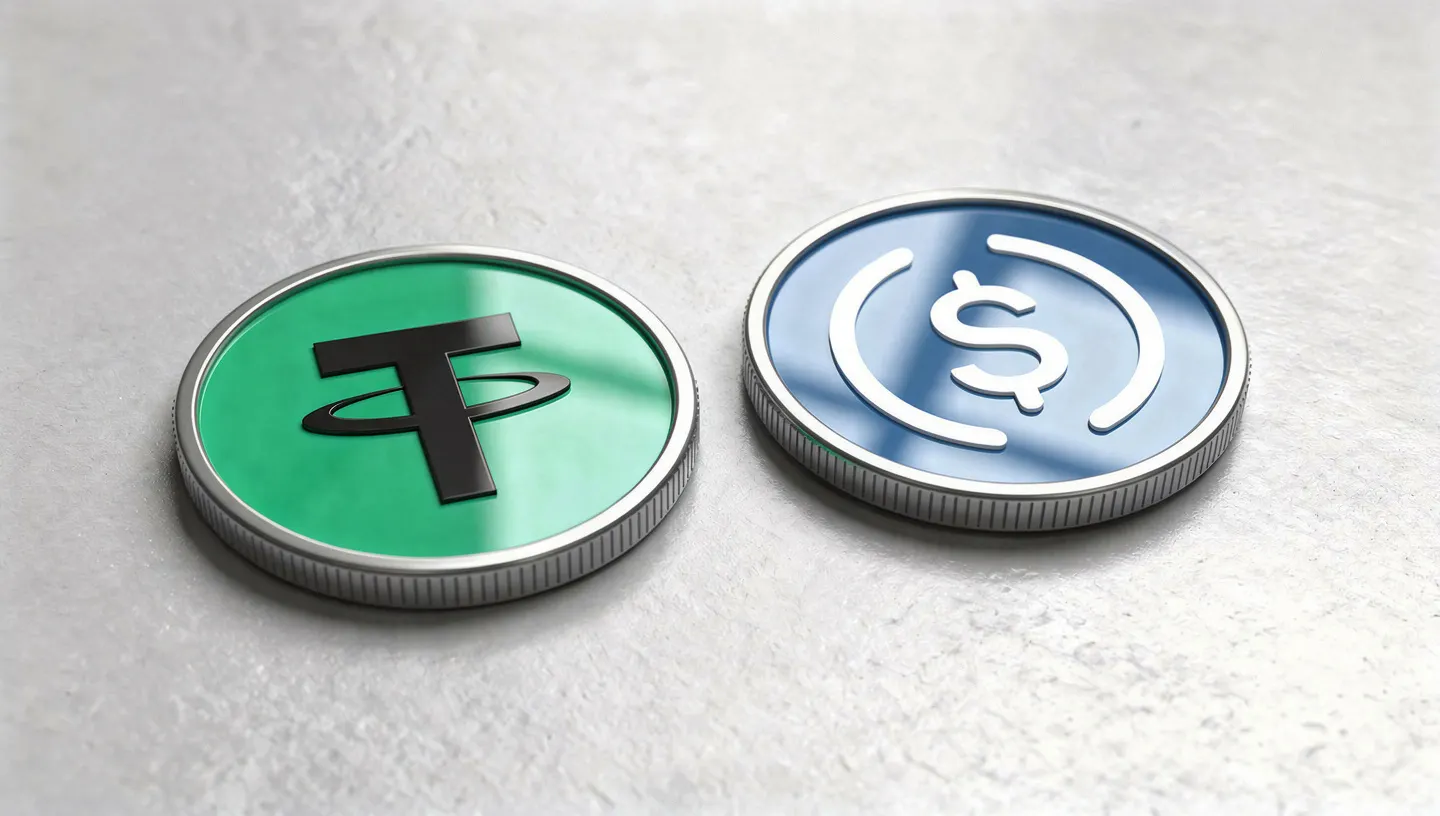
The largest stablecoins in the world – USDC (Circle), USDT (Tether), and DAI (Sky/MakerDAO) – are ERC-20 tokens on Ethereum. This is not incidental. Ethereum is the settlement layer these issuers chose because of its security, liquidity, and developer infrastructure. In August 2025, the volume of transactions on the Ethereum network reached $320 billion according to The Block – a four-year high, driven largely by stablecoin transfers.
Why the world’s biggest stablecoins live on Ethereum
Ethereum offers stablecoin issuers something no other network has matched at scale: a combination of security, deep liquidity, and a developer base that builds integrations. Every major DeFi protocol accepts USDC and USDT as first-class assets. Every major exchange supports ERC-20 withdrawals. The network effect that has built up around Ethereum as a stablecoin home is enormous and self-reinforcing – the more protocols accept USDC on Ethereum, the more valuable it is to issue USDC on Ethereum.
What ETH has to do with stablecoin transactions
Here is the part most people miss: every USDC transfer on Ethereum costs gas fees paid in ETH. A user who holds nothing but USDC still needs ETH in their wallet to move that USDC anywhere. This creates a structural source of ETH demand that is entirely independent of ETH’s price or speculative interest. As long as stablecoins settle on Ethereum, ETH demand from gas exists. McKinsey projects that tokenized real-world assets – the next wave of stablecoin-adjacent issuance – could reach $1.7 trillion by 2030, which would represent a significant increase in on-chain settlement activity and by extension ETH gas demand.
NFTs: How ETH Underpins Digital Ownership
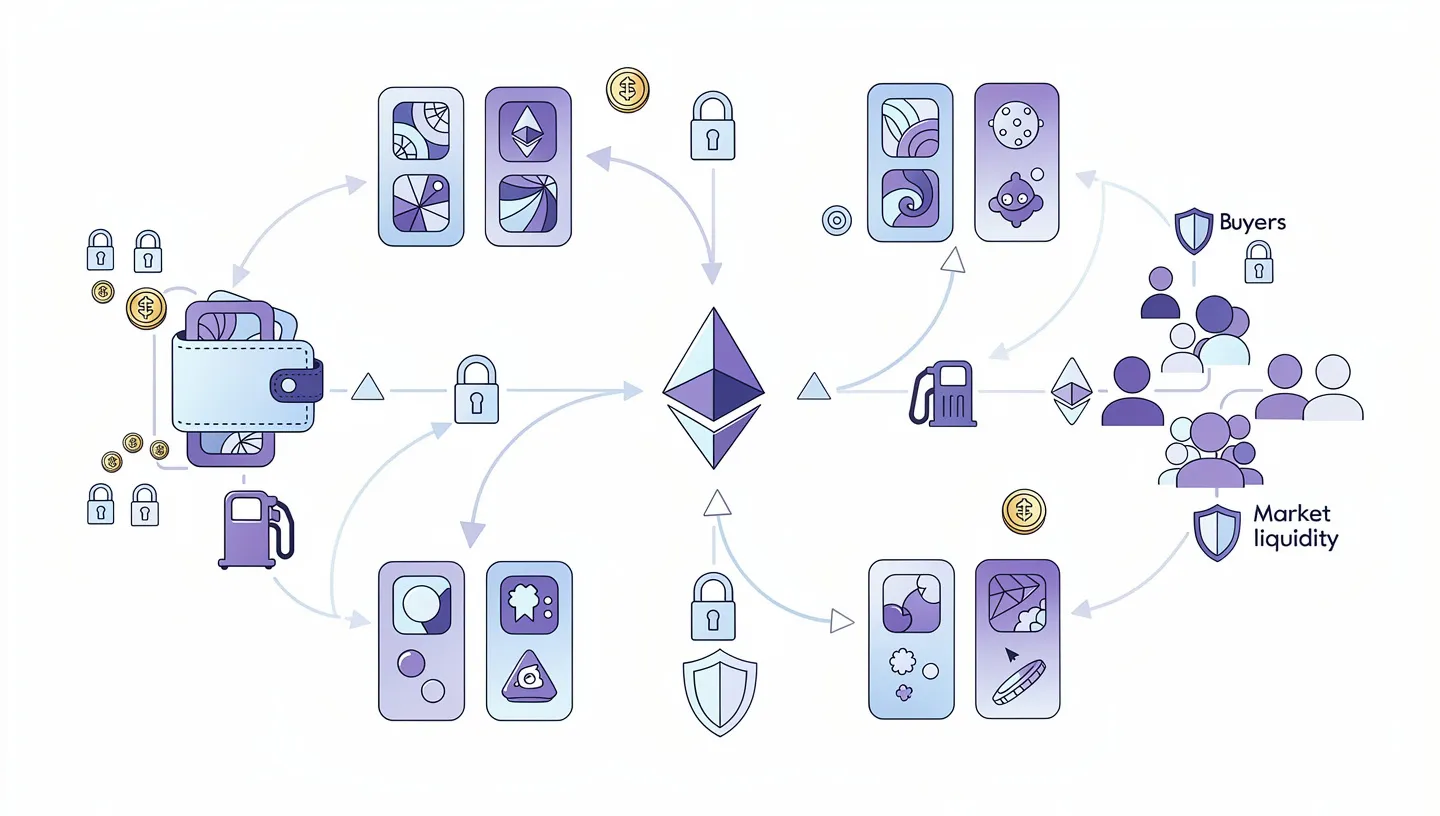
Non-fungible tokens are the mechanism by which Ethereum records unique ownership on-chain. Unlike ERC-20 tokens where each unit is identical, NFTs use the ERC-721 and ERC-1155 standards to create tokens where each one is distinct. Every NFT mint is a transaction on Ethereum. Every transfer costs gas. Every sale through a marketplace like OpenSea or Blur requires ETH for the gas fee, even if the sale price is denominated in a stablecoin.
What NFTs actually are and why they need ETH
The NFT is a record on Ethereum’s blockchain that says: this specific token ID belongs to this specific address, and it points to this specific piece of data. The blockchain provides the provenance – a verifiable, tamper-proof history of who has owned the token from the moment it was created. Because Ethereum is the dominant chain for NFTs, the market liquidity and tooling are concentrated there. Competing chains offer cheaper fees but thinner markets and fewer buyers.
Beyond art – where NFTs are used now
The art and collectible phase brought NFTs into mainstream attention, but the applications have moved well beyond it. Gaming uses NFTs for in-game item ownership where players can trade assets freely rather than being locked into one game’s economy. Event ticketing experiments with NFTs to prevent scalping and add post-event utility to ticket holders. Membership communities use token-gated access where holding a specific NFT unlocks services, forums, or events. Real estate and fund tokenization uses NFT-like structures to represent fractional ownership of physical assets – the boundary between NFTs and real-world asset tokenization is blurring as these use cases converge.
ETH as Digital Money: Payments, Transfers, and Store of Value
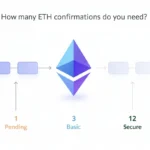
Beyond its role as gas and collateral, ETH functions as money in the direct sense: you can send it to anyone with an Ethereum address, anywhere in the world, without a bank account, without currency conversion, and without waiting for banking hours. A transaction confirms in under 30 seconds and reaches finality after roughly 15 minutes – faster than international wire transfers that take one to three business days and come with correspondent bank fees.
Sending ETH across borders without banks
For cross-border payments, ETH removes intermediaries that traditionally add cost and delay. Companies like Aave, Compound, and a growing number of payment platforms use Ethereum to move value across jurisdictions in real time. Individuals use it for remittances to family members in countries where banking infrastructure is limited or where local currency is unstable. The network does not care about your nationality, your credit history, or your relationship with any financial institution. You need a wallet and an internet connection. The practical steps for moving ETH to someone else are covered in the guide on how to sell Ethereum, which also covers converting back to local currency after a transfer.
ETH as a store of value – the investment case
ETH functions differently from Bitcoin as an investment. Bitcoin’s case rests almost entirely on scarcity – a fixed supply of 21 million coins. ETH has no hard cap but has a deflationary mechanism built into its fee structure. Under EIP-1559, the base fee of every transaction is burned rather than paid to validators. When the network is busy enough, the ETH burned exceeds the ETH issued as staking rewards, making the total supply shrink. During the most active periods since the Merge, ETH has been net deflationary.
ETH also offers yield that Bitcoin does not. Staking produces 3-4% annually on held ETH, which means long-term holders can earn returns on their position rather than simply waiting for price appreciation. Institutional interest has formalized with the approval of ETH ETFs, and companies are beginning to hold ETH on their treasury balance sheets as they do with Bitcoin. If you are considering buying ETH for the first time, the guide on how to buy Ethereum covers the steps from choosing an exchange to moving funds to a wallet.
Where you can actually spend or use ETH today
Merchant acceptance of ETH has grown alongside layer-2 adoption. Coinbase Commerce, BitPay, and similar processors allow businesses to accept ETH and ERC-20 tokens, converting to local currency at point of sale. PayPal allows users to buy, hold, and send ETH. Robinhood has integrated Ethereum-based assets. On layer-2 networks specifically, the low transaction costs make small ETH payments practical for the first time – sending $5 worth of ETH for a service no longer gets eaten by a $2 gas fee.
Real-World Asset Tokenization: The Biggest New Use Case for ETH
The most significant emerging use for Ethereum is the tokenization of real-world assets – converting financial instruments, commodities, and property into digital tokens that settle on-chain. This is not a speculative future. It is happening now, with major institutions leading the adoption.
What tokenization means and why Ethereum leads
Tokenization takes an asset – a government bond, a share of real estate, a gold bar, a corporate loan – and creates a digital representation of it on a blockchain. The token can be traded, transferred, and used as collateral without the friction of traditional settlement systems. Ethereum leads this category because it has the deepest developer infrastructure, the most established DeFi protocols for token integration, and the longest track record of securing large amounts of value.
BlackRock launched its BUIDL tokenized money market fund on Ethereum, reaching $500 million in assets within weeks of launch. Franklin Templeton tokenized a US government money market fund on Ethereum. JPMorgan runs an inter-bank payment network using a permissioned version of Ethereum with more than 300 participating banks. Microsoft and LVMH adopted Enterprise Ethereum for luxury goods provenance tracking. These are not experiments – they are live operations handling real money. The smart contract infrastructure that makes this possible is the same infrastructure that powers DeFi and NFTs.
Who is already using Ethereum for real-world assets
Beyond BlackRock and Franklin Templeton, the pattern of institutional adoption is consistent. Robinhood lets users buy tokenized stocks on a layer-2 network built on Ethereum. Worldcoin, co-created by OpenAI’s Sam Altman, uses Ethereum as the anchor for identity verification at scale. Sony’s Soneium is an Ethereum layer-2 for gaming and digital collectibles. Coinbase built Base – its own layer-2 – on Ethereum’s infrastructure rather than starting a separate chain.
What this means for ETH demand
Every tokenized asset transaction settles through Ethereum and costs gas fees in ETH. As the volume of RWA transactions grows – McKinsey projects the tokenized asset market could reach $1.7 trillion by 2030 – the gas demand it creates scales with it. This is a fundamentally different demand driver from speculative trading. It is institutional use of ETH as operational infrastructure, which tends to be more stable and less price-sensitive than retail speculation.
DAOs and Governance: ETH in Decentralized Organizations
Decentralized Autonomous Organizations are one of the original use cases that the Ethereum whitepaper described in 2013. A DAO is an organization whose rules are encoded in smart contracts rather than legal documents. Decisions are made through token-based voting, and the treasury is held in a smart contract that releases funds only when governance conditions are met.
What a DAO is and how ETH fits in
In a DAO, holding the governance token gives you voting rights on proposals. Some DAOs use ETH directly as the governance token. Others issue their own governance token but hold their treasury in ETH because it is the most widely accepted and liquid asset on the network. MakerDAO (now Sky) uses ETH as collateral to mint the DAI stablecoin and is governed by MKR token holders. Uniswap, Compound, and Aave all operate as DAOs where token holders vote on protocol changes, fee structures, and treasury allocations worth hundreds of millions of dollars.
Enterprise Ethereum – large companies building on the network
The Enterprise Ethereum Alliance has over 200 member organizations including Samsung, JPMorgan, Mastercard, and Microsoft. These companies use permissioned versions of Ethereum – networks that use Ethereum’s technology but restrict who can participate as a validator. The Covantis initiative, set up by commodity trading institutions, runs post-trade processing for agricultural shipping transactions on Enterprise Ethereum. These permissioned networks often use ETH or ETH-equivalent tokens for gas, and they settle important transactions back to public Ethereum for final settlement. Understanding how Ethereum works at the protocol level helps explain why its architecture translates well to enterprise applications that need programmable settlement without trusting a central authority.
Frequently Asked Questions
What is ETH used for exactly?
ETH has several distinct uses. It pays gas fees for every transaction and smart contract interaction on Ethereum. It is used as collateral in staking, where validators lock ETH to secure the network and earn rewards. It functions as digital money for cross-border payments. It serves as collateral in DeFi lending protocols. And it is held as an investment by individuals and institutions who want exposure to Ethereum’s growth as a network.
Is ETH the same as Ethereum?
No. Ethereum is the network – the programmable blockchain platform. ETH is the native token that runs on it. When people say “I bought Ethereum,” they usually mean they bought ETH. But the Ethereum network itself is infrastructure: a global computer that runs smart contracts and decentralized applications. ETH is what you use to pay for operations on that infrastructure.
Why do you need ETH to use Ethereum apps?
Because every operation on Ethereum requires computational work, and the network charges for that work in ETH. This is called the gas fee. Even if you are using an app that deals only in stablecoins like USDC, you still need a small amount of ETH in your wallet to pay the gas fee for each transaction. ETH is the only currency the Ethereum network accepts for gas – it cannot be paid in any other token.
Can you earn money with ETH without trading it?
Yes, through staking. By staking ETH, you earn approximately 3-4% annually in staking rewards. You do not need to sell or trade anything. Liquid staking protocols like Lido and Rocket Pool let you do this with any amount of ETH, with no technical setup required. You can also earn by providing liquidity to DeFi protocols, though that carries additional risks like impermanent loss and smart contract exposure.
What is the difference between ETH and stablecoins like USDC?
USDC is a stablecoin pegged to the US dollar – one USDC is always worth approximately one dollar. Its price does not change with market conditions. ETH has a floating price that moves with supply, demand, and network activity. USDC is used to preserve dollar value on-chain. ETH is the native asset of the Ethereum network, used to pay fees, stake, and invest. Importantly, even USDC transactions on Ethereum require ETH to pay the gas fee – the two assets serve complementary rather than competing purposes.
Is ETH used in DeFi?
Extensively. ETH is deposited as collateral in lending protocols like Aave and Compound. It is the base pair for most token swaps on decentralized exchanges like Uniswap. It is provided as liquidity in trading pools to earn a share of fees. It is used in yield farming strategies across multiple protocols simultaneously. DeFi is one of the largest categories of ETH usage by gas consumed, second only to simple token transfers.
What gives ETH its value?
Three things. First, utility: you need ETH to use Ethereum, and Ethereum hosts hundreds of billions of dollars in activity. Second, scarcity mechanics: EIP-1559 burns a portion of every gas fee, reducing supply during high-activity periods. In busy months, more ETH is burned than issued, making the total supply shrink. Third, yield: staking produces 3-4% annually, giving holders a reason to hold rather than sell, which reduces circulating supply further. These three factors together – required utility, supply reduction, and yield – make ETH structurally different from tokens that rely entirely on speculation.