Read this out loud: 0xd8dA6BF26964aF9D7eEd9e03E53415D37aA96045. That is Vitalik Buterin’s Ethereum wallet address. Now read this: vitalik.eth. Same destination. One of them you will remember tomorrow. The Ethereum Name Service solves a problem that every Ethereum user runs into within the first week: wallet addresses are impossible to remember and one wrong character sends your funds somewhere you cannot get them back from. ENS replaces those 42-character strings with human-readable .eth domains that work across wallets, blockchains, and Web3 applications.
What Is the Ethereum Name Service?
The Ethereum Name Service is a decentralized naming system built on Ethereum. It does for crypto addresses what the DNS (Domain Name System) did for the internet: turns unreadable technical identifiers into names that people can actually use.
When you type google.com into a browser, DNS translates that into an IP address like 142.250.80.46. When you send ETH to vitalik.eth, ENS translates that into the correct wallet address. The mechanics are similar. The infrastructure is completely different.
ENS vs DNS – the same idea, a different network
Traditional DNS is controlled by a hierarchy of organizations: ICANN at the top, registrars like GoDaddy in the middle, and individual domain owners at the bottom. Any of those layers can step in and suspend or redirect a domain. ENS runs on smart contracts on Ethereum. There is no central authority that can take your .eth name away as long as you renew it and hold the private key to the wallet that owns it. The protocol’s rules are encoded in the contracts themselves, not in a terms-of-service document that a company can change.
ENS does not replace DNS. It extends naming into Web3. If you already own a .com or .org domain through a traditional registrar, you can link it to ENS and use it there too without buying a .eth name separately.
Who created ENS and when
Nick Johnson, a core developer at the Ethereum Foundation, created ENS in May 2017 alongside Alex Van de Sande. The Ethereum Foundation provided the initial funding. ENS launched as a separate organization in 2021 with its own governance structure, the ENS DAO, funded by the November 2021 token airdrop. It now operates independently from Ethereum Foundation with a team of core contributors and a community that votes on protocol decisions.
How ENS Works: Registry, Resolver, and Registrar
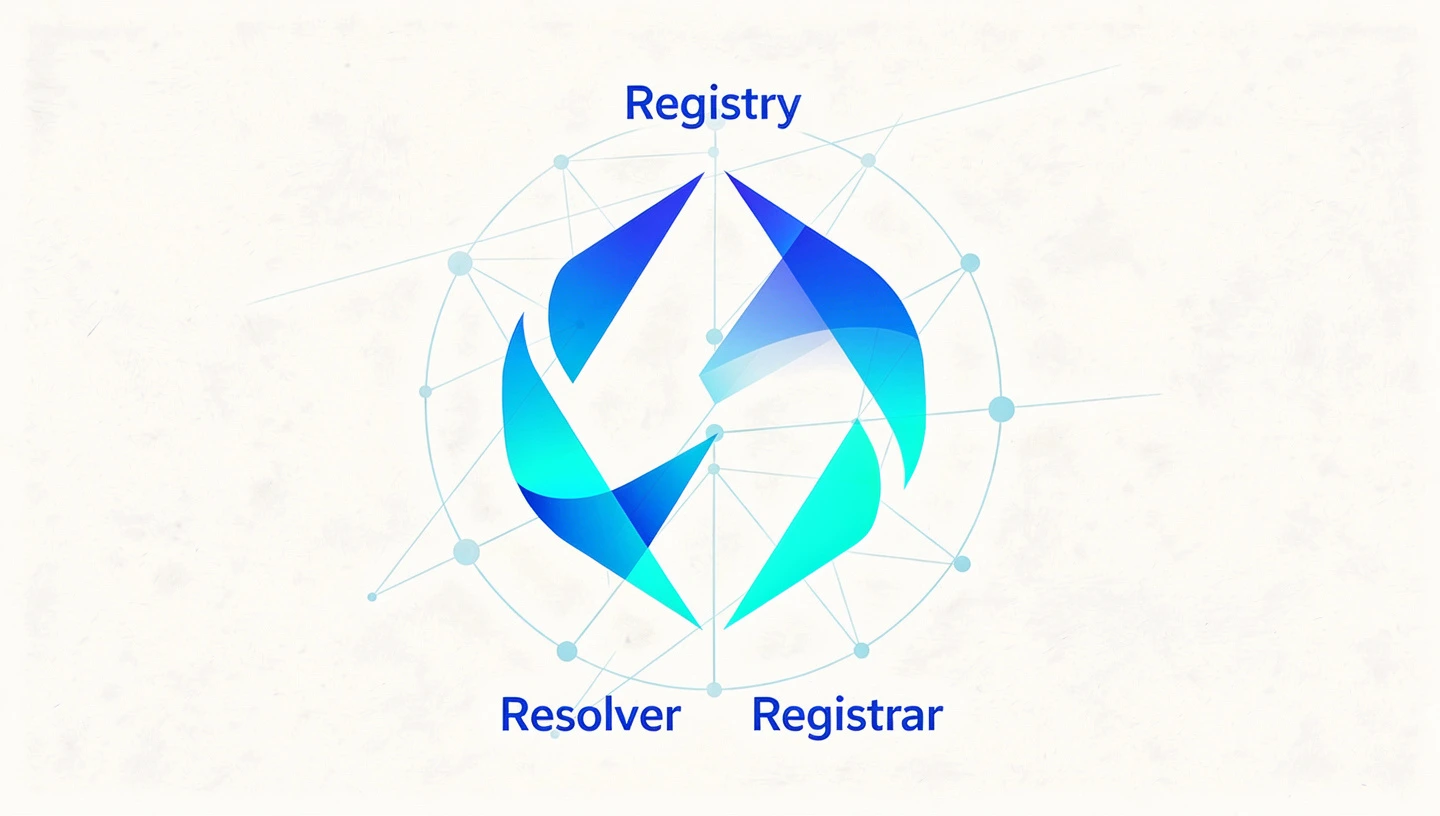
ENS is not a single contract. It is a system of three interconnected smart contracts that each handle a different part of the naming process. Understanding what each one does removes the mystery from how a .eth name actually resolves to a wallet address.
| Component | What it does |
|---|---|
| Registry | Master contract that tracks ownership of every name and points to the correct resolver |
| Resolver | Translates the .eth name into an address, IPFS hash, BTC address, and any other record |
| Registrar | Controls registration rules, pricing, and renewal for .eth domains |
| ERC-721 NFT | Every .eth name is a transferable NFT sitting in your wallet like any other token |
The Registry – the master list of all .eth names
The Registry is the central ledger. For every registered name, it stores three things: who owns the name, which resolver contract should be used to look up its records, and a TTL (time to live) that tells applications how long to cache a result before checking again. The Registry does not store where alice.eth points. It only stores who owns it and where to ask about the destination. That separation of responsibilities is what makes the system flexible enough to support dozens of record types beyond just Ethereum addresses.
The Resolver – where the actual translation happens
The Resolver is the contract that does the lookup work. When MetaMask needs to find out where alice.eth points, it asks the Registry which resolver to use, then asks that resolver for the address. A resolver can hold multiple records for a single name: the ETH address, a Bitcoin address, a Solana address, an IPFS hash pointing to a website, an email address, an avatar image URL, a Twitter/X handle, and more. One .eth domain becomes a single anchor for every piece of a person’s online identity across multiple chains and platforms.
The Registrar – how .eth registration is controlled
The Registrar is the contract that manages who can register a .eth name and at what price. For .eth names, the ETH Registrar Controller handles the registration process, enforces the pricing tiers based on name length, and manages renewals. The registrar is locked in the sense that no single entity can change its rules without going through the ENS DAO governance process. Your ownership of a registered name is contractually enforced, not dependent on a company’s goodwill.
Namehash – how ENS converts readable names to on-chain data
Ethereum contracts cannot work directly with a text string like “alice.eth.” The Namehash algorithm converts any ENS name into a fixed-length 32-byte value that smart contracts can handle. It does this hierarchically: “eth” gets hashed first, then “alice.eth” is derived from that, then “sub.alice.eth” is derived from that, and so on. This means the parent domain mathematically controls the child domain space without needing a centralized database to enforce it. The Ethereum Virtual Machine processes these hashed values when executing ENS lookups, which is why the system works within Ethereum’s existing architecture without modifications to the base protocol.
What Can You Do With an .eth Domain?
The simplest answer is: replace your wallet address with something usable. But the practical applications go further than that, and they have expanded as more wallets, exchanges, and applications have added ENS support.
Replace your wallet address with a name people can remember
Sending ETH to the wrong address is permanent. Ethereum transactions are irreversible and there is no recovery process for funds sent to a mistyped address. A .eth domain removes the main source of that error: manual copying of a 42-character hexadecimal string. In wallets that support ENS natively, such as MetaMask, Rainbow, Coinbase Wallet, and Trust Wallet, you type the .eth name in the recipient field and the wallet resolves it to the correct address before you confirm. The address is shown for verification, but the entry process becomes as simple as sending an email.
Multi-chain address mapping – one name for every blockchain
One .eth name can hold addresses for multiple blockchains simultaneously. The resolver stores a Bitcoin address, a Solana address, an Ethereum address, and others as separate records under the same name. Applications that support multi-chain resolution pull the right address for the right chain automatically. This means alice.eth can receive BTC directly into a Bitcoin wallet and ETH directly into an Ethereum wallet using the same human-readable name, without the sender needing to know which chain they are on. It is one of the less-publicized features of ENS that becomes genuinely useful as multi-chain portfolios become more common.
Host a decentralized website with your .eth name
By pointing the content record of a .eth name to an IPFS hash, you can host a website that loads through the ENS name in browsers that support it, such as Brave and Status. An IPFS-hosted website has no central server to take down and no hosting company that can terminate your account. The content lives on the IPFS network and the name lives on Ethereum. Short of stopping renewing the .eth name or changing the IPFS hash it points to, nobody can redirect or remove the site. This is what decentralized publishing actually looks like in practice.
Web3 identity – your .eth name as your online profile
When you set your primary ENS name, you link your .eth name to your wallet address in reverse: so that when an application looks up your 0x… address, it returns alice.eth instead. This is called reverse resolution. Applications that support it, including Uniswap, OpenSea, Aave, and most major DeFi platforms, display your .eth name everywhere your address would normally appear. Your ENS profile can also store an avatar, a short bio, and links to social accounts. The result is a portable Web3 identity that travels with your wallet across every application that reads ENS records, rather than having a separate profile on each platform.
Subdomains – how organizations issue names at scale
Owning yourname.eth gives you the ability to create unlimited subdomains under it: pay.yourname.eth, blog.yourname.eth, or team.yourname.eth. You control those subdomains completely and can give them to others or use them for different purposes. This is the mechanism that allows organizations to issue named identities to many users without each user registering their own .eth name. Coinbase uses ENS infrastructure for its cb.id subnames, letting Coinbase users have a human-readable identifier for free. Projects can issue member.project.eth to contributors. The parent domain owner sets the records for subdomains and can revoke them, which is the appropriate tradeoff for a free subdomain versus a self-owned .eth name.
How to Register an .eth Domain – Step by Step
Registration happens through app.ens.domains. You need an Ethereum wallet with enough ETH to cover the annual registration fee plus the gas cost of two transactions. The two-transaction process exists to prevent frontrunning: a brief waiting period between the first and second transaction makes it difficult for bots to see your intended name and register it before you.
.eth domain pricing – what names actually cost
| Name length | Annual cost |
|---|---|
| 5+ characters | $5 per year |
| 4 characters | $160 per year |
| 3 characters | $640 per year |
These are the base registration fees denominated in USD but paid in ETH at the current exchange rate. Gas fees come on top. On a quiet network, gas for registration runs $2-5. During busy periods, it can reach $15-30 or more. Understanding how Ethereum gas fees work helps you time registrations for when the network is less congested, which typically means early morning UTC on weekdays.
The registration process at app.ens.domains
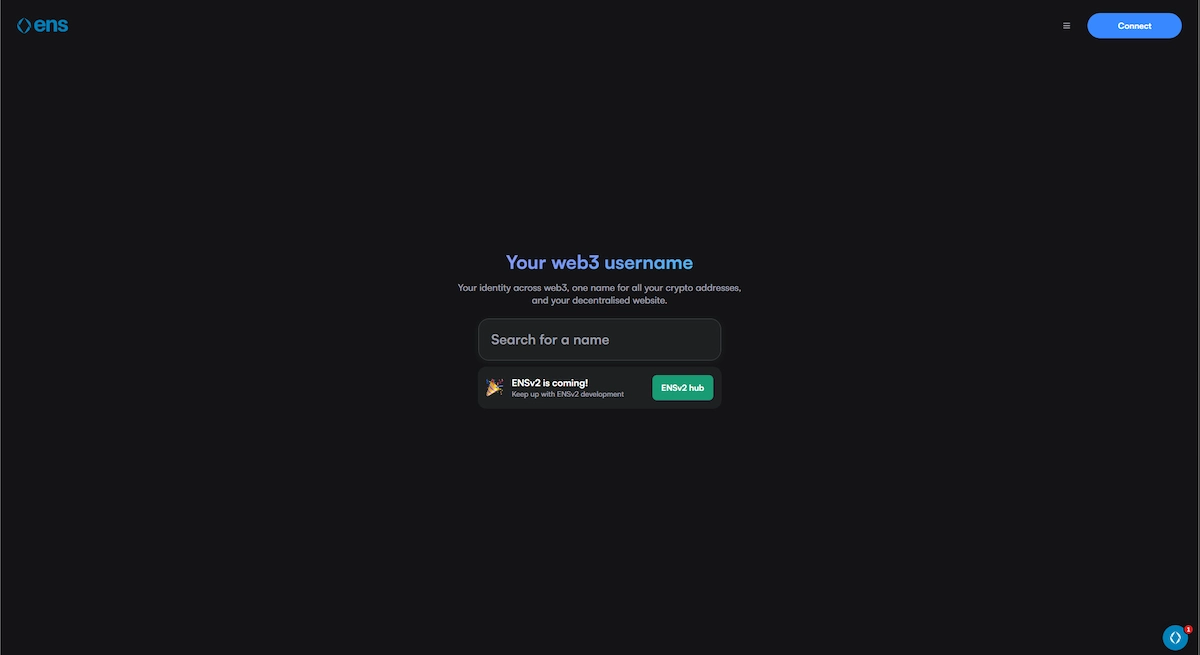
- Go to app.ens.domains and connect your wallet. MetaMask, Rainbow, Coinbase Wallet, and most major wallets work.
- Search for the name you want. The app shows whether it is available and what it costs per year.
- Choose how many years to register for. One year is the minimum. Registering for three or more years is practical because renewal reminders are easy to miss and the grace period is only 90 days.
- Confirm the first transaction and wait 60 seconds. This is the anti-frontrunning delay.
- Confirm the second transaction. This completes the registration and mints the .eth name as an ERC-721 NFT in your wallet.
- Set the resolver to point to your wallet address so the name actually resolves to you.
- Add any additional records you want: a Bitcoin address, an avatar, a bio, or links to social profiles.
Setting your primary ENS name
Registering a .eth name and setting a primary ENS name are two separate steps. Registration means you own the name. Setting a primary name means your wallet address resolves back to that name when applications look it up. Without this step, apps will still show your 0x… address even if you own alice.eth. The setup takes one transaction in the ENS manager, costs a small amount of gas, and applies across every application that reads ENS records. Once set, it follows your wallet everywhere.
Renewal and the 90-day grace period
When a .eth name expires, the previous owner has a 90-day grace period to renew it. During this period, the name cannot be registered by anyone else, but it also stops resolving. After the 90 days, the name goes to a temporary premium auction where the starting price decreases over 28 days until it reaches the standard registration price. If you miss the grace period, you lose the name permanently unless you outbid others in that auction. Registering for longer periods upfront and setting a calendar reminder is simpler than trying to catch a renewal at the last moment.
ENS as an NFT: Owning, Trading, and the Secondary Market
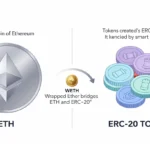
Every .eth domain is an ERC-721 token. This has practical consequences beyond just being an interesting technical detail. It means your ENS name lives in your wallet alongside your other tokens, can be transferred with a standard ERC-721 transfer, and appears on every NFT marketplace that indexes Ethereum.
Your .eth name is an ERC-721 NFT in your wallet
Because the name is a token, you can send it to another wallet, sell it on OpenSea or Blur, or use it as collateral in DeFi protocols that accept ERC-721 tokens. If you transfer a .eth name to another address, that address becomes the new owner and controller. The resolver records stay the same until the new owner updates them. This makes ENS names straightforwardly tradeable without any special marketplace infrastructure – they work with any platform that handles ERC-721 tokens. To understand more about how smart contracts handle token ownership and transfers, the overview covers the underlying mechanics.
The secondary market – how much .eth names sell for
Short and memorable .eth names trade for significant amounts. Three-character names like 000.eth have sold for hundreds of ETH. Four-character names trade in the thousands of dollars range for common combinations. Common dictionary words, brand names that happen to be available, and names with obvious utility all command premiums on the secondary market. The dynamic mirrors the early .com market from the 1990s: short, recognizable names with broad appeal have disproportionate value regardless of who owns them. The factors that determine secondary market price are length, readability, keyword relevance, and how memorable the name is in a Web3 context.
What to know about .eth names as an asset
The secondary market for .eth names is active but narrow. Most names trade rarely or not at all. The names with genuine secondary market liquidity are short, common, or tied to recognizable concepts. Buying a five-character name that describes your business and using it for its utility is straightforward. Buying names speculatively and waiting for buyers is a different proposition with real liquidity risk. The market has lower volume than most people assume from looking at high-profile sales.
The ENS Token: Governance and the DAO
The ENS token is a governance token. It does not generate yield, does not share protocol revenue with holders, and is not required to register or use a .eth domain. Its sole function is voting rights in the ENS DAO, which controls decisions about the protocol.
What the ENS token does
ENS DAO votes on changes to the protocol’s pricing structure, treasury allocations, grants to developers building on ENS, and amendments to the DAO constitution. The constitution has one notable provision that matters to every .eth holder: it explicitly prohibits the DAO from taking away ownership of a registered name without the owner’s consent. Price increases are only permitted to prevent abuse or fund operations, not to extract value from existing holders. This is a governance commitment, not a technical limitation, but it is enforced through the DAO’s own rules and public accountability.
The November 2021 airdrop
ENS distributed tokens in November 2021 to every wallet that held a .eth name registered before October 31, 2021. The amount each wallet received depended on how long the name had been held and whether a primary ENS name had been set. Individual allocations ranged from around 200 tokens for recent registrations to several thousand for long-term holders who had set up their primary name. At the peak price of approximately $83.41 in November 2021, some wallets received airdrop allocations worth tens of thousands of dollars.
| Allocation | Percentage |
|---|---|
| ENS DAO treasury | 50% |
| Airdrop to .eth holders | 25% |
| Core contributors (4-year vesting) | 25% |
Total supply is capped at 100 million ENS tokens. There is no ongoing issuance or inflation beyond what the DAO votes to release from the treasury for specific purposes.
ENS DAO – how the protocol is governed today
The ENS DAO operates through on-chain voting where token holders delegate their votes to representatives or vote directly. Major protocol changes require a formal proposal, a discussion period, and then a vote. The DAO controls a treasury funded by registration and renewal fees. Surplus revenue beyond operational costs goes toward Web3 public goods as determined by governance votes. This funding model means the protocol’s financial sustainability is tied directly to how many people use and renew .eth names.
ENS Integrations: Where .eth Names Work in 2026
The value of ENS scales with how many places accept it. In 2026, the integration list has grown to the point where a .eth name is recognized in most of the tools an active Ethereum user would encounter in a typical week.
Wallets that support ENS natively
Native ENS resolution means you can type a .eth name in the send field and the wallet looks up the address for you automatically. MetaMask has supported this since 2018. Rainbow, Coinbase Wallet, Trust Wallet, Argent, and Gnosis Safe all handle ENS resolution natively. In these wallets, sending to a .eth name works exactly like sending to a 0x address – the resolution happens in the background and the actual address is displayed for confirmation before you approve the transaction. For users setting up MetaMask for the first time and wanting to use ENS, the guide on how to set up MetaMask covers the initial configuration.
Coinbase and Base – ENS at scale
Coinbase has built two ENS-powered naming products. The first is cb.id, which gives Coinbase users a free subdomain under the cb.id name through ENS infrastructure. The second is Basenames, launched on Coinbase’s Base layer-2 network, which lets Base users register name.base.eth as their on-chain identity. In July 2025, Base App integrated ENS as a core “Secure Identity” pillar, making it the most visible consumer-facing ENS deployment at scale. These products collectively represent millions of users interacting with ENS infrastructure without necessarily knowing that is what they are using.
Exchanges, dApps, and real-world integrations
Uniswap, Aave, and OpenSea all display .eth names in their interfaces when they detect a primary ENS name set on a connected wallet. In April 2026, PayPal added support for sending cryptocurrency directly to .eth names, which was a notable step toward mainstream payment use. GoDaddy integrated with ENS to allow owners of traditional DNS domains to link them to the ENS system. Brave Browser and Status both support ENS resolution for .eth websites, letting users navigate to IPFS-hosted sites by typing the .eth name in the address bar. The depth of integration now means ENS operates as infrastructure rather than an optional add-on for most serious Ethereum users. If you are comparing which wallets best support ENS and want to see how MetaMask stacks up against Coinbase Wallet specifically, the MetaMask vs Coinbase Wallet comparison covers that in detail.
ENSv2: What Is Changing in 2026
ENS has been running on the same core architecture since 2017. ENSv2 is the first major protocol upgrade and it changes several things about how names resolve and how subdomains work at scale.
Why ENS needed an upgrade
The original architecture had two practical limitations. First, gas fees made registering and updating ENS records expensive during periods of network congestion. A casual user paying $20 in gas to register a $5 name is not a good experience. Second, issuing subdomains at scale, thousands of subdomains for a large organization, required paying a gas fee for each one, which made organizational use cases uneconomical on mainnet.
What ENSv2 actually changes
In February 2026, ENS cancelled the previously announced Namechain plan, which would have deployed a dedicated Layer 2 chain for ENS. The reason given was that Ethereum’s own upgrades had reduced mainnet gas costs dramatically enough that a separate chain was no longer necessary. ENSv2 now deploys directly to Ethereum mainnet with an improved contract architecture. The key technical addition is CCIP-Read (Cross-Chain Interoperability Protocol), which allows ENS resolvers to serve records stored off-chain without requiring an on-chain transaction for every update. This makes it possible to update ENS records frequently or in bulk without paying gas each time, while the ownership and security anchor remains on Ethereum.
Gasless subnames – what this means for organizations
Through CCIP-Read and off-chain resolvers, an organization can issue thousands of subdomains under their .eth name without paying a gas fee per subdomain. The parent name is registered on-chain. The subdomains resolve through an off-chain server that the parent name owner controls, with the resolution path still anchored to Ethereum’s security model. Coinbase’s Basenames and cb.id are already operating on this model. For ENS in 2026, the practical result is that organizational and enterprise use cases that were previously blocked by gas economics become viable without moving to a different chain or a weaker security model.
ENS vs Competitors: Why ENS Leads
ENS is not the only Web3 naming service, but it has a lead in integrations, registered names, and decentralization that competitors have not closed.
Unstoppable Domains and other naming services
Unstoppable Domains sells .crypto, .nft, .x, and other domain extensions with a one-time purchase model instead of annual renewals. The argument for that model is simplicity and no renewal risk. The tradeoff is that Unstoppable Domains maintains more centralized control over the namespace and has faced questions about how decentralized its infrastructure actually is. NEAR Protocol has its own naming service for NEAR addresses. Solana has .sol names. Each is native to its own chain and has limited cross-chain recognition compared to ENS, which benefits from Ethereum being the chain with the most wallet and dApp integrations overall.
ENS currently has over 2 million registered names and more than 800 documented integrations across wallets, exchanges, and applications. That network effect compounds: each new integration makes existing .eth names more useful, which drives more registrations, which makes adding ENS support more worthwhile for the next application. Understanding what ETH is used for more broadly gives context for why Ethereum’s dominance in DeFi, NFTs, and developer tooling flows through to ENS adoption as well.
ENS and traditional DNS – complementary, not competing
ENS supports traditional DNS domains alongside .eth. If you own alice.com through GoDaddy or another registrar, you can link it to ENS and use alice.com as your ENS name without buying alice.eth. GoDaddy has an integration that makes this link straightforward. For users who already have an established web presence under a .com or .org, this is a practical path to Web3 identity without abandoning an existing domain. The long-term vision is that the boundary between traditional web identity and on-chain identity becomes less visible as the two systems interoperate more closely.
Frequently Asked Questions
What is the Ethereum Name Service?
The Ethereum Name Service is a decentralized naming protocol on Ethereum that maps human-readable .eth names to wallet addresses, IPFS hashes, and other records. It works like the internet’s DNS but runs on smart contracts rather than centralized servers. A .eth name can receive crypto on multiple blockchains, point to a decentralized website, and serve as a Web3 identity profile across applications.
.eth domain cost – how much does registration cost?
Names with five or more characters cost $5 per year. Four-character names cost $160 per year. Three-character names cost $640 per year. All prices are denominated in USD but paid in ETH at the current rate. Gas fees for the two registration transactions add $2-30 on top depending on network activity at the time.
Can I use my .eth name to receive crypto on other blockchains?
Yes. A .eth name can store addresses for Bitcoin, Solana, Litecoin, and other blockchains in addition to Ethereum. Applications that support multi-chain ENS resolution pull the correct address for the relevant chain automatically. The sender uses the same .eth name regardless of which chain they are sending from.
What happens if my .eth domain expires?
After expiry, there is a 90-day grace period during which only the original owner can renew it. The name stops resolving during this period. After 90 days, it enters a temporary premium auction where the price starts high and decreases over 28 days before settling at the standard registration rate. Missing the grace period means losing the name.
Is my .eth domain secure and can it be taken away?
ENS ownership is enforced by smart contracts, not by a company’s terms of service. The ENS DAO constitution explicitly prohibits removing a registered name from its owner without consent. As long as you control the wallet that holds the .eth name and renew it before the grace period ends, no one can take it. The security of your name is the same as the security of your wallet’s private key.
What is the ENS token and do I need it to register a domain?
The ENS token is a governance token for voting on protocol decisions through the ENS DAO. You do not need ENS tokens to register or use a .eth domain. Registration requires only ETH for the annual fee and gas. ENS tokens are only relevant if you want to participate in governance votes about protocol changes.
Can I sell my .eth domain?
Yes. Every .eth domain is an ERC-721 NFT that can be listed on OpenSea, Blur, or any marketplace that supports ERC-721 tokens. You can also transfer it directly to another wallet. Short and memorable names have an active secondary market. Transferring a name passes full ownership and control to the new wallet address.