Once a smart contract is deployed on Ethereum mainnet, its code becomes permanent. There is no patch, no rollback, no quick fix if something is wrong. A bug discovered after launch can mean locked funds, exploited logic, or a complete rewrite that requires migrating every user to a new contract address. Sepolia exists to catch those bugs before they matter. It is Ethereum’s primary public testnet, a network that mirrors mainnet closely enough that what works on Sepolia almost always works on mainnet, using Sepolia ETH instead of real Ether so nothing is actually at risk.
What Is Sepolia and What Is Sepolia ETH?
Sepolia and Sepolia ETH are two different things that get used interchangeably in casual conversation, which causes confusion for anyone new to Ethereum development.
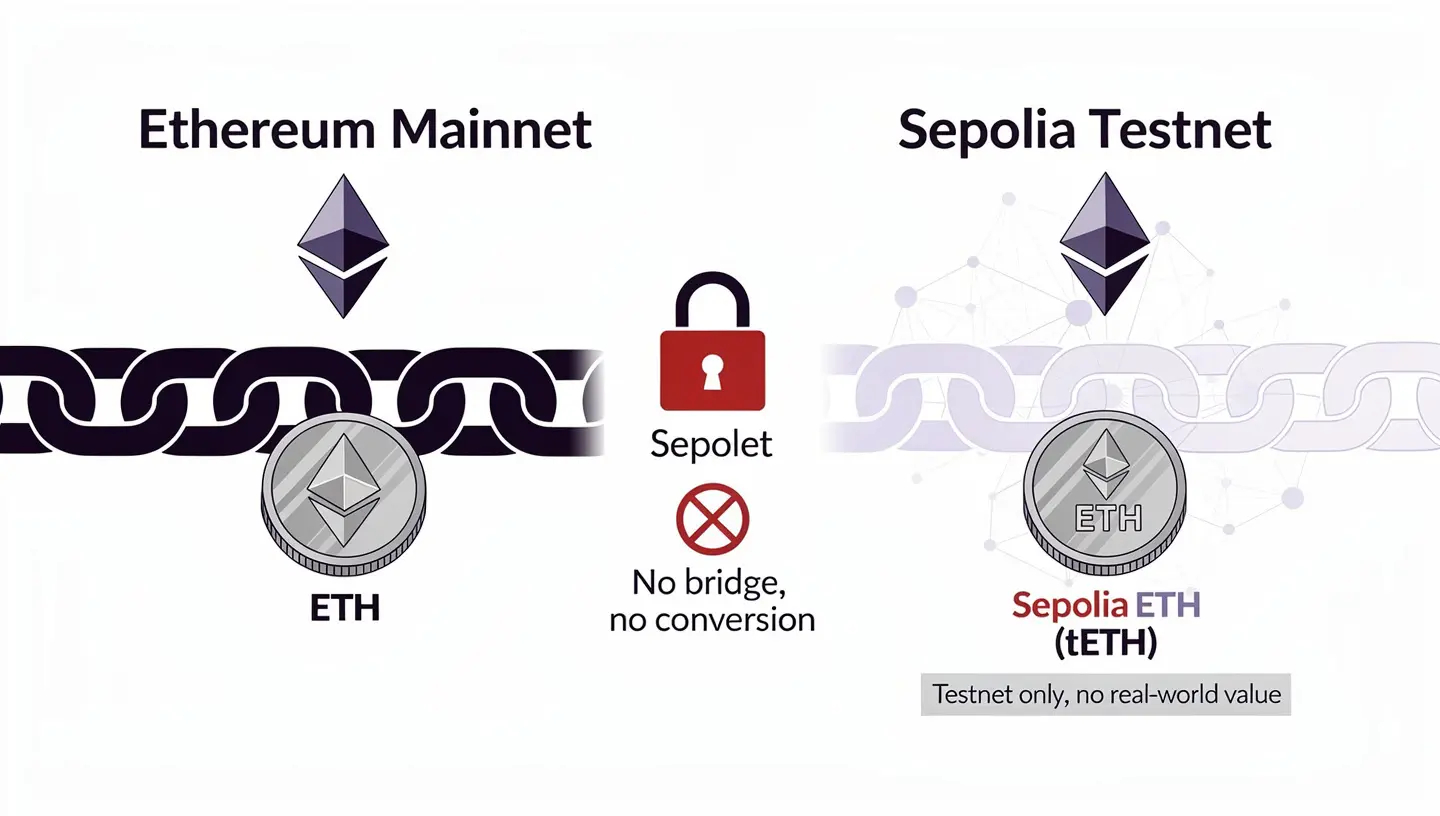
Sepolia the network vs Sepolia ETH the token
Sepolia is the network itself: a separate blockchain that runs the same consensus rules and execution environment as Ethereum mainnet, but exists purely for testing. Sepolia ETH, sometimes written as tETH, is the native currency of that network. It looks like ETH, behaves like ETH inside the Sepolia environment, and is used to pay gas fees on Sepolia exactly like real ETH pays gas on mainnet. The difference is that Sepolia ETH has no monetary value. It cannot be withdrawn, bridged, or converted to mainnet ETH through any legitimate mechanism, because the two networks are completely separate ledgers.
This distinction matters because scammers specifically target people who do not understand it. Anyone offering to buy or sell you Sepolia ETH for real money is running a scam, since the token has no path to becoming anything of value outside the test environment.
Why Ethereum needs testnets at all
A smart contract deployed to mainnet cannot be edited. If a developer finds a bug after deployment, the only options are deploying an entirely new contract or building workarounds into a separate upgrade mechanism, both of which are expensive and risky. Testing before deployment is the only real defense against this.
A local development environment, such as Hardhat’s built-in network, handles basic logic testing, but it cannot replicate everything that happens on a live, public blockchain: real network latency, actual gas pricing behavior, interaction with other live contracts, and the unpredictability of a shared, public environment. Sepolia fills that gap. It behaves enough like mainnet that a contract working correctly on Sepolia gives genuine confidence before a mainnet deployment. The broader mechanics of how smart contracts work and why immutability is a core design choice explain why this testing step is not optional for any serious project.
Sepolia network specifications
| Specification | Value |
|---|---|
| Network name | Sepolia |
| Chain ID | 11155111 |
| Consensus mechanism | Proof of Stake |
| Block time | ~12 seconds |
| Launched | 2021 (Proof of Authority), transitioned to Proof of Stake in 2022 |
| Status | Official long-term Ethereum testnet |
The History of Sepolia: From Goerli to Today
Sepolia did not appear out of nowhere. It replaced older testnets that had served Ethereum developers for years but eventually became impractical to maintain.
Why Goerli and Ropsten were deprecated
Ropsten transitioned to a Proof of Stake-style consensus ahead of Ethereum mainnet’s own transition, which meant it stopped behaving as a reliable preview of what mainnet would eventually look like. That timing mismatch made it less useful as a staging environment exactly when developers needed accuracy the most. Goerli ran into a different problem: a shortage of validators willing to keep running infrastructure for a network that paid nothing in real value. As fewer validators stayed active, block production became less reliable. Both networks had also grown large over years of accumulated test data, making them heavier and slower to sync than a testnet needs to be. Rather than patch both networks indefinitely, the Ethereum community consolidated around two canonical testnets going forward.
The shift from Proof of Authority to Proof of Stake
Sepolia launched in 2021 as a Proof of Authority network, meaning a small, trusted set of validators controlled block production. This design made the network fast and simple to bootstrap, but it did not reflect how Ethereum’s actual consensus mechanism worked at the time. In 2022, Sepolia transitioned to Proof of Stake, timed to align with Ethereum mainnet’s own shift during The Merge. This change is what made Sepolia genuinely useful as a pre-deployment testing ground: it now runs the same consensus logic, the same validator-based block production, and the same execution environment as mainnet. Understanding how the current consensus mechanism functions on mainnet is covered in the guide on Ethereum Proof of Stake.
Sepolia and Holesky – two different testnets, two different jobs
Holesky launched in 2023 with a different goal than Sepolia. It was built to mirror mainnet’s scale, with a validator count and state size closer to what mainnet actually has. This makes Holesky the right choice for testing staking infrastructure, validator client software, or anything where the sheer size and behavior of the validator set matters.
Sepolia is lighter and faster to sync, which makes it the better default for application development. If you are testing an ERC-20 token contract, a DeFi protocol, or a general dApp deployment workflow, Sepolia is the standard choice. If you are building or testing infrastructure meant to operate at mainnet scale – staking pools, validator monitoring tools, large-scale node infrastructure – Holesky is the more accurate environment.
How to Get Sepolia ETH – Faucets Compared
Sepolia ETH has no monetary value, so it is distributed freely through services called faucets. Getting enough to deploy and test a contract typically takes a few minutes.
What a faucet actually does
A faucet is a service that sends a small, fixed amount of testnet ETH to any wallet address that requests it. Because the token has no value, there is no financial reason to restrict access tightly, but faucets still implement rate limiting, account requirements, or mainnet balance checks to prevent a small number of bots from draining the supply and leaving nothing for actual developers.
Popular Sepolia faucets and what they require
| Faucet | Amount | Frequency | Requirement |
|---|---|---|---|
| Alchemy Sepolia Faucet | 0.5 ETH | Daily | Alchemy account |
| Infura Faucet | 0.5 ETH | Daily | Infura account |
| Chainlink Faucet | 0.1 ETH | Per request | Wallet connect only |
| Google Cloud Web3 Faucet | 0.05 ETH | Daily | Google account |
| Base Sepolia Faucet (thirdweb) | 0.01 ETH | Daily | Wallet connect only |
Troubleshooting – what to do when faucets run dry
If a faucet rejects your request, the most common cause is rate limiting – most faucets cap how often a single wallet or account can claim, typically once every 24 hours. Switching to a different faucet provider solves this immediately rather than waiting out the cooldown. An “insufficient funds” error when you try to deploy usually means your wallet is not actually connected to Sepolia, even if you have received testnet ETH – double-check the network selector in your wallet matches the network where you requested funds. For larger amounts needed during heavy testing, requesting from two or three faucets in sequence is a normal workflow rather than a workaround. Some faucets also require a small mainnet ETH balance in the requesting wallet as an anti-abuse measure, which is worth checking before assuming a faucet is broken.
How to Connect MetaMask to Sepolia
MetaMask supports Sepolia by default, but the network is often hidden until you enable testnet visibility in settings.
Enabling testnets in MetaMask
Recent versions of MetaMask hide test networks from the network selector by default to avoid confusing new users. To enable Sepolia, go to Settings, then Advanced, and toggle on “Show test networks.” Once enabled, Sepolia appears in the network dropdown alongside mainnet and any other networks you have added.
Sepolia RPC connection details
| Field | Value |
|---|---|
| Network Name | Sepolia |
| RPC URL | A public or provider-issued Sepolia endpoint |
| Chain ID | 11155111 |
| Currency Symbol | SepoliaETH |
| Block Explorer | sepolia.etherscan.io |
Using a managed RPC provider vs running your own node
A public RPC endpoint is free and works fine for casual testing, but it comes with shared rate limits that can throttle you during heavier development sessions. Managed RPC providers like Infura, Alchemy, GetBlock, and NOWNodes offer more reliable uptime and higher rate limits, usually with a free tier sufficient for most individual developers and paid tiers for production-scale testing. Running your own Sepolia node gives full control and no rate limits at all, but it requires ongoing technical maintenance and storage for the chain data, which is overkill for most application development work. For most developers building and testing a single project, a managed RPC provider’s free tier is the practical middle ground.
Deploying a Smart Contract on Sepolia – A Practical Example
Moving from local testing to a public testnet deployment follows a consistent workflow across most Ethereum development frameworks.
Setting up Hardhat for Sepolia deployment
A Hardhat project’s configuration file needs three pieces of information to deploy to Sepolia: a Sepolia RPC URL from your provider of choice, the private key of a test wallet holding Sepolia ETH (never your mainnet wallet’s private key), and an Etherscan API key if you plan to verify the contract’s source code publicly after deployment. These values typically get stored in environment variables rather than hardcoded directly into the configuration file, to avoid accidentally committing a private key to a public repository.
The deployment workflow
- Write and test the contract locally using Hardhat’s built-in network or Foundry’s Anvil, where transactions are instant and free.
- Compile the contract to confirm there are no syntax or compilation errors.
- Run the deployment script targeting the Sepolia network specifically, rather than the default local network.
- Wait for confirmation, which typically takes 12-15 seconds for the first block inclusion.
- Verify the contract’s source code on Sepolia Etherscan so anyone interacting with it can read the actual logic rather than just the compiled bytecode.
- Test real interactions through Remix, a connected frontend, or direct calls through your RPC provider to confirm the deployed contract behaves as expected under live network conditions.
Common deployment errors and what they mean
An “insufficient funds for gas” error means the wallet you are deploying from does not hold enough Sepolia ETH to cover the transaction cost. A “nonce too low” error usually means a previous transaction from the same wallet is still pending and needs to confirm before the next one can process, or that your wallet’s local nonce tracking has fallen out of sync and needs a manual reset. A “network mismatch” error typically means your wallet or deployment script is pointed at the wrong network entirely, which is worth checking against the chain ID before assuming something more complex is wrong.
What Sepolia Is Used For – Real Developer Use Cases
Sepolia’s role goes beyond simple “does my contract work” testing. It supports a wide range of pre-production validation that would be too risky or expensive to do directly on mainnet.
Testing ERC-20 and ERC-721 token contracts
Before launching any token, deploying it to Sepolia first lets a development team confirm that transfer, approve, mint, and burn functions all behave exactly as intended, with zero financial risk if something is wrong. This is standard practice across the industry: no serious project deploys a token contract straight to mainnet without first proving it works correctly in a public test environment. The differences between fungible and non-fungible token standards, and what each one requires from a contract, are covered in the guide on ERC-20 vs ERC-721.
Simulating mainnet conditions before launch
Sepolia lets developers measure real gas usage for their contract’s functions under conditions that closely match mainnet, rather than guessing based on local testing where gas costs nothing. It also exposes how a contract behaves when included in a block alongside other live transactions, and how it handles edge cases like reverted calls or failed transactions in a shared, public environment rather than an isolated local sandbox. Understanding the cost structure that this testing reveals is covered in the guide on Ethereum gas fees.
Staging wallets, oracles, and indexers
Wallet integrations, such as confirming that a MetaMask connect flow works correctly within a dApp’s frontend, get tested on Sepolia before going live. Chainlink price feeds are available on Sepolia specifically so DeFi protocols can test price-dependent logic – lending thresholds, liquidation triggers, swap pricing – without using real funds. Indexing services like The Graph also offer Sepolia-based subgraphs, letting teams validate their data indexing setup before pointing it at mainnet activity.
Testing upcoming Ethereum features
Because Sepolia tracks Ethereum’s mainnet upgrade schedule closely, it is also where developers get early access to test features before they reach production. Account abstraction under EIP-4337 changes how wallets can be built, allowing smart contract-based accounts with custom transaction logic. EOF, the EVM Object Format, restructures how contract bytecode is organized at a low level. EIP-7702 allows a standard externally owned account to temporarily take on smart contract behavior. Testing against these changes on Sepolia ahead of a mainnet rollout gives projects a head start on compatibility before the rest of the ecosystem catches up. The underlying execution environment that all of these proposals modify is explained in the guide on the Ethereum Virtual Machine.
Sepolia on Layer 2 – Base Sepolia and Beyond
Sepolia ETH is not limited to Ethereum’s own testnet. Several Layer 2 networks built their testing environments directly on top of Sepolia, using its ETH as the base test asset.
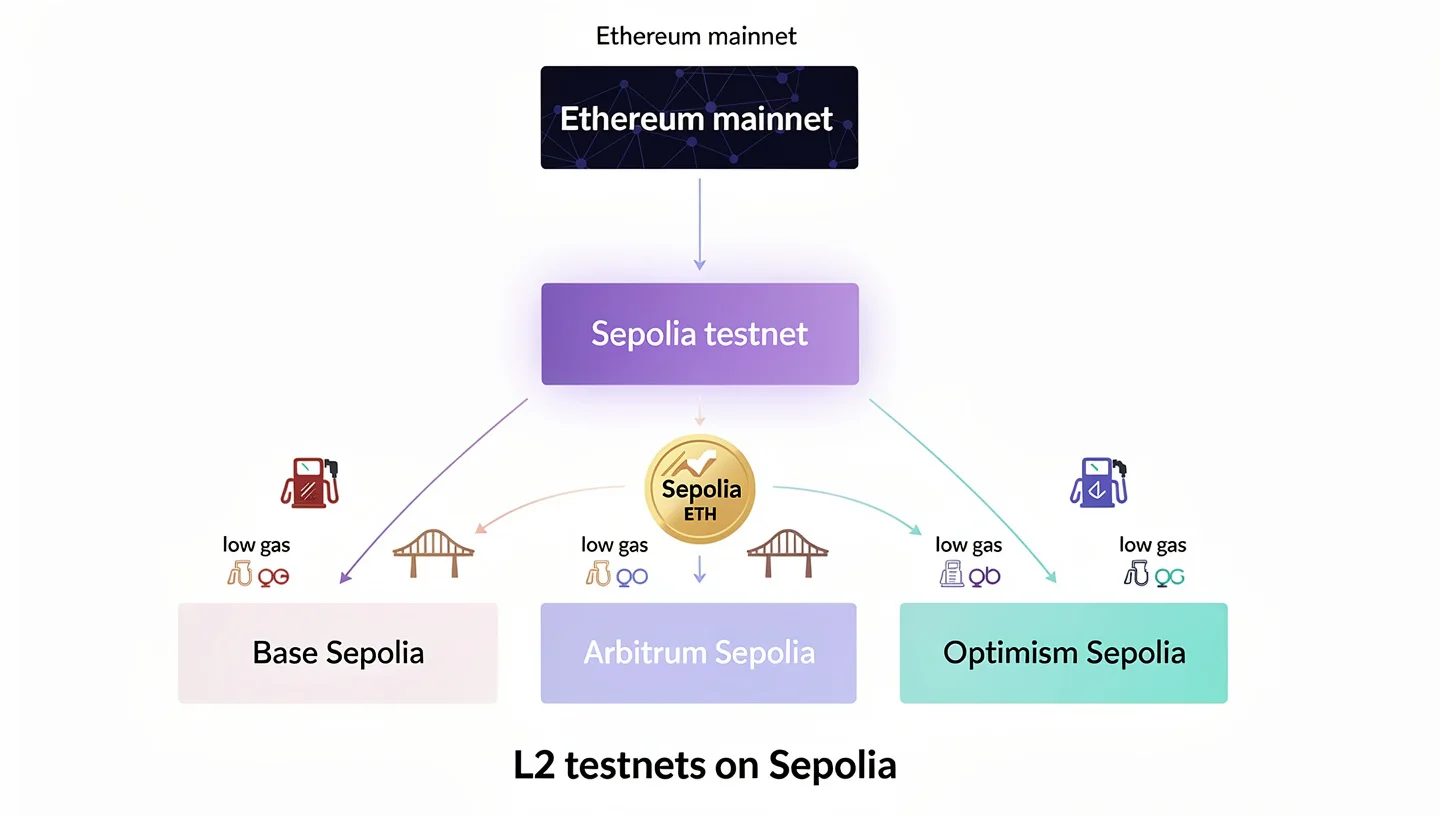
How Layer 2 testnets use Sepolia as their foundation
Base Sepolia, Arbitrum Sepolia, and Optimism Sepolia all run as Layer 2 test networks that settle back to Ethereum’s Sepolia rather than to mainnet. This means a single Sepolia ETH balance, obtained from any of the faucets covered earlier, can be bridged into any of these Layer 2 testnets for testing. The practical benefit is consistency: developers do not need a separate set of test funds for every Layer 2 network they want to validate against.
Base Sepolia – chain ID and configuration
Base Sepolia runs with chain ID 84532 and is designed to closely mirror the production behavior of Base mainnet. Faucets for Base Sepolia, including options through thirdweb and the Coinbase Developer Platform, typically distribute around 0.01 ETH per day, smaller amounts than Sepolia’s own faucets since Layer 2 gas costs are dramatically lower than mainnet costs. This makes Base Sepolia useful specifically for testing cross-chain bridge flows and Layer 2-specific contract behavior before committing to a Base mainnet launch.
Why testing on L2 testnets matters before mainnet launch
Bugs specific to Layer 2 architecture do not always surface during Layer 1 Sepolia testing. Bridge mechanics, sequencer behavior, and the specific way a Layer 2’s rollup reaches finality back on Ethereum all require their own dedicated testing pass. A contract that works flawlessly on Sepolia mainnet-equivalent testing can still behave unexpectedly once deployed through a Layer 2’s bridge and sequencer infrastructure, which is exactly why dedicated L2 testnets exist rather than relying on L1 testing alone. The process for actually moving funds between Ethereum mainnet and Layer 2 networks once you are ready for production is covered in the guide on bridging ETH to layer 2.
Sepolia ETH Security: Scams and What to Watch For
Because Sepolia ETH looks and functions like real ETH within its own environment, it has become a target for a specific category of scam aimed at people who do not fully understand the distinction between testnet and mainnet assets.
Why Sepolia ETH has zero monetary value
Sepolia and Ethereum mainnet are entirely separate blockchains with separate transaction histories and separate ledgers. There is no bridge, conversion mechanism, or technical process that moves value from Sepolia to mainnet, because Sepolia ETH was never backed by anything of value to begin with. It exists purely to pay for gas within the Sepolia test environment. Any claim that Sepolia ETH can be converted, exchanged, or cashed out for real money is false by the basic design of how these two networks work.
The “sell you testnet ETH” scam
A documented scam pattern involves someone offering to sell Sepolia ETH for real cryptocurrency or fiat currency, often targeting new developers who are still learning the difference between testnets and mainnet. The victim sends real payment, and in return receives Sepolia ETH that has no value outside the test network, leaving them with a worthless asset and a real financial loss. MetaMask’s own support documentation states this directly: anyone attempting to sell you testnet ETH is running a scam, full stop, with no legitimate exception.
Fake faucets and phishing risks
Some malicious sites mimic legitimate faucet interfaces but request a full wallet connection and, in more aggressive cases, attempt to extract a seed phrase under the guise of “verifying” eligibility for testnet funds. A legitimate faucet never needs your seed phrase. It only ever needs your public wallet address to send tokens to. Before using any faucet, confirm it is hosted on an official domain belonging to a known provider such as Alchemy, Infura, or Google Cloud, rather than a search result or a link shared in a Discord or Telegram message. Protecting your wallet credentials matters just as much in a test environment as it does for real funds, since the same wallet often holds both.
Frequently Asked Questions
What is Sepolia ETH?
Sepolia ETH is the test currency used on Sepolia, Ethereum’s primary public testnet. It functions exactly like real ETH within the Sepolia environment, paying for gas fees and transaction costs, but it has no monetary value and cannot be exchanged for real ETH or any other currency through any legitimate method.
Is Sepolia ETH worth real money?
No. Sepolia ETH has zero monetary value. It exists only within the Sepolia test network and cannot be withdrawn, bridged, or converted to mainnet ETH. Anyone offering to buy or sell Sepolia ETH for real money is running a scam.
How do I get free Sepolia ETH?
Sepolia ETH is distributed through faucets – free services that send a small amount of testnet ETH to any wallet address. Popular options include the Alchemy Sepolia Faucet and Infura Faucet, each offering around 0.5 ETH per day, as well as the Chainlink Faucet and Google Cloud Web3 Faucet for smaller amounts with different access requirements.
What is the difference between Sepolia and Holesky?
Sepolia is lighter, faster to sync, and best suited for general application and smart contract development. Holesky is designed to mirror mainnet’s scale and validator count, making it the better choice for testing staking infrastructure or validator software at production-like scale.
Can I use Sepolia ETH on mainnet?
No. Sepolia and Ethereum mainnet are entirely separate blockchains with no conversion mechanism between them. Sepolia ETH only has function and value within the Sepolia test network itself.
What is the Sepolia chain ID?
Sepolia’s chain ID is 11155111. This value is required when manually adding the Sepolia network to a wallet or configuring a development framework like Hardhat to deploy to the correct testnet.
Why did Ethereum replace Goerli with Sepolia?
Goerli suffered from a shortage of validators willing to maintain infrastructure for a network with no real financial incentive, which made block production less reliable over time. Ropsten’s consensus transition happened out of sync with Ethereum mainnet’s own upgrade path, reducing its accuracy as a testing environment. Sepolia and Holesky were designated as the two canonical long-term testnets to consolidate development and validator resources rather than spreading them across four separate aging networks.