ETH is the short code for Ether, the digital currency that runs on the Ethereum network. When people ask what ETH means, they usually want a simple answer: ETH is money, similar to how USD is the code for the US dollar. It pays for transactions, rewards the people who keep the network running, and gives users a way to store value without going through a bank. Ethereum itself is the network, while ETH is the currency that moves inside it. The rest of this guide breaks down where ETH came from, what it actually does, and why so many people consider it valuable.
What does ETH stand for?
ETH stands for Ether, the native currency of the Ethereum network. The word native simply means Ether was built specifically for this network and isn’t borrowed from anywhere else. Every time someone sends a payment, mints an NFT, or uses an app built on Ethereum, that action gets paid for in ETH.
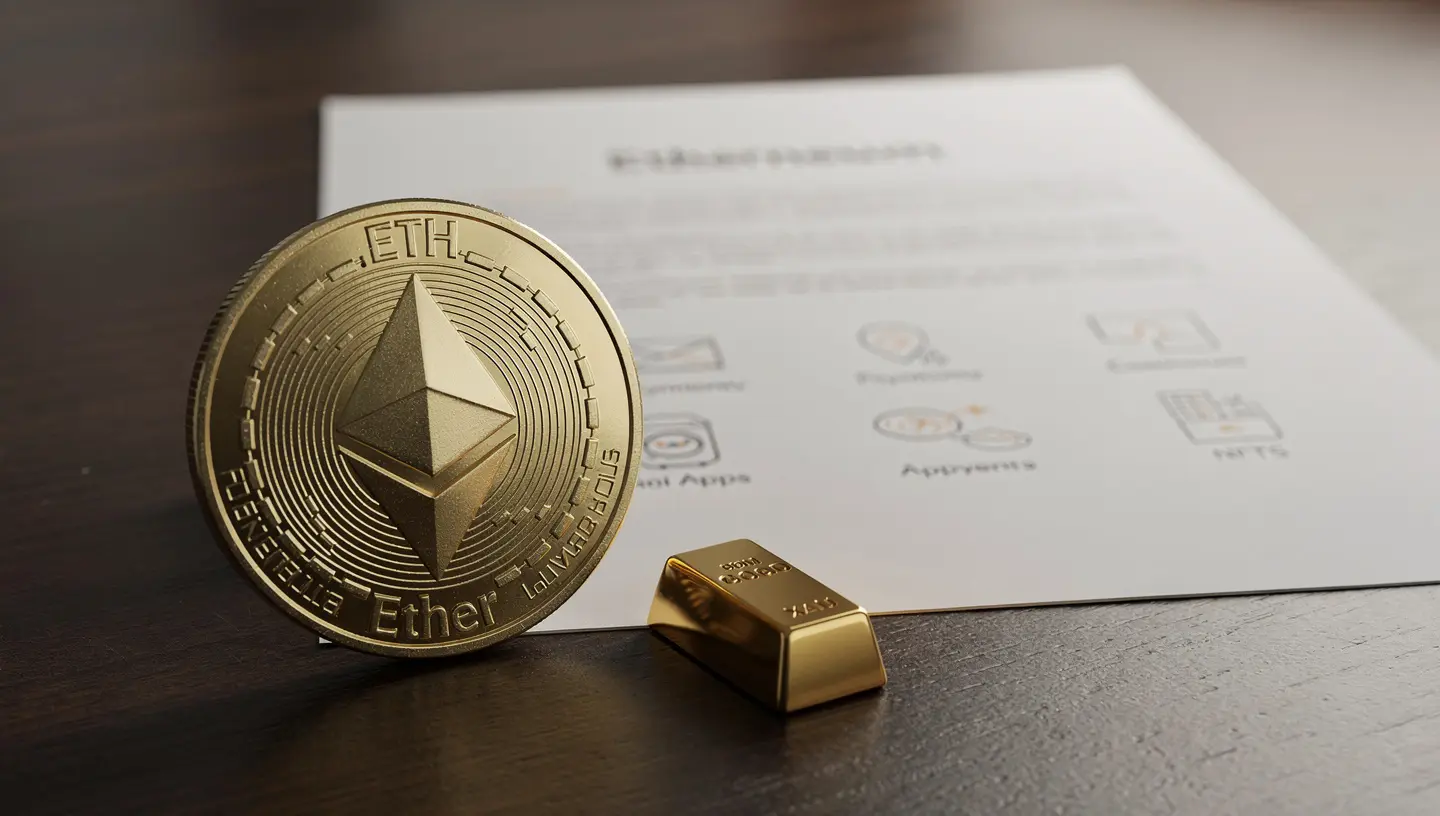
You’ll often see ETH and Ether used as if they’re the same word, and in everyday conversation that’s fine. Technically, Ether is the full name of the currency, while ETH is its trading symbol, the same way gold is traded under the symbol XAU. People also use Ether as a unit of measurement, the same way someone might say they hold ten dollars.
If you want the full breakdown of how Ether fits into the wider Ethereum picture, our guide on what is Ether covers the technical side in more detail.
What’s the difference between Ethereum, Ether, and ETH?
This is where most of the confusion starts. Ethereum, Ether, and ETH are three names that get mixed up constantly, but each one means something specific.
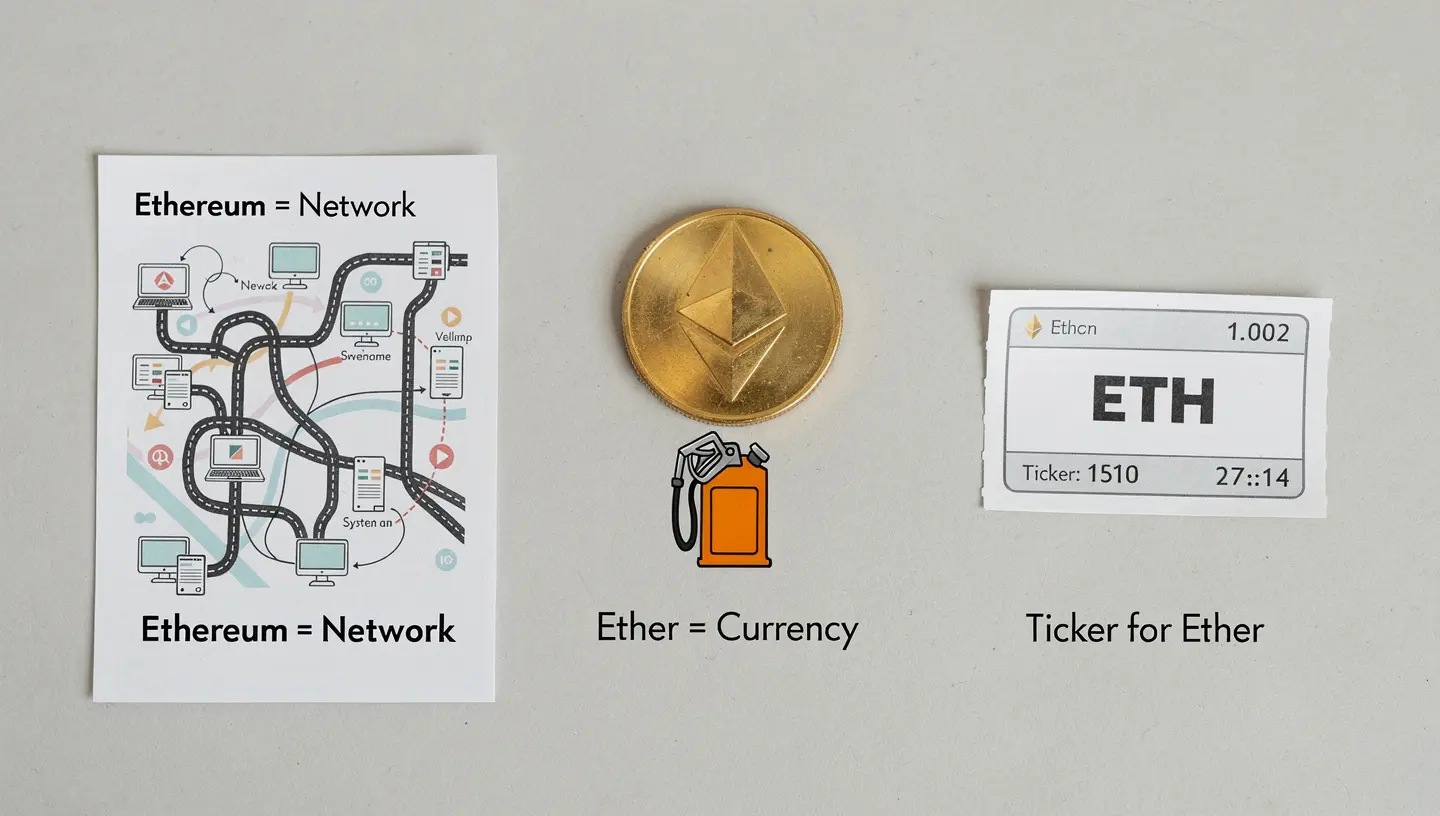
Ethereum is the network itself: the software, the rules, and the global group of computers that keep it running. Think of it as the entire highway system.
Ether is the currency that exists on that network. It’s the asset people own, send, and hold in their wallets. Sticking with the highway comparison, Ether is the fuel that moves traffic along.
ETH is simply the short code, or ticker, used for Ether on exchanges and price charts. When someone checks the price of ETH on an app, they’re checking the price of Ether.
So in plain terms: Ethereum is the network, Ether is the currency, and ETH is what people call that currency for short. Most articles, including this one, switch between Ether and ETH without much thought because in daily use they mean the same thing.
Where did ETH come from?
ETH didn’t appear out of nowhere. It was created alongside the Ethereum network, which was first described in a paper written by programmer Vitalik Buterin in 2013. Buterin wanted to build a network that could do more than just send payments the way Bitcoin does. He wanted a platform where people could build apps directly into the blockchain itself, according to the Ethereum Foundation.
To fund the project, the team behind Ethereum sold Ether to early supporters in 2014, raising about $18 million. The network officially went live on July 30, 2015, and the first batch of ETH entered circulation that day.
You can read more about the people behind the project and how the idea came together in our piece on who created Ethereum.
What does ETH actually do?
ETH isn’t just something to buy and hold. It has three main jobs on the Ethereum network:
- It pays for activity on the network through gas fees
- It powers the code behind decentralized apps and smart contracts
- It can be locked up through staking to help secure the network
Each of these jobs works a little differently, so it helps to look at them one at a time.
Paying gas fees
Every action on Ethereum costs a small fee, and that fee is paid in ETH. This is usually called a gas fee, named after the idea that computing power, like fuel, is needed to process anything on the network.
Sending ETH to a friend, swapping one token for another, or minting an NFT all require gas. The fee changes depending on how busy the network is at that moment. During quiet periods it might cost less than a cent, while during high demand it can climb much higher.
These fees go toward paying the people and computers that process transactions, plus a portion gets permanently removed from circulation. For a closer look at how these costs are calculated, check our guide on Ethereum gas fees.
Powering smart contracts
Smart contracts are small computer programs that live on the Ethereum network and run exactly as written, without anyone able to alter them once they’re live. They handle agreements automatically: if certain conditions are met, the contract carries out the action on its own.
ETH is what pays for these programs to run. Every line of code that gets executed uses a small amount of ETH as its fuel. This is the same gas system mentioned earlier, just applied to more complex actions than a simple payment.
Smart contracts are the reason Ethereum supports things like lending apps, decentralized exchanges, and NFT marketplaces. Without ETH to pay for execution, none of these programs would be able to run. If you want a fuller explanation of how this works, our article on what are smart contracts goes through it step by step.
Securing the network through staking
The third job ETH does is help keep Ethereum secure. Since September 2022, Ethereum has used a system called proof of stake, where people lock up their ETH to become validators.
Validators are responsible for checking transactions and adding new blocks to the chain. In return for doing this honestly, they earn rewards paid in ETH. If a validator tries to cheat the system, they risk losing part of the ETH they staked, which keeps most participants honest.
This setup replaced an older system called proof of work, which relied on computers competing to solve puzzles. The switch cut Ethereum’s energy use by more than 99 percent. For a deeper explanation of how validators are chosen and rewarded, see our guide on Ethereum proof of stake.
Why does ETH have value?
ETH gets its value from a mix of supply, demand, and usefulness, the same forces that affect most assets.
On the supply side, Ethereum has no fixed maximum number of coins, unlike Bitcoin’s 21 million cap. New ETH is created to reward validators, but a portion of every transaction fee is permanently burned, meaning it’s removed from circulation for good. During busy periods, more ETH can be burned than created, which slowly shrinks the total supply.
On the demand side, ETH is needed for almost everything that happens on the network. Every app, every transfer, and every smart contract requires ETH to function, so as Ethereum gets used more, demand for ETH tends to grow with it.
Many holders also treat ETH as a way to earn passive income, since staked ETH produces ongoing rewards. To see exactly how many coins exist right now, our page on how many ETH are there tracks the current supply, with live numbers also available on Etherscan.
ETH vs Bitcoin: what’s the real difference?
Bitcoin and Ethereum are often mentioned together, but they were built for different reasons. Bitcoin was designed mainly as a form of digital money, a way to send value without a bank. Ethereum was designed as a broader platform where developers could build apps, and ETH exists to keep that platform running.

Here’s a quick side by side look at how the two compare:
| Feature | Bitcoin (BTC) | Ethereum (ETH) |
|---|---|---|
| Main purpose | Digital money | Programmable network |
| Consensus method | Proof of work | Proof of stake |
| Maximum supply | 21 million | No fixed cap |
| Average block time | About 10 minutes | About 12 seconds |
Neither system is controlled by a single company or government, which is part of why both are described as a decentralized network. Bitcoin focuses on being a stable store of value, while Ethereum focuses on being a flexible base for new applications. If you want to understand exactly what it means for a network like Ethereum to have no central authority, our explainer on whether ETH is decentralized covers that in plain terms.
How do you get ETH?
There are a few common ways people get their hands on ETH. The simplest is buying it directly through a cryptocurrency exchange using regular money like dollars or euros. Once purchased, ETH can be kept on the exchange or moved to a personal wallet for safer, long term storage.
Another option is earning ETH through staking, where holders lock up coins they already own in exchange for rewards over time. Some people also receive ETH as payment for goods, services, or freelance work, since it can move across borders quickly without involving a bank.
Mining ETH the old way, the method Bitcoin still uses, is no longer possible on Ethereum since the network switched to proof of stake. For a full walkthrough of the buying process, our guide on how to buy Ethereum covers each step.
Bottom line
ETH is the currency that powers the Ethereum network. It pays for transactions, runs smart contracts, and rewards the people who keep the system secure through staking. Ethereum is the network, Ether is the asset, and ETH is simply the short way of saying it. Whether someone is buying their first coin or just trying to understand what shows up on a price chart, knowing what ETH means is the first step to understanding how the rest of the network works.
Frequently asked questions
Is ETH the same as Ethereum?
No. Ethereum is the network, while ETH is the currency that runs on it. People often use the names interchangeably in casual conversation, but technically they refer to different things.
What does ETH stand for exactly?
ETH is short for Ether, the native currency of the Ethereum network. It works as the ticker symbol shown on exchanges and price charts.
How many ETH coins exist?
There’s no fixed maximum supply of ETH, unlike Bitcoin’s 21 million cap. New coins are issued to reward validators while a portion of fees gets burned with every transaction, so the total changes over time.
Can you mine ETH?
No, not anymore. Ethereum used to rely on mining before September 2022, but the network now runs on proof of stake instead, where validators replace miners. Our guide on whether you can mine Ethereum explains the full history of that switch.
Is ETH a good investment?
That depends on personal goals and risk tolerance. ETH’s price can swing significantly within short periods, and unlike stocks, it isn’t backed by company earnings or physical assets. Its value comes mostly from how widely the network gets used and how much demand there is for the apps built on top of it. Anyone considering buying ETH should look into current market conditions, staking rewards, and overall risk before committing any money.
What is ETH mainly used for?
ETH is mainly used to pay transaction fees, power smart contracts, and secure the network through staking, with many people also using it as a form of payment between individuals and businesses that accept crypto directly. For the broader list of practical uses, see our breakdown of what ETH is used for.