ETH is not an ERC-20 token. ETH is the native coin of the Ethereum network, and it was created before the ERC-20 standard existed. ERC-20 is a technical standard for tokens built on top of Ethereum by developers using smart contracts, not for the network’s own currency. The two are related because they both live on the Ethereum blockchain, but they work differently and serve different purposes. This guide explains what ERC-20 means, why ETH does not follow that standard, how the two compare side by side, and what Wrapped Ether (WETH) is and why it was built to bridge the gap between them.
What does ERC-20 mean?
ERC stands for Ethereum Request for Comments, and 20 is the number assigned to this specific proposal. The official finalized version is called EIP-20 (Ethereum Improvement Proposal 20), though most people use ERC-20. The standard was first proposed by developer Fabian Vogelsteller in November 2015 and was formally recognized in 2017.
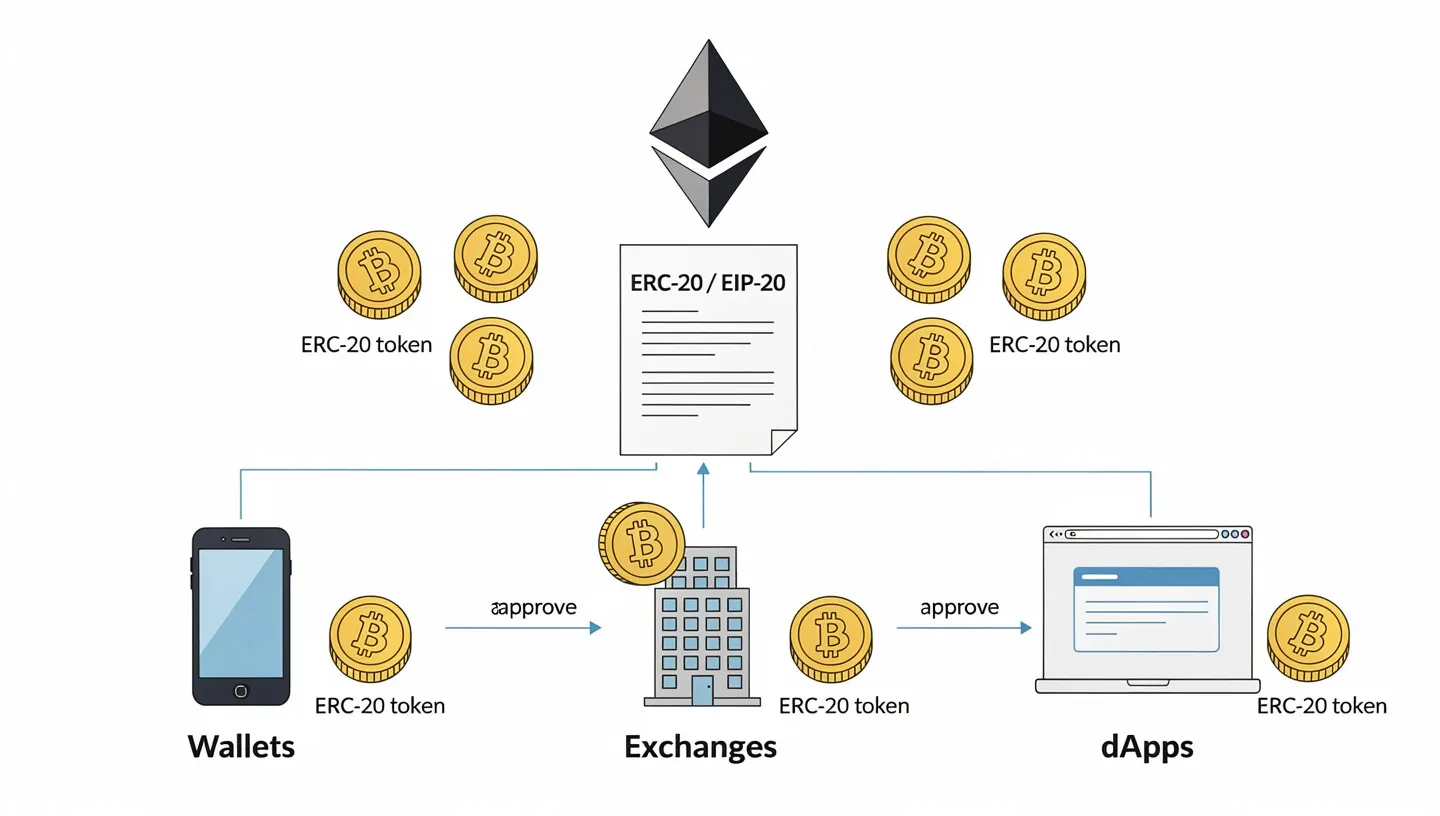
ERC-20 defines a set of rules that any token built on Ethereum must follow to work properly across wallets, exchanges, and decentralized applications. These rules cover how tokens are transferred between addresses, how balances are checked, and how one address can approve another to spend tokens on its behalf. Any token contract that follows these rules is called an ERC-20 token.
Before ERC-20 existed, every developer building a token on Ethereum used their own rules. That made tokens incompatible with each other and with the applications trying to support them. ERC-20 solved that by creating a shared set of functions that every token contract must include. To understand how these contracts run at the code level, see our guide on what smart contracts are and how they work.
What is the difference between a coin and a token?
Before going further, it helps to understand the difference between a coin and a token, since this is what separates ETH from ERC-20 tokens at a basic level.
A coin is a digital currency that has its own independent blockchain. Bitcoin runs on the Bitcoin blockchain. ETH runs on the Ethereum blockchain. Both are coins because the network they run on was built around them from the start.
A token is built on top of an existing blockchain using a smart contract. It does not have its own network. Instead, it relies on the infrastructure of a blockchain like Ethereum to function. ERC-20 tokens are tokens in this sense: USDT, UNI, and LINK all run on the Ethereum blockchain, but none of them is native to it. For a detailed explanation of what Ether is and how it fits into this picture, see our article on what Ether is.
ETH is a coin because it is the currency the Ethereum network was built around. ERC-20 tokens are tokens because they are created afterward, on top of that network, through smart contracts deployed by developers.
Is ETH an ERC-20 token?
No. ETH is not an ERC-20 token, and the reason is straightforward: ETH was created before the ERC-20 standard existed.
The Ethereum network launched on 30 July 2015. ETH entered circulation that same day as the native currency of the network. The ERC-20 standard was proposed in November 2015 and not formally recognized until 2017. ETH was never required to follow a standard that had not yet been written when the network went live.
There is also a structural difference. ERC-20 tokens are smart contracts deployed on the Ethereum blockchain. Each one has its own contract address, and the contract keeps a record of who holds how many tokens. ETH is not a smart contract. It is the native asset of the network, handled directly by the Ethereum protocol. Every ERC-20 token has a contract address you can look up. ETH does not. For a full breakdown of how ETH works as the network’s main currency, see our guide on what ETH means and how it works.
How does ETH differ from ERC-20 tokens?
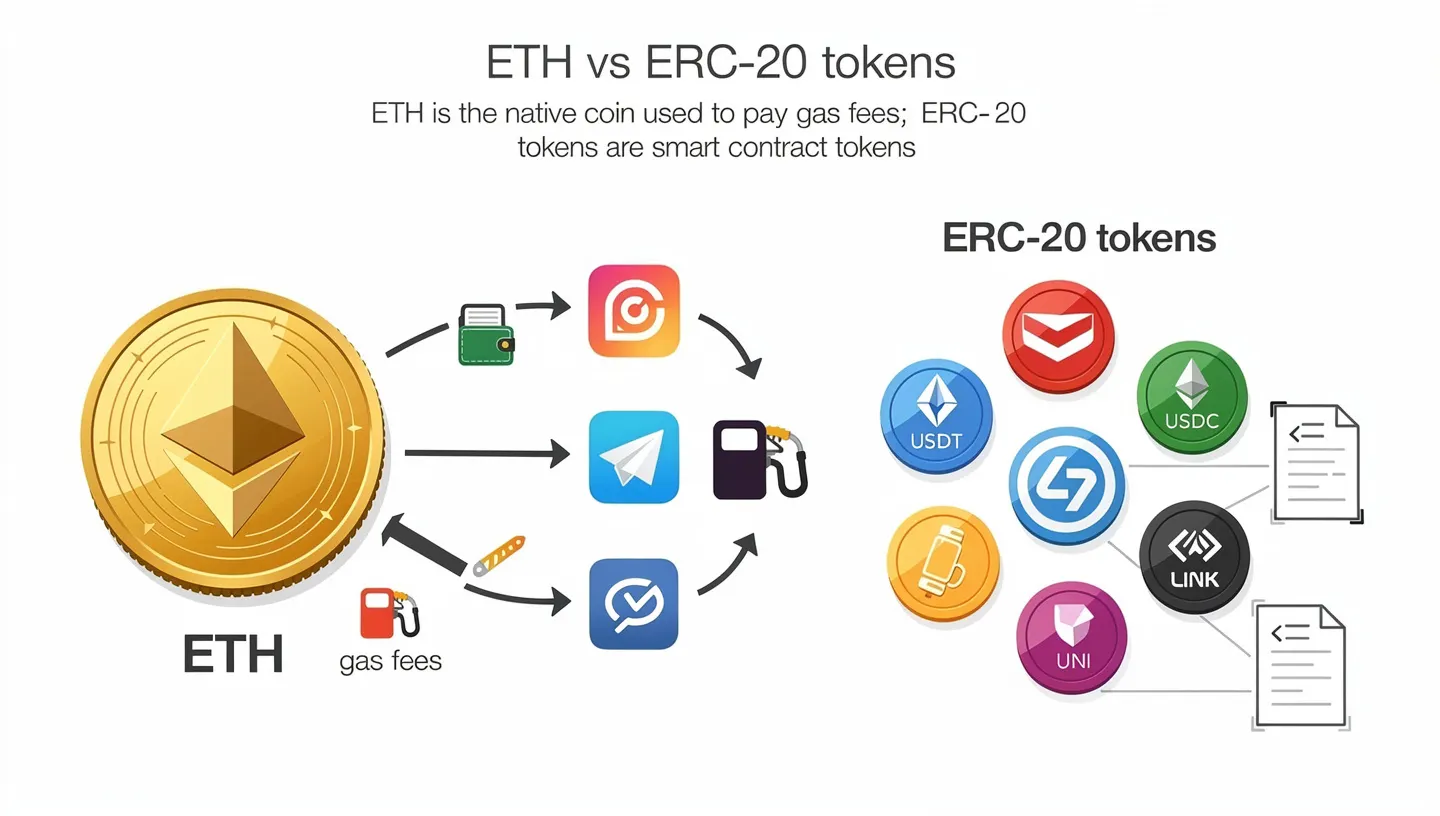
The table below compares ETH and ERC-20 tokens across the features that matter most in practice:
| Feature | ETH | ERC-20 tokens |
|---|---|---|
| Type | Native coin | Token (smart contract) |
| Created | 2015, before ERC-20 standard | After ERC-20 standard (2017 onward) |
| Contract address | None | Each token has its own |
| Can pay gas fees | Yes | No, gas always requires ETH |
| How it moves | Handled by Ethereum protocol | Handled by the token’s smart contract |
| Supply rules | No fixed cap, portion burned each transaction | Defined individually per token contract |
| Examples | ETH only | USDT, USDC, UNI, LINK, DAI |
The gas fee point is the one that affects users most directly. Every action on Ethereum, including sending ERC-20 tokens, swapping them on a decentralized exchange, or using any application built on Ethereum, requires ETH to cover the transaction fee. ERC-20 tokens cannot pay that fee themselves. This means anyone working with ERC-20 tokens always needs some ETH in their wallet, even when they are not sending ETH directly. For a full explanation of how gas is calculated and what drives the cost, see our guide on Ethereum gas fees.
What are ERC-20 tokens used for?
ERC-20 tokens cover a wide range of uses on the Ethereum network. Most fall into one of three categories.
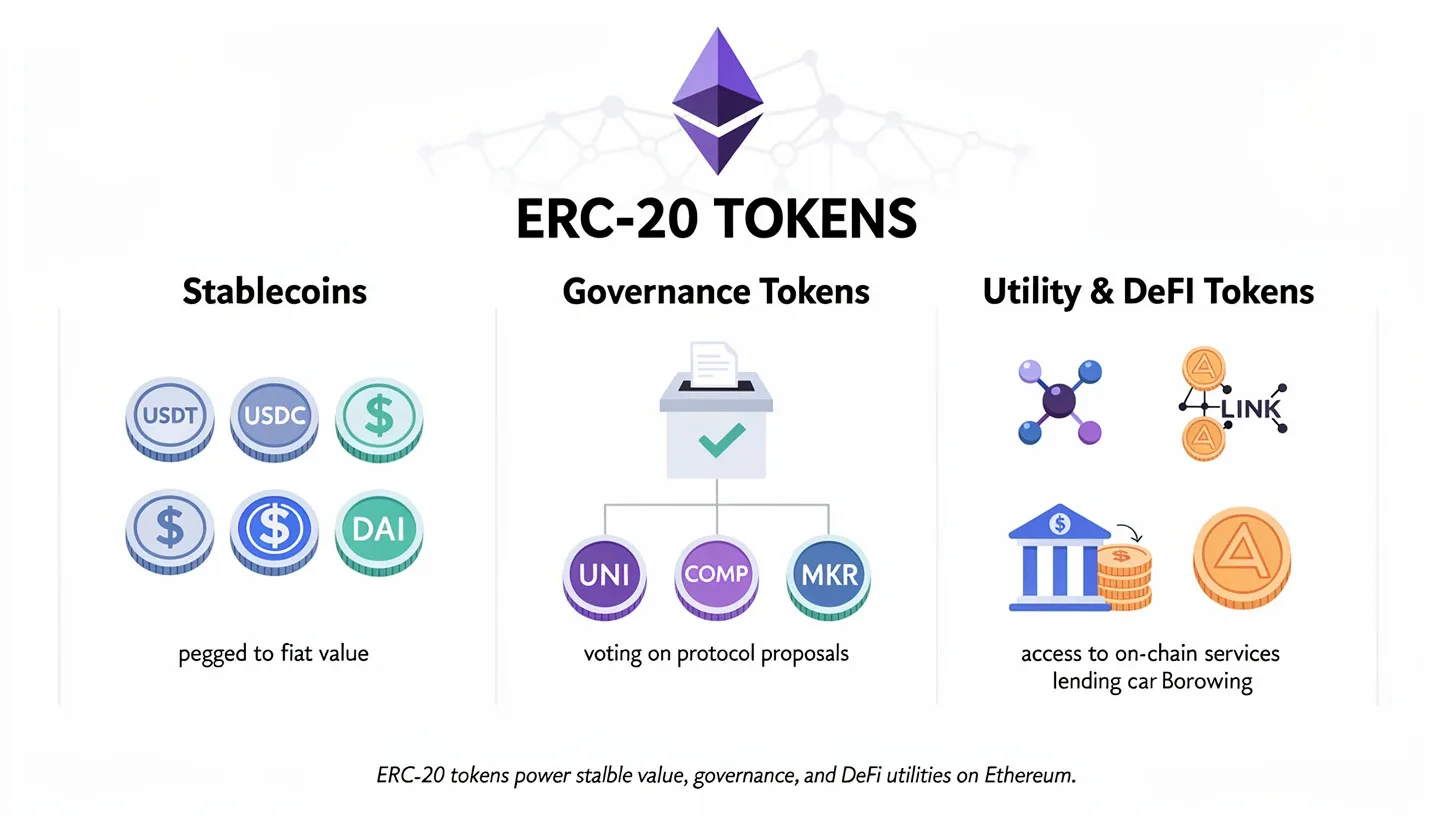
Stablecoins are ERC-20 tokens pegged to the value of a fiat currency like the US dollar. USDT (Tether), USDC, and DAI are the most widely held. They give users a way to hold a stable value on Ethereum without converting back to fiat or leaving the network. For a broader look at what ETH itself is used for compared to these tokens, see our breakdown of what ETH is used for.
Governance tokens give holders voting rights in the protocols that issued them. UNI (Uniswap), COMP (Compound), and MKR (MakerDAO) all work this way. Holders connect their wallet, check open proposals, and vote directly from their address without giving up custody of the tokens.
Utility and DeFi tokens are used to access specific services. LINK pays for data feeds from the Chainlink oracle network. AAVE is used for lending and borrowing on the Aave platform. Both are ERC-20 tokens that function as entry tickets to their respective protocols.
Some tokens that started as ERC-20 tokens have since migrated to their own blockchains. BNB, EOS, and Tron all launched on Ethereum before moving to separate networks. To understand how ERC-20 tokens compare to NFT standards on Ethereum, see our article on ERC-20 vs ERC-721.
Why is ETH not ERC-20 compatible?
The core issue is timing. ETH predates the ERC-20 standard, and no adjustment was ever made to bring ETH into compliance after the standard was introduced. When developers began building decentralized exchanges and lending platforms on Ethereum, they designed those applications around ERC-20 tokens. ETH, being the native coin, does not behave like an ERC-20 token and cannot be processed by the same code paths.
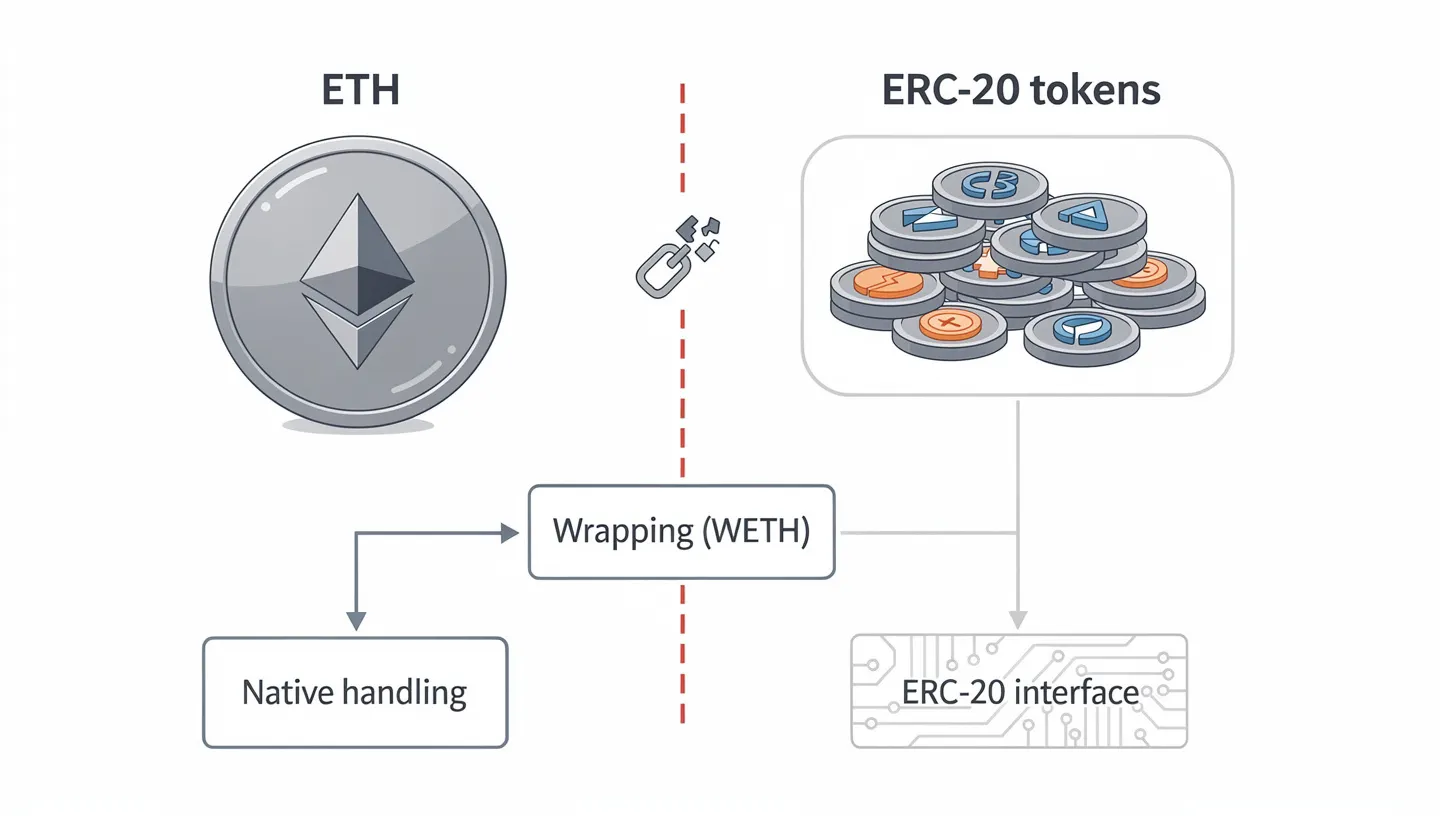
On a decentralized exchange like Uniswap, every trading pair is built to work with the ERC-20 interface. When one side of a pair is native ETH instead of an ERC-20 token, the exchange needs a separate set of instructions just to handle it. That means more code, more complexity, and a wider surface area for implementation errors. Most DeFi protocols avoid this either by requiring users to wrap their ETH first or by maintaining two entirely separate internal systems, one for ETH and one for ERC-20 tokens.
This is not a design flaw. ETH was built to be the native fuel of the network. The ERC-20 standard came later to give developers a shared framework for building tokens on top of that network. The two serve different roles by design. To understand how the Ethereum network processes instructions at the machine level, see our guide on the Ethereum Virtual Machine.
What is WETH and why does it exist?
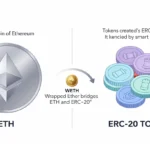
WETH, short for Wrapped Ether, is an ERC-20 token that represents ETH at a ratio of 1:1. It was built specifically because ETH is not ERC-20 compatible and cannot be used directly in many DeFi applications and decentralized exchanges that only accept ERC-20 tokens.
To get WETH, a user sends ETH to the WETH smart contract. The contract locks that ETH and issues the same amount of WETH in return. That WETH can be swapped on Uniswap, used as collateral on Aave or Compound, or deposited into a liquidity pool, the same as any other ERC-20 token. To get ETH back, the user sends WETH to the same contract and receives the original ETH. The process can be reversed at any time without a third party.
According to the Ethereum Foundation, roughly 3% of the total ETH supply is locked in the WETH contract, making it one of the most widely used tokens on the network.
There is one firm limit: WETH cannot pay gas fees. Gas fees on Ethereum must always be paid in native ETH. Anyone using WETH in DeFi needs to keep some native ETH in their wallet to cover each transaction.
What are some examples of ERC-20 tokens?
There are thousands of ERC-20 tokens deployed on the Ethereum network. The ones that appear most often across exchanges and DeFi applications are listed below:
- USDT (Tether) – stablecoin pegged to the US dollar, the most widely traded ERC-20 token by volume
- USDC (USD Coin) – stablecoin pegged to the US dollar, issued by Circle
- DAI – decentralized stablecoin managed by the MakerDAO protocol
- UNI (Uniswap) – governance token for the Uniswap decentralized exchange
- LINK (Chainlink) – utility token used to pay for Chainlink oracle data feeds
- AAVE – governance and utility token for the Aave lending protocol
- SHIB (Shiba Inu) – meme token launched as an ERC-20 token in 2020
Not all tokens stay on Ethereum permanently. BNB launched as an ERC-20 token before Binance moved it to the BNB Smart Chain. EOS and Tron followed the same path, starting on Ethereum before migrating to their own blockchains. A token that has migrated to another network is no longer an ERC-20 token, even if it began as one. Full token contract data for any ERC-20 token can be verified on Etherscan.
What are the risks of ERC-20 tokens?
ERC-20 tokens carry a few specific risks that do not apply in the same way to native ETH.
Sending to an incompatible contract address
If an ERC-20 token is sent to a smart contract that was not built to receive it, the token is permanently locked. The ERC-20 standard has no built-in mechanism to notify the receiving contract or to recover tokens sent by mistake. Once the transaction is confirmed on the blockchain, it cannot be reversed. This is one of the most common and costly errors in crypto, and it happens because contract addresses look the same as regular wallet addresses to the sender.
Token approval and allowance risk
ERC-20 tokens use an allowance system. When a user connects their wallet to a DeFi protocol, they typically approve the protocol to spend a set amount of tokens on their behalf. If that approval is set to an unlimited amount, a malicious or poorly written contract could withdraw far more than intended. Keeping approvals limited to the exact amount needed and revoking them afterward cuts down on this exposure.
No built-in legitimacy guarantee
Anyone can deploy an ERC-20 token contract. The standard defines how the token behaves technically but says nothing about its value, its supply cap, or who controls it. A token contract can be written to allow unlimited minting, meaning the person who deployed it could increase the supply at any time. Before holding any ERC-20 token, it is worth checking who controls the contract and whether any supply limits are written into the code. For a full walkthrough of how to transfer tokens safely, see our guide on how to transfer Ethereum and ERC-20 tokens.
ERC-20 on other blockchains
ERC-20 was built for Ethereum, but its structure inspired similar token standards on other blockchains:
- BEP-20 on the BNB Smart Chain
- SPL on the Solana network
- TRC-20 on the Tron network
These standards follow a comparable structure to ERC-20, but they run on separate networks with their own validators and consensus rules. A BEP-20 token is not compatible with an Ethereum wallet, and an SPL token cannot be sent to an ERC-20 address. Moving tokens between these networks requires a bridge, which is a separate tool and process from a standard wallet transfer. Sending an ERC-20 token directly to a BNB Smart Chain address or a Solana address without using a bridge will result in the tokens being permanently lost.
How to store ERC-20 tokens
Any Ethereum wallet can hold ERC-20 tokens because every ERC-20 token lives on the Ethereum blockchain. The wallet stores the user’s private key and address, while the token’s smart contract keeps a record of how many tokens belong to that address.
Software wallets like MetaMask are the most common choice for users who interact with DeFi applications and decentralized exchanges. They connect directly to browser-based applications and handle token approvals and balance checks from a single interface. Hardware wallets like Ledger and Trezor store private keys offline and are the safer option for anyone holding a significant amount of ERC-20 tokens over a long period.
Keeping tokens on a centralized exchange means the exchange holds the private keys on the user’s behalf. For anyone who wants direct control over their ERC-20 tokens, a self-custody wallet is the standard approach. To understand how the Ethereum network processes and confirms transactions, see our guide on how Ethereum works.
Frequently asked questions
Is ETH an ERC-20 token?
No. ETH is the native coin of the Ethereum network and does not follow the ERC-20 standard. ETH was launched on 30 July 2015, before the ERC-20 standard was written. ERC-20 is a standard for tokens created by developers on top of Ethereum using smart contracts. ETH is not a smart contract and has no contract address.
What does ERC-20 stand for?
ERC stands for Ethereum Request for Comments, and 20 is the number of the specific proposal. The formally finalized version is called EIP-20 (Ethereum Improvement Proposal 20). Both names refer to the same token standard and are used interchangeably in most contexts.
Can ETH be used on ERC-20 platforms?
Not directly. Because ETH is not ERC-20 compatible, it cannot be used natively in DeFi protocols and decentralized exchanges that only accept ERC-20 tokens. The workaround is Wrapped Ether (WETH), an ERC-20 token pegged 1:1 to ETH. By converting ETH to WETH, users can interact with any platform that requires ERC-20 tokens.
What is the difference between ETH and WETH?
ETH is the native coin of Ethereum, used to pay gas fees and send value directly on the blockchain. WETH is an ERC-20 token that represents ETH at a 1:1 ratio and can be used on DeFi platforms and decentralized exchanges that do not accept native ETH. The key practical difference is that WETH cannot pay gas fees. Gas always requires native ETH, so anyone using WETH in DeFi needs to keep some native ETH in their wallet alongside it.
Are all Ethereum tokens ERC-20?
No. ERC-20 is the standard for fungible tokens, where every unit is identical and interchangeable. There are other standards on Ethereum for different purposes. ERC-721 is the standard for non-fungible tokens (NFTs), where each token is unique. ERC-1155 is a multi-token standard that can handle both fungible and non-fungible tokens within a single contract.
What happens if you send ERC-20 tokens to the wrong address?
If ERC-20 tokens are sent to a smart contract that was not designed to receive them, the tokens are permanently locked and cannot be recovered. The ERC-20 standard has no built-in mechanism to handle or return tokens sent to incompatible contracts. If tokens are sent to a regular wallet address by mistake, only the person who controls that address can send them back. Always double-check the receiving address and confirm you are on the correct network before approving any token transfer.