You send ETH to an exchange, the app shows it as pending, and a small number starts climbing: 1, 2, 3 confirmations. How many of those do you actually need before the funds are safe to use? The honest answer depends on what you are doing, since a coffee sized payment and a six figure transfer do not carry the same risk. This guide breaks down what a confirmation actually is, how many you need in different situations, and why some platforms make you wait far longer than others.
By the end you should be able to look at any pending ETH transaction and know roughly how long it needs, whether you are sending to a friend, depositing on an exchange, or waiting on a large transfer where extra caution actually matters.
What Is a Block Confirmation on Ethereum?
Every time you send ETH, that transaction gets bundled into a block along with others and added to the chain. The moment that happens, your transaction has one confirmation. Every block added after that one adds another confirmation, since it buries your transaction one layer deeper under the growing chain. Two blocks later, you have two confirmations. Ten blocks later, ten confirmations, and so on for as long as you keep counting.
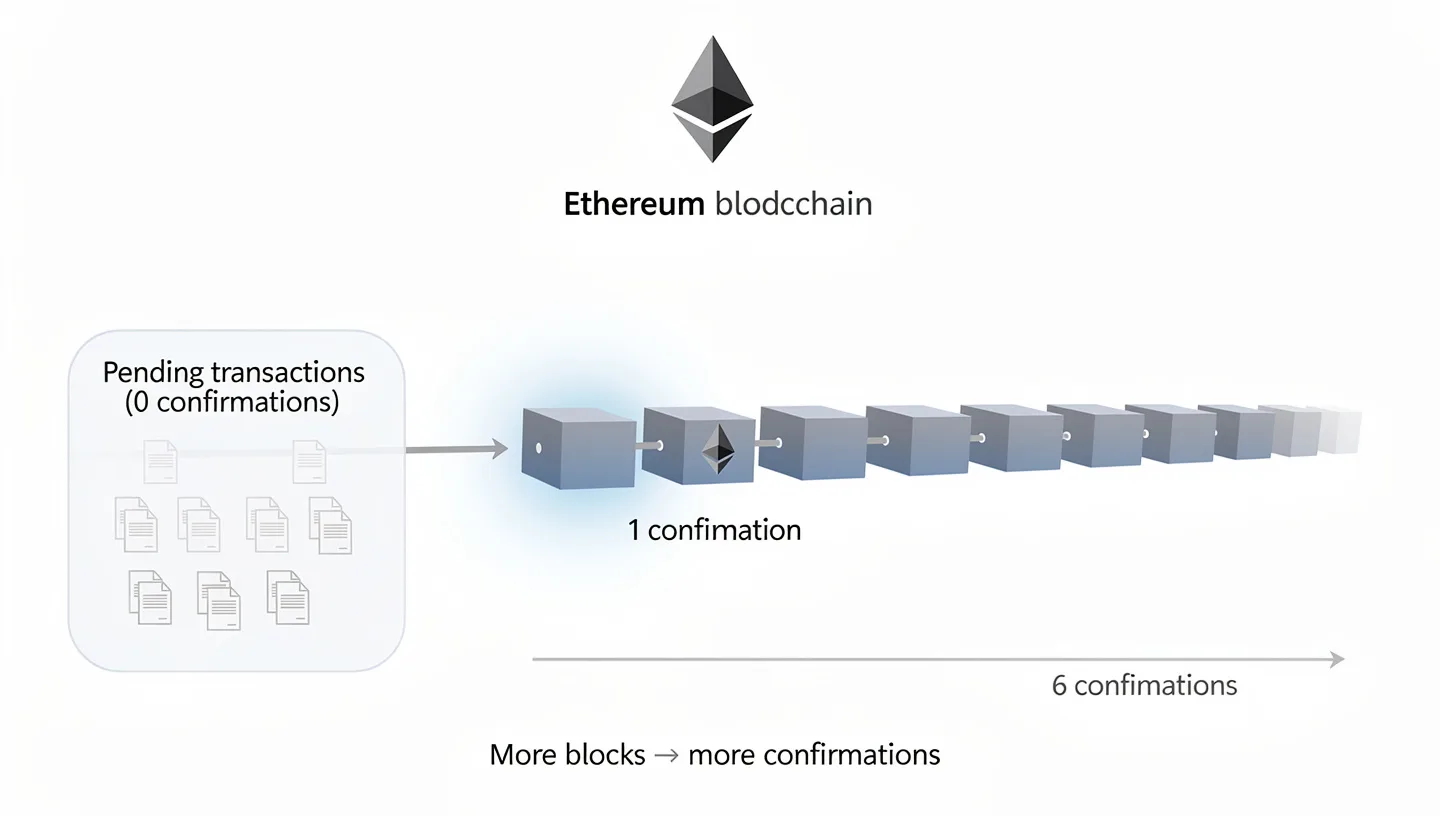
The idea behind counting confirmations is simple: the deeper a transaction sits under newer blocks, the harder it becomes for anyone to rewrite history and undo it. A transaction with zero confirmations is still sitting in the pool of pending transactions, waiting to be picked up. A transaction with even a single confirmation has already been recorded, though most platforms still want a few more before treating it as fully settled, and knowing where that threshold sits for your specific situation is really the whole point of this guide.
This system exists because blockchains are built to be trustless. Nobody has to take your word that a payment went through, and nobody has to take the word of the person receiving it either. The chain itself, and the growing number of blocks sitting on top of any given transaction, is the proof that everyone can check independently. Understanding how the Ethereum network processes transactions in the first place makes this whole confirmation process much easier to follow, especially once you start asking how many confirmations a specific situation actually calls for.
How Long Does One Confirmation Take?
Once your transaction lands in its first block, the clock for further confirmations starts ticking at a predictable pace. Knowing that pace is what lets you estimate, with reasonable accuracy, how long any given number of confirmations will actually take in practice.
Block time on Ethereum, the gap between one block and the next, runs at a steady 12 seconds. This pace comes from how the network is structured under Proof of Stake, where time is divided into fixed 12 second windows called slots. In each slot, one validator gets the chance to propose a new block, and other validators check and confirm it before the network moves to the next slot.
Because this 12 second rhythm rarely changes, working out roughly how long a given number of confirmations will take is straightforward math. Twelve confirmations lands somewhere around two to three minutes. Thirty confirmations lands closer to six minutes. These numbers assume your transaction gets picked up in the very next block, which usually happens quickly but is not guaranteed the moment the network gets busy.
It is worth noting how much this block time has shaped Ethereum’s reputation. A steady 12 second pace is not the fastest among modern blockchains, but it strikes a balance most networks struggle with, fast enough for everyday use while still staying decentralized across thousands of independent validators rather than a small handful of servers.
Confirmations vs Finality: What’s the Difference?
This is the part most guides skip over, and it matters more than the raw confirmation count. A confirmation is a gradual measure of security, each new block makes reversing your transaction slightly harder than before. Finality is a hard stop, a point where the network gives a mathematical guarantee that your transaction cannot be undone at all under normal protocol rules. Grasping this distinction clears up most of the confusion people run into when comparing conflicting numbers across different sources.
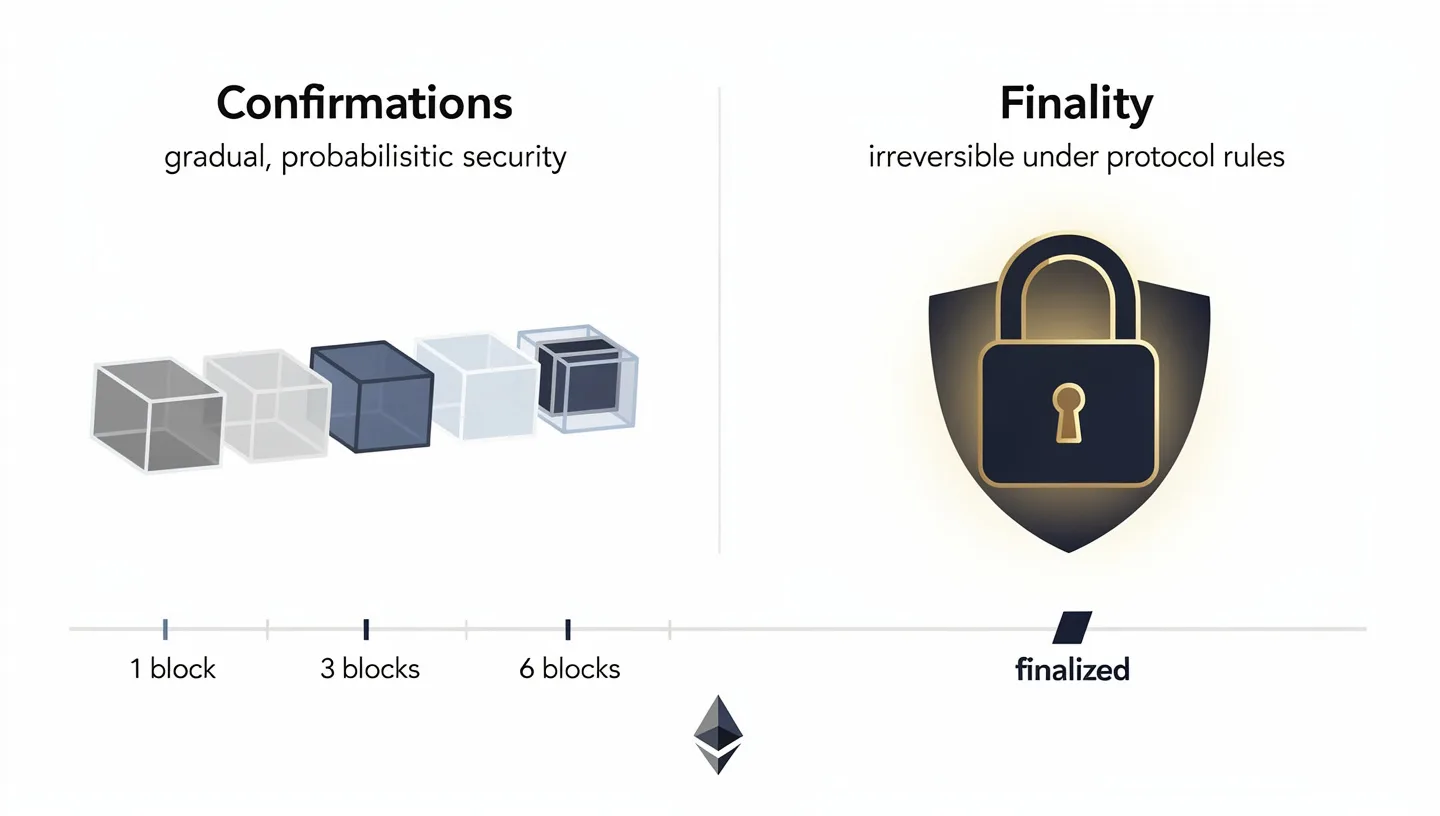
On Ethereum, finality arrives after roughly two full epochs, an epoch being a block of 32 slots, which works out to somewhere around 12 to 15 minutes. Once a transaction is finalized, reversing it would require an enormous portion of all staked ETH to be destroyed through a penalty called slashing, something that has never happened and would cost attackers a staggering amount of money to attempt. You can read more about how this security model works in Ethereum’s own documentation on Proof of Stake, which explains the slashing mechanism in detail.
Here is the part that surprises people: almost nobody actually waits for full finality. A coffee shop accepting ETH does not need 13 minutes of certainty. An exchange handling a large deposit might. The number of confirmations you need is really a question of how much risk you are willing to accept for the situation in front of you, not a fixed rule that applies everywhere.
Think of confirmations and finality as two different kinds of assurance stacked on top of each other. Confirmations answer the everyday question of whether a payment has landed and can reasonably be trusted. Finality answers a much narrower, much stronger question: could this transaction ever be undone, under any circumstance the protocol allows for. Most people only ever need the first answer, while institutions moving very large sums are often the ones who genuinely need the second.
This distinction did not exist in quite the same form before Ethereum’s move to Proof of Stake. Under the old system, security only ever grew gradually with each additional block, and there was no fixed point where the network could say with mathematical certainty that a transaction was permanently locked in. The current design trades a small amount of raw speed for a much clearer guarantee, which is part of why understanding both confirmations and finality together gives a far more complete picture than looking at either one on its own.
How Many Confirmations Do You Actually Need?
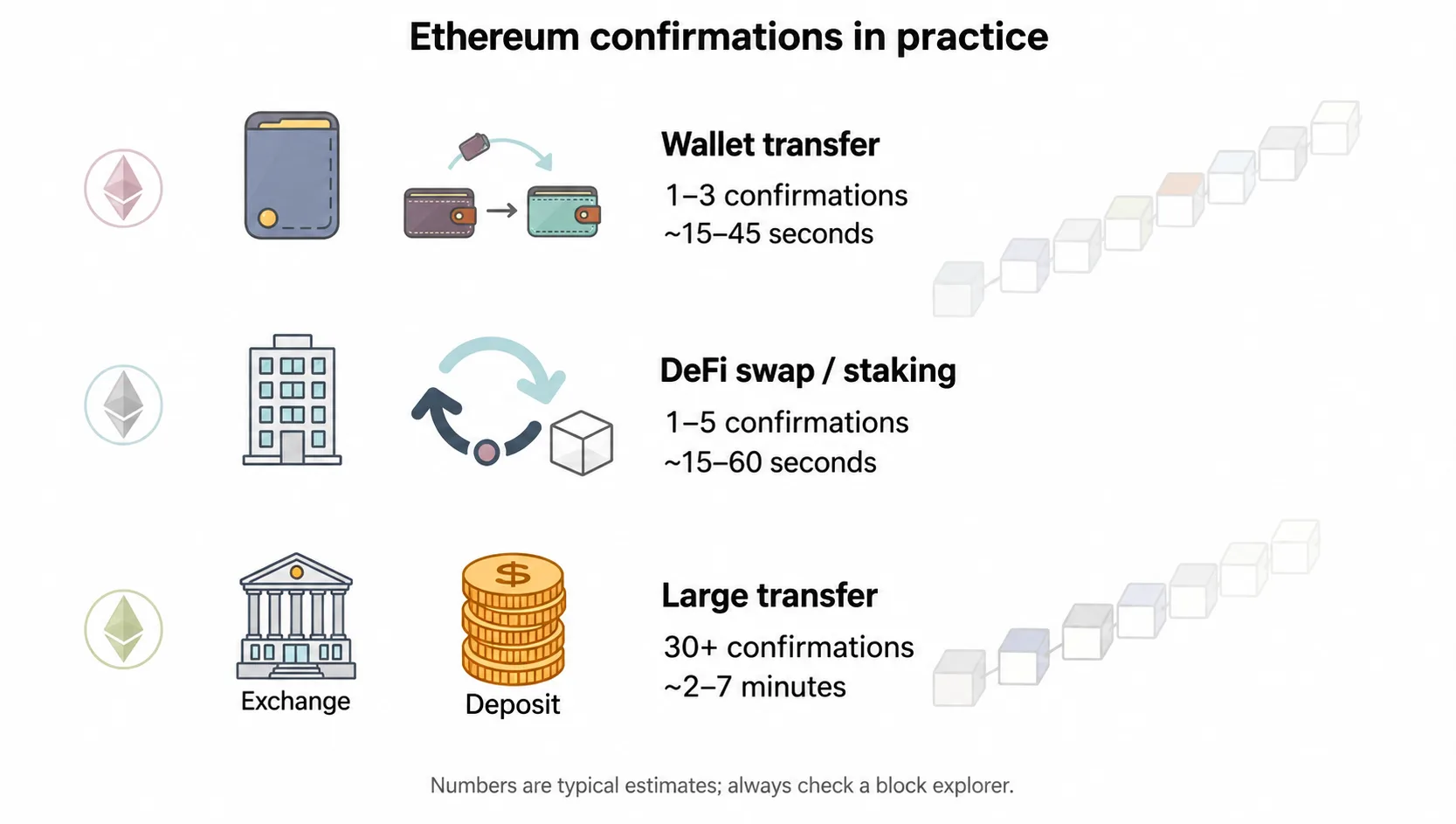
The right number changes depending on what kind of transaction you are dealing with. Here is a practical breakdown.
| Type of Transaction | Typical Confirmations | Approximate Time |
|---|---|---|
| Wallet-to-wallet transfer | 1 to 3 | 15 to 45 seconds |
| DeFi swaps and staking actions | 1 to 5 | 15 to 60 seconds |
| Deposits to a crypto exchange | 12 to 35 | 2 to 7 minutes |
| Large or high-value transfers | 30 or more | 6 minutes or longer |
These numbers are working estimates rather than strict rules, since actual wait times shift with network conditions and the gas price you set, usually measured in Gwei. Treat the table as a starting point for what to expect rather than a promise, and check a block explorer directly whenever precision actually matters.
The categories in the table are not hard boundaries either. A platform might sit right between two rows, treating a modest exchange deposit closer to the DeFi end of the scale while reserving the higher confirmation counts for withdrawals or larger sums. Reading the specific policy of whatever service you are using still beats assuming a one size fits all number applies everywhere. Keep in mind too that confirmation requirements depend entirely on where the funds are going, not on where they originally came from or how you first acquired them.
Wallet-to-Wallet Transfers
Sending ETH from one wallet to another rarely needs more than a handful of confirmations, since most wallets show the funds as received the moment the transaction is included in a block. A wallet-to-wallet send for a normal amount usually clears in under a minute once the transaction gets picked up.
DeFi Transactions and Swaps
Decentralized exchanges and lending platforms tend to move fast, often acting on a transaction after just one or two confirmations. Speed matters more here than deep security, since the amounts involved in a routine swap are usually modest and the platform itself is built around quick execution. A failed or reverted swap is also easy to retry, which lowers the stakes compared with a deposit that a centralized exchange has to credit permanently.
Sending to a Crypto Exchange
Centralized exchanges take this far more seriously, since they are accepting a deposit on your behalf and covering the risk if something goes wrong. Most require somewhere between 12 and 35 confirmations before crediting your account, which stretches the wait to several minutes.
This caution is not arbitrary. An exchange crediting your account effectively lets you trade or withdraw against that deposit immediately, so if a chain reorganization were ever to reverse the original transaction after the exchange had already acted on it, the exchange would be the one absorbing the loss. Waiting for more confirmations shifts that risk down close to zero before any funds become usable on the platform.
Large or High-Value Transfers
Anything moving a serious amount of value, whether that is a personal transfer or an institutional settlement, tends to sit at 30 or more confirmations. At that depth the transaction is close enough to full finality that reversing it would already be extremely difficult, giving both sides real peace of mind before treating the funds as settled.
There is no strict rule forcing anyone to use exactly 30 confirmations for a large transfer. Some platforms set their own threshold higher out of caution, especially during periods of unusual network activity, and it is common for a service handling institutional sized amounts to simply wait for full finality rather than settle for a fixed confirmation count. If you are ever unsure how cautious to be, matching the size of your wait to the size of the transaction is a reasonable rule of thumb, and there is nothing wrong with waiting longer than strictly necessary if it lets you sleep easier.
Confirmation Requirements by Exchange
Exchange policies shift over time, but the numbers below give a fair sense of how platforms typically handle ETH deposits.
| Exchange | Confirmations Required |
|---|---|
| Coinbase | Around 35 |
| Kraken | Around 20 |
| Binance | Around 12 |
| Crypto.com | Around 12 |
These figures change occasionally as platforms adjust their own risk policies, so treat the table as a general guide rather than a guarantee. If you are moving a meaningful amount to an exchange, checking that specific platform’s current deposit policy before sending saves you from guessing how long you will be waiting. This matters just as much whether you are depositing ETH you already held or funds fresh from buying ETH for the first time, since the confirmation count depends on the destination, not the source.
What Affects How Long Confirmations Take?
The 12 second block time stays fixed, but that does not mean every transaction moves through the process at the same speed. A few practical factors decide whether your transaction gets picked up right away or sits waiting its turn, and understanding them helps explain why two people sending the exact same amount can end up waiting very different lengths of time.
Gas Fees and Priority
Validators build blocks by picking transactions willing to pay the most, so a higher gas fee gets your transaction included sooner. When the network is quiet, even a modest fee lands you in the next block. When it is busy, transactions offering a low tip can sit waiting for several minutes or longer while others jump ahead of them. Most wallets let you adjust this fee directly before confirming a send, giving you some control over how quickly your transaction gets picked up.
Network Congestion
Busy stretches, whether triggered by a popular NFT mint, a volatile market, or heavy DeFi activity, mean more transactions are competing for the same limited block space. Confirmation counts themselves do not slow down, since blocks still land every 12 seconds, but getting your transaction into that first block can take longer if the mempool is crowded with higher paying competitors.
Transaction Complexity
A plain ETH transfer is about as simple as it gets and usually gets included quickly. A transaction that calls a smart contract, such as a swap or a staking deposit, requires more computational work and a higher gas limit, which can occasionally add friction if that limit is set too low or the network is under heavy load.
Wallet type plays a smaller but still noticeable role too. A hot wallet already connected to the internet can broadcast a transaction the instant you approve it, while a cold hardware wallet needs an extra step of being connected and unlocked first, which adds a short delay before the transaction even reaches the network. That gap has nothing to do with confirmations themselves, but it does affect the total time you experience from clicking send to actually seeing funds arrive.
How to Speed Up an ETH Confirmation
If a transaction is taking longer than expected, a few things usually help move it along.
- Check current gas prices before sending and choose a fast or priority setting rather than the cheapest option.
- If a transaction is already stuck, most wallets offer a speed up or replace-by-fee option that resubmits it with a higher fee.
- Avoid sending during known busy periods, such as major NFT launches or sudden market swings, when possible.
- For smart contract interactions, double check that the gas limit is set high enough, since an insufficient limit can cause delays or outright failure.
None of these tricks change how long a single confirmation itself takes, since block time stays fixed at 12 seconds regardless of your fee. What they change is how quickly your transaction gets picked up for that first block in the first place, which is usually the part actually costing you time. Sites like ultrasound.money track live gas prices and network activity if you want a sense of whether the network is quiet or congested before you send anything.
Timing matters more than people expect. A transfer submitted at a quiet moment, say late at night in a region with low activity, can clear noticeably faster than the exact same transaction sent during a busy stretch, even with an identical gas fee attached. If you are not in a rush, waiting an hour or two for congestion to settle can sometimes save both time and money.
How to Check Your Confirmation Status
The simplest way to track a pending transaction is to paste its hash into an Ethereum block explorer such as Etherscan. The result page shows a running confirmation count that updates as new blocks land, along with the transaction’s current status: pending, success, or failed. Checking this directly is far more reliable than guessing based on how long the app on your phone has been spinning.
Most wallets also show a basic version of this status directly in their interface, though it usually lags a few seconds behind what a block explorer shows in real time. If a transfer is taking noticeably longer than the table above suggests, checking the block explorer first tells you whether the delay is simply the network being busy or something worth troubleshooting, such as a gas fee set too low to attract a validator’s attention. Anyone new to sending funds might also want a refresher on how to transfer Ethereum correctly before assuming a stuck transaction is a bigger problem than it actually is.
Frequently Asked Questions
A few more questions come up often once people understand the basics of how confirmations and finality actually work together.
Is one confirmation enough for Ethereum?
For small, low-risk transfers between your own wallets, one confirmation is often enough since the transaction is already recorded on the chain. For anything involving real value or a third party such as an exchange, waiting for several more confirmations is the safer choice.
How long does it take to reach finality on Ethereum?
Finality typically arrives after about two epochs, roughly 12 to 15 minutes. At that point the transaction is considered cryptographically irreversible under normal protocol rules, though most everyday transactions never need to wait that long.
Why do exchanges require more confirmations than wallets?
Exchanges are accepting responsibility for your deposit the moment they credit your account, so they wait longer to reduce the tiny risk of a chain reorganization reversing the transaction after the fact. A personal wallet transfer carries far less of that institutional risk.
Can a confirmed ETH transaction be reversed?
In theory a transaction with very few confirmations could be affected by a brief chain reorganization, though this is rare on Ethereum under Proof of Stake. Once a transaction reaches finality, reversing it would require an attack costing an enormous amount of staked ETH, making it practically impossible.
Why is my ETH transaction still pending?
A pending transaction usually means the gas fee attached was too low for current network conditions, or the network is simply congested with higher paying transactions ahead of yours. Checking current gas prices and using a speed up option in your wallet is the usual fix.
How many confirmations does Coinbase need for ETH?
Coinbase has generally required around 35 confirmations for ETH deposits, which takes roughly seven minutes under normal network conditions. This figure can change, so checking their current deposit policy before sending a large amount is worth doing. Kraken and other major platforms tend to sit somewhere lower on that scale, which is part of why comparing exchanges before a large deposit is a habit worth building.
Does a higher gas fee reduce the number of confirmations needed?
No. A higher gas fee only affects how quickly your transaction gets picked up for its first confirmation. Once it is included in a block, every confirmation after that still arrives at the same steady 12 second pace, regardless of what fee you paid.