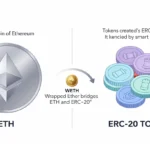
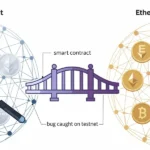
Anyone who spends time in Ethereum wallets or on decentralized exchanges eventually runs into two tickers that look almost identical: ETH and WETH. They carry the same price, the same name at first glance, and the same blockchain underneath them, yet they are not interchangeable in every situation. Understanding ETH vs WETH matters the moment you try to trade on a decentralized exchange, provide liquidity, or bid on an NFT and the platform suddenly asks for a token you have never heard of before.
The confusion is understandable. Nothing about the letter W in front of ETH tells a new user what changes underneath the surface, and most exchanges do not explain the difference before asking you to wrap your funds. This guide walks through what each token actually is, why WETH was created in the first place, how the two differ in practice, and what happens technically when you move from one to the other. By the end you should be able to tell at a glance which one a given situation calls for.
What Is ETH?
ETH is the native currency of the Ethereum network. It is the asset that pays for every transaction on the chain, the one validators receive as a reward for securing the network, and the one most people buy first when they enter the crypto space. ETH was built into the protocol itself, which means it does not follow the rules that apply to tokens created on top of Ethereum.
ETH covers a handful of jobs at once. It pays gas fees for every transaction and every smart contract call. It works as a store of value for long term holders. And since the network moved to proof of stake, ETH is also the asset that validators lock up to help secure the chain. None of these roles require ETH to follow any token standard, because ETH sits at the base layer rather than on top of it.
It helps to compare ETH to something outside crypto. A national currency exists independently of any card, app, or bank that later gets built to move it around. ETH works the same way inside Ethereum. It settles value directly at the protocol level, the way cash settles a purchase without needing a separate ledger to confirm it. Tokens, on the other hand, are closer to gift cards or loyalty points: they carry value, but that value rides on top of infrastructure someone else built and maintains.
What Is WETH?
WETH, short for Wrapped Ether, is a token that represents ETH on a one to one basis. Every WETH in circulation is backed by an equal amount of ETH sitting inside a smart contract. The value never drifts apart from ETH, because you can always trade one for the other through that same contract.
The easiest way to picture the difference is to separate coins from tokens. A coin runs on its own blockchain and settles transactions directly, the way ETH does on Ethereum. A token, on the other hand, is built using existing blockchain infrastructure and follows a set of rules written into a smart contract. WETH is a token built on top of Ethereum that simply mirrors the value of the coin underneath it. Think of it the way you would think of a claim ticket at a coat check: the ticket is not the coat, but it always gets you the coat back.
Why Does WETH Exist in the First Place?
Ethereum launched in 2015, years before developers agreed on a common format for tokens. In 2017 the community settled on the ERC-20 standard, a shared set of functions such as transfer, approve, and balance that let different tokens talk to the same smart contracts and interfaces without custom code for each one. The problem was timing. ETH already existed and was not built to follow rules that came out two years later, so it never became an ERC-20 token itself.
That gap created friction. Decentralized exchanges, lending markets, and liquidity pools were being built around the ERC-20 format, and ETH simply did not fit the mold. A group of developers, including teams behind 0x, MakerDAO, and Gnosis, solved this by writing a small contract that locks ETH and issues an equal amount of an ERC-20 compliant token in return. The canonical WETH contract went live on Ethereum mainnet in January 2018 and has barely changed since, because a contract holding this much value has little reason to be touched once it works. The full technical proposal behind it is documented in the original ERC-20 token standard, which laid out the functions every compliant token, WETH included, had to implement.
Before this contract existed, developers writing DeFi applications had to write two separate code paths for every function: one for ETH and a different one for every ERC-20 token. That doubled the testing burden and doubled the chances of a bug slipping through. Wrapping ETH into a token that behaves exactly like every other ERC-20 asset let developers delete that second code path entirely and treat every asset the same way inside their contracts.
ETH vs WETH: Key Differences
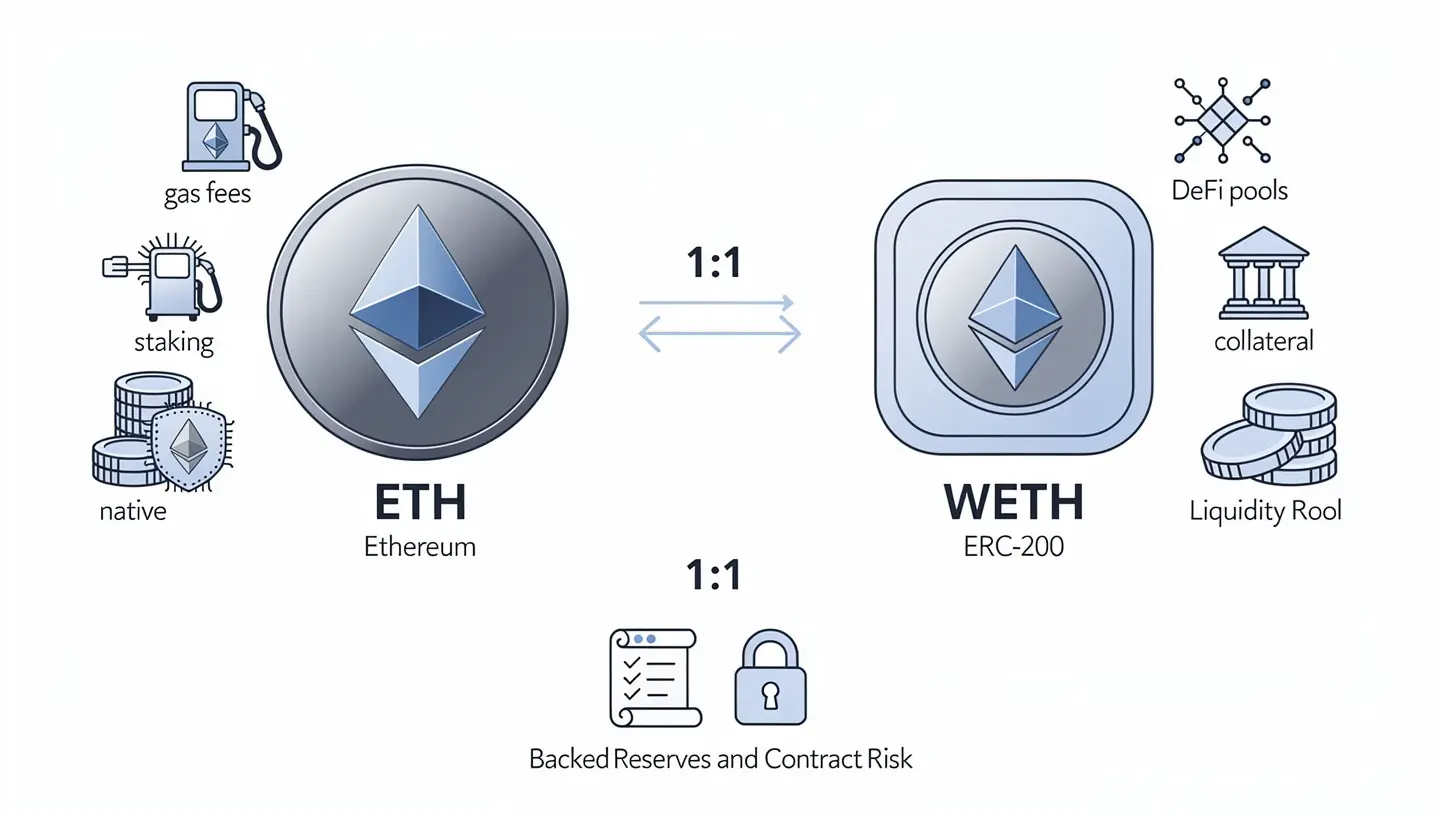
Both assets share the same price and the same underlying network, so the differences come down to structure and use rather than value.
Nature and Origin
ETH is the native asset of the Ethereum blockchain, built into the protocol from day one. WETH is a token created afterward through a smart contract, designed specifically to give ETH an ERC-20 shell it never had on its own.
ERC-20 Compatibility
This is the core distinction. WETH follows the ERC-20 standard down to the letter, with functions like transfer and approve baked in. ETH does not, which is exactly why platforms built for ERC-20 tokens cannot accept plain ETH without extra custom logic. This same standard also governs other well known tokens on Ethereum, including stablecoins and governance tokens, which is why WETH slots into the same pools, wallets, and interfaces without any special handling once it exists.
Developers sometimes describe this as giving ETH a uniform, so every contract can treat it exactly the way it treats any other ERC-20 asset. Without that uniform, a decentralized exchange would need one set of code to handle ETH and a completely separate set of code to handle every other token, which is both slower to build and more likely to contain bugs.
Gas Fees
ETH pays for gas on every transaction, no exceptions. WETH cannot be used to cover gas fees at all, even though wrapping and unwrapping still costs gas paid in regular ETH. If your wallet runs completely dry of ETH, you will not be able to unwrap your WETH back into spendable ETH until you top up.
Use Cases
ETH gets used for everyday transfers, staking, and paying fees. WETH is built for DeFi work: trading pairs on decentralized exchanges, collateral on lending platforms, and liquidity pools that require a standard token format.
Price and Value
WETH tracks ETH at a strict one to one ratio, since every WETH token is backed by locked ETH sitting in the wrapping contract. Minor price gaps can appear for a few seconds on thin markets, but arbitrage traders close that gap almost instantly because converting between the two is cheap and direct.
Centralization Concerns
ETH itself has no single point of failure beyond the Ethereum network as a whole. WETH, by contrast, depends on one smart contract holding the locked reserves. That contract has been running since 2018 without incident and has been audited repeatedly, but it still introduces a layer that pure ETH does not have. Anyone curious can inspect the exact holdings and transaction history of the canonical WETH contract on Etherscan, where the locked reserves are fully visible to the public at any moment.
A short summary of the practical differences looks like this:
| Feature | ETH | WETH |
|---|---|---|
| Type | Native coin | ERC-20 token |
| Pays gas fees | Yes | No |
| Works directly in DeFi pools | No | Yes |
| Backed by | The Ethereum protocol itself | Locked ETH in a smart contract |
| Used for staking | Yes | No |
How to Wrap ETH into WETH
Wrapping ETH means sending it into the WETH smart contract and receiving WETH back at a fixed rate. Most people never touch the contract directly, since wallets and decentralized exchanges handle the interaction behind a single button.
A typical wrap on a platform such as Uniswap looks like this:
- Connect your wallet to the exchange or app.
- Select ETH as the token to send and WETH as the token to receive.
- Enter the amount you want to wrap and confirm the transaction.
- Pay the small gas fee required to interact with the contract.
- Wait for the transaction to confirm, after which WETH appears in your wallet.
Some hardware wallets and browser extensions display this whole process as a single swap, with no separate wrap button anywhere in sight. The result is the same regardless of how the interface labels it: ETH goes in, WETH comes out, and the exchange rate never moves away from one to one.
Under the hood, this calls a deposit function on the WETH smart contract, which locks your ETH and mints an equal amount of WETH directly to your address. Nothing about your balance changes in value, only in format.
Some wallets and mobile apps hide this step behind a single swap button and never mention the word wrap at all, especially when they are routing you into a liquidity pool automatically. It is still worth knowing what happened behind the scenes, since that locked ETH sits in the contract until someone, whether that is you or another user, sends the matching WETH back to release it.
How to Unwrap WETH Back to ETH
Unwrapping runs the same process in reverse. You send WETH back to the contract, which burns the tokens and releases the equivalent amount of ETH to your wallet. The steps mirror wrapping almost exactly: pick WETH as the token to send, ETH as the token to receive, confirm the swap, and pay the gas fee.
There is no slippage and no price risk in either direction, since the contract always honors the fixed one to one rate. The only real cost is the gas needed to trigger the transaction, which is why some traders time their wraps and unwraps for periods when the network is less busy.
One detail that trips up new users: you cannot unwrap WETH if you have no ETH left at all to cover the gas fee for that transaction. It sounds circular, but it is the same rule that applies to every transaction on Ethereum, wrapping included. Keeping a small ETH balance on hand avoids getting stuck with WETH you technically cannot move.
Where Is WETH Actually Used?
Decentralized Exchanges
Platforms such as Uniswap, SushiSwap, and Balancer build their liquidity pools around ERC-20 pairs. WETH became the default trading pair for ETH on these platforms simply because raw ETH does not fit the pool structure without being wrapped first.
Liquidity providers who deposit into an ETH pool are almost always depositing WETH rather than plain ETH, even if the interface displays an ETH logo throughout the process. The wrapping happens automatically the moment you confirm the deposit, and unwrapping happens the same way when you withdraw your share of the pool.
Lending and Borrowing
Protocols like Aave, Compound, and MakerDAO accept WETH as collateral for loans. Since these platforms are built entirely around ERC-20 deposits, WETH lets ETH holders borrow against their holdings without ever selling the underlying asset.
NFT Marketplaces
Marketplaces such as OpenSea rely on WETH for bids and offers, because a bid needs to be locked in an ERC-20 format that the smart contract can hold in escrow until the seller accepts or the bidder cancels. Bidding with plain ETH is not possible on most of these platforms for exactly this reason, so collectors often keep a portion of their holdings pre-wrapped and ready to go.
Cross-Chain and Layer 2 Activity
Moving assets between chains almost always means passing through a wrapped or bridged version of the original token. WETH plays that role for ETH across rollups, sidechains, and other EVM compatible networks, the same way WBTC does for Bitcoin.
Other chains have their own equivalents built on the same idea. WBNB wraps BNB for use on BNB Smart Chain, and WMATIC does the same job for Polygon. All of these tokens exist for one reason: native coins were designed before the ERC-20 standard existed, and wrapping is the workaround that lets them join the same DeFi ecosystem as everything built after them.
Risks of Using WETH
WETH inherits Ethereum’s security, but it adds its own layer of smart contract risk on top. The canonical contract has been battle tested since 2018 and has never been hacked, yet the same cannot be said for every wrapped asset out there. In 2022, attackers stole more than 120,000 wrapped ETH from the Wormhole bridge, a separate contract used to move assets between Ethereum and Solana. The lesson from that incident is not that WETH itself is unsafe, but that any bridge or wrapping mechanism is only as strong as its code and its audits.
It is worth separating two things that often get blurred together: the canonical WETH contract on Ethereum mainnet, and the many bridge specific wrapped tokens that carry a similar name on other chains. The mainnet contract is the one referenced throughout this guide, the one with years of continuous use and no history of being drained. A wrapped ETH token issued by a newer bridge on a different chain is a separate piece of code entirely, with its own audit history, or in some cases, none at all.
Counterparty risk is the other factor worth understanding. When you wrap ETH, you are trusting that the contract holding your locked ETH will always release it back on demand. The canonical WETH contract has a long track record, but newer or less audited wrapping contracts on other chains deserve more scrutiny before you commit funds. Staying alert to common scams in the space is worth doing regardless of which token you hold, since fake WETH contracts and phishing sites that mimic wrapping interfaces do circulate from time to time.
A simple habit protects against most of this: always check the contract address of the WETH you are interacting with against the widely recognized canonical address rather than trusting a name or logo inside an app. Wallets that display verified token lists make this easier, but it never hurts to double check before approving a large transaction.
ETH vs WETH: Which One Should You Use?
For everyday transfers, paying gas, or simply holding ETH long term, plain ETH is the right choice and the only option that actually works for network fees. The moment you want to trade on a decentralized exchange, provide liquidity, borrow against your holdings, or bid on an NFT, WETH becomes necessary because those platforms are built around the ERC-20 format. Most people end up holding a mix of both: ETH for gas and storage, WETH for whatever DeFi activity they are involved in at the time.
A simple rule of thumb works for most situations: keep enough plain ETH in your wallet to cover gas for the next several transactions, and wrap only the amount you actually plan to use inside DeFi. There is rarely a reason to wrap your entire balance at once, since you can always convert more the moment you need it, and the process takes seconds either way. If you are still building your first position, it helps to know how to buy ETH before worrying about wrapping it.
Frequently Asked Questions
Is WETH worth the same as ETH?
Yes. Every WETH token is backed one to one by ETH locked in the wrapping contract, so the two track the same price at all times. Small gaps can appear for a moment on thin markets, but they close quickly because converting between the two costs almost nothing beyond gas.
Can I convert WETH back to ETH at any time?
Yes, unwrapping is available at any time and works instantly through the same contract used for wrapping. You send WETH in, the contract burns it, and you receive the matching amount of ETH back to your wallet.
Can WETH be used to pay gas fees?
No. Gas fees on Ethereum must be paid in ETH, never in WETH. This is one of the clearest practical differences between the two, and it is worth keeping a small ETH balance on hand even if most of your holdings sit as WETH.
Is WETH safe to use?
The canonical WETH contract has operated since January 2018 without a known exploit and has been reviewed extensively by the developer community. That said, wrapped assets always carry some smart contract risk, so it is worth checking that any platform you interact with is using the official, widely recognized WETH contract rather than an imitation.
Does wrapping ETH cost money?
Wrapping and unwrapping both require a standard Ethereum transaction, which means paying gas in ETH. The wrap itself does not cost anything beyond that network fee, since the exchange rate between ETH and WETH never changes.
Can WETH be used on other blockchains?
WETH can exist on other EVM compatible chains, but only through a bridge that locks ETH on one side and mints a wrapped version on the other. It is worth checking which bridge issued the WETH you are holding, since not every wrapped token labeled WETH on a different chain is backed by the same reserves.
Why is WETH considered more centralized than ETH?
ETH settles at the protocol level and does not depend on any single contract to function. WETH depends entirely on one smart contract holding the locked reserves that back every token in circulation. That contract has a strong track record, but it still represents a single point that the whole system relies on, which is not something plain ETH has to deal with.