Gwei is a small denomination of ether (ETH) used to display gas fees on the Ethereum network. One gwei equals 0.000000001 ETH, or one billionth of an ether. When a wallet shows that a transaction costs “25 gwei,” it is displaying the fee in a format that is easier to read than a long string of decimal places. Gwei is not a separate token or investment, and you do not need to buy it. If you hold ETH in a wallet, you already hold ether that can be expressed in gwei. This guide covers what gwei is, how it relates to wei and ether, how to convert between units, how gas fees are calculated, why gwei prices move up and down, and what to do if a transaction gets stuck because the gwei setting was too low.
What is gwei?
Gwei is short for gigawei. The prefix “giga” means one billion, and wei is the base unit of ether. So one gwei equals one billion wei. The full name of the unit is gigawei, shortened to gwei in everyday use across wallets, gas trackers, and block explorers.
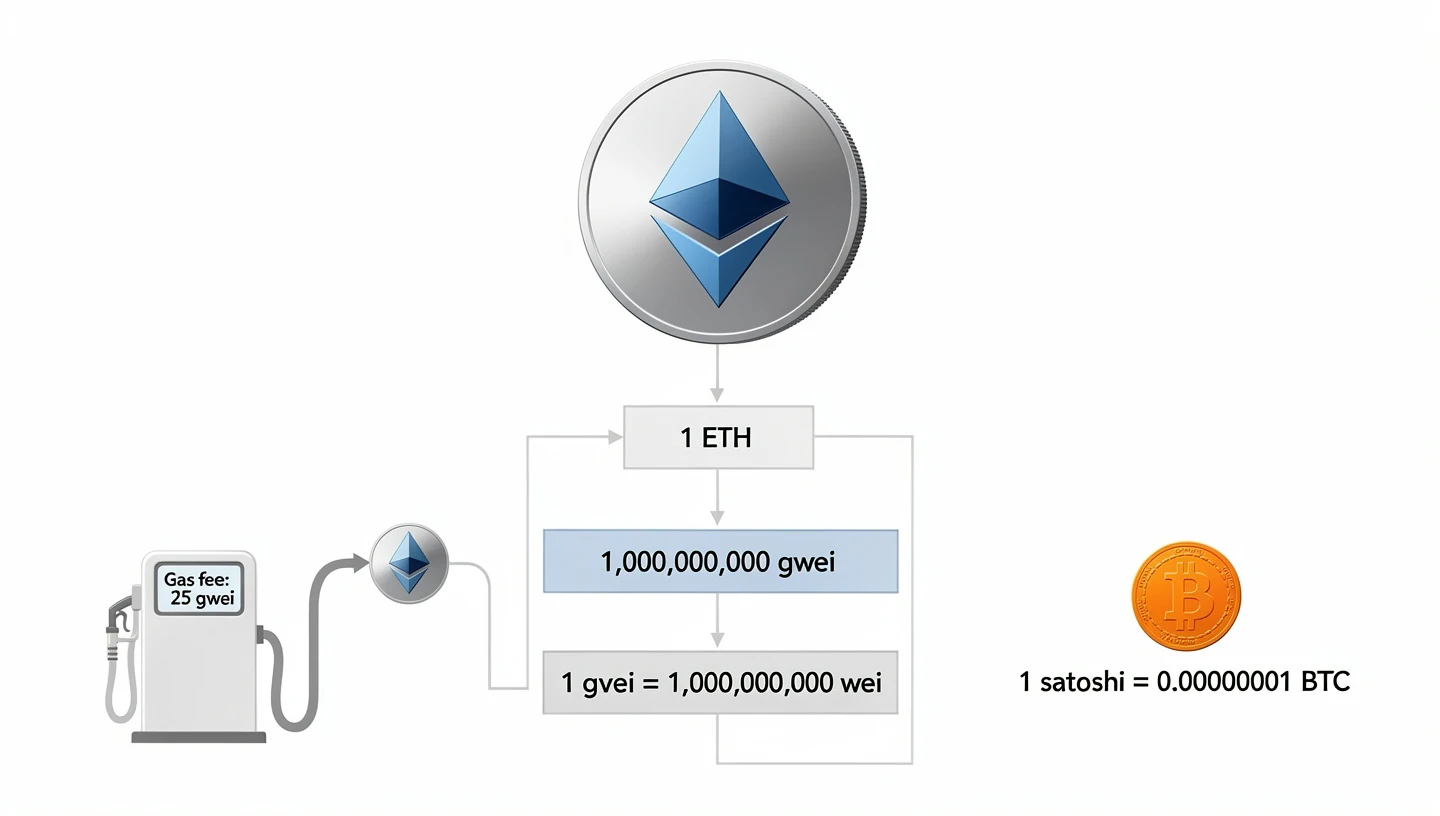
Gwei is the denomination most commonly used to express gas fees on Ethereum. Gas fees are the charges paid for every action on the Ethereum network, from sending tokens to executing smart contracts. Because these fees are often tiny fractions of one ETH, expressing them directly in ETH would mean writing numbers like 0.000000025 ETH. Written in gwei, that same amount becomes 25 gwei, which is far easier to read and compare.
The comparison most sources use is dollars and cents: if ETH is the dollar, gwei is a much smaller fraction of a cent. Another useful comparison is to Bitcoin, where the satoshi plays a similar role. One satoshi equals 10⁻⁸ BTC; one gwei equals 10⁻⁹ ETH. Gwei represents a smaller fraction of its currency than a satoshi does of Bitcoin.
Gwei also carries two alternative names used less frequently. The first is Shannon, named after Claude Shannon, an American mathematician and cryptographer described as the father of information theory. The second is nanoether (or nano). In developer documentation and older Ethereum materials you may see “Shannon” used in place of gwei. In practice, gwei is the only name that appears in wallets, gas trackers, and exchange interfaces today.
Is gwei a token? Clearing up the confusion
There is a source of confusion around the word “gwei” because there is an ERC-20 token called ETHGas with the ticker GWEI. This token is a governance asset for a blockspace futures protocol built on Ethereum, and it has its own market price on exchanges. It is not related to the gwei denomination described in this article.
The gwei denomination is part of the Ethereum protocol itself and has been since the network launched in 2015. It is not tradeable, it has no market cap, and it cannot be bought or sold on its own. When a wallet or gas tracker shows “30 gwei,” it is describing a price denominated in ETH. The number tells you how much ETH you will spend per unit of gas, expressed in billionths of an ether.
If someone tells you to “buy gwei,” they are likely referring to the ETHGas token, which is a separate product entirely. The gwei unit built into Ethereum requires no purchase and no special action. You simply need ETH in a wallet on the correct network to pay gas fees. You do not buy gwei any more than you buy cents when you hold US dollars.
All ETH denominations: from wei to ether
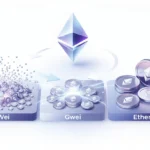
Ether is divisible into much smaller units, similar to how a dollar can be broken into cents. The smallest indivisible unit is called wei, and all other denominations are multiples of wei.
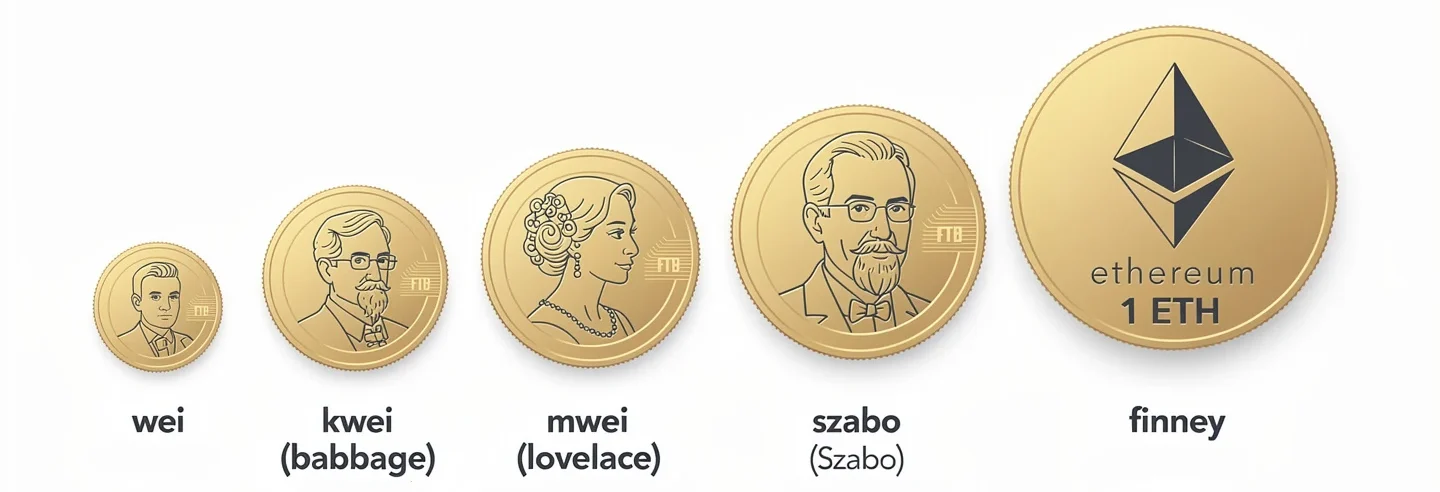
There are seven named units in the system, each carrying an alternative nickname honoring a person whose work contributed to cryptography or computing.
| Unit | Value in ETH | Alternative name | Named after |
|---|---|---|---|
| Wei | 10⁻¹⁸ | Wei | Wei Dai |
| Kwei | 10⁻¹⁵ | Babbage | Charles Babbage |
| Mwei | 10⁻¹² | Lovelace | Ada Lovelace |
| Gwei | 10⁻⁹ | Shannon | Claude Shannon |
| Szabo | 10⁻⁶ | Szabo | Nick Szabo |
| Finney | 10⁻³ | Finney | Hal Finney |
| ETH | 1 | Ether | – |
Wei Dai is a computer scientist who studied at the University of Washington and worked in cryptography at Microsoft. He was part of the cypherpunk movement in the 1990s and wrote the b-money proposal, an early design for a decentralized digital currency that laid theoretical groundwork for later cryptocurrency development. The smallest unit of ether is named after him in recognition of that contribution.
Claude Shannon, after whom gwei is named, developed information theory in the 1940s, the mathematical framework that underlies modern digital communications, data compression, and cryptography. His work is foundational to the entire field of computer science and telecommunications.
Nick Szabo, after whom the szabo unit is named, is the computer scientist credited with developing the concept of smart contracts in the 1990s, years before Ethereum existed. Hal Finney was a cryptographer, cypherpunk, and early Bitcoin contributor who received the first Bitcoin transaction ever sent by Satoshi Nakamoto.
In practice, only wei, gwei, and ETH appear regularly in wallets, block explorers, and gas trackers. Kwei, mwei, szabo, and finney are rarely seen outside developer documentation. For a full explanation of how ETH itself functions as the primary currency of the network, see our guide on what Ether is and how it differs from the ETH ticker.
How to convert gwei to ETH (and back)
Converting between gwei and ETH requires dividing or multiplying by one billion. The three conversions you are most likely to need are below.
Gwei to ETH: divide the gwei amount by 1,000,000,000
Example: 25 gwei ÷ 1,000,000,000 = 0.000000025 ETH
Wei to gwei: divide the wei amount by 1,000,000,000
Example: 420,069,000,000 wei ÷ 1,000,000,000 = 420.069 gwei
Gwei to USD: multiply gwei by the ETH price, then divide by 1,000,000,000
Example: at an ETH price of $3,500, one gwei = $3,500 ÷ 1,000,000,000 = $0.0000000035. So 25 gwei = $0.0000000875 per unit of gas.
These per-unit amounts are tiny precisely because gas fees are calculated by multiplying the gwei price by the number of gas units consumed, not by paying “gwei per transaction.” A standard ETH transfer consumes 21,000 gas units. At 25 gwei per unit: 21,000 × 25 = 525,000 gwei = 0.000525 ETH.
For quick conversions without manual calculation, the Etherscan Unit Converter and Alchemy Gwei Calculator both accept any denomination as input and return the equivalent in all others instantly.
Gas vs gwei: what is the difference?
Gas and gwei are related but they measure different things. Confusing them is one of the most common errors when starting out with Ethereum. For a full guide on how gas fees are calculated and what determines their cost, see our article on Ethereum gas fees.
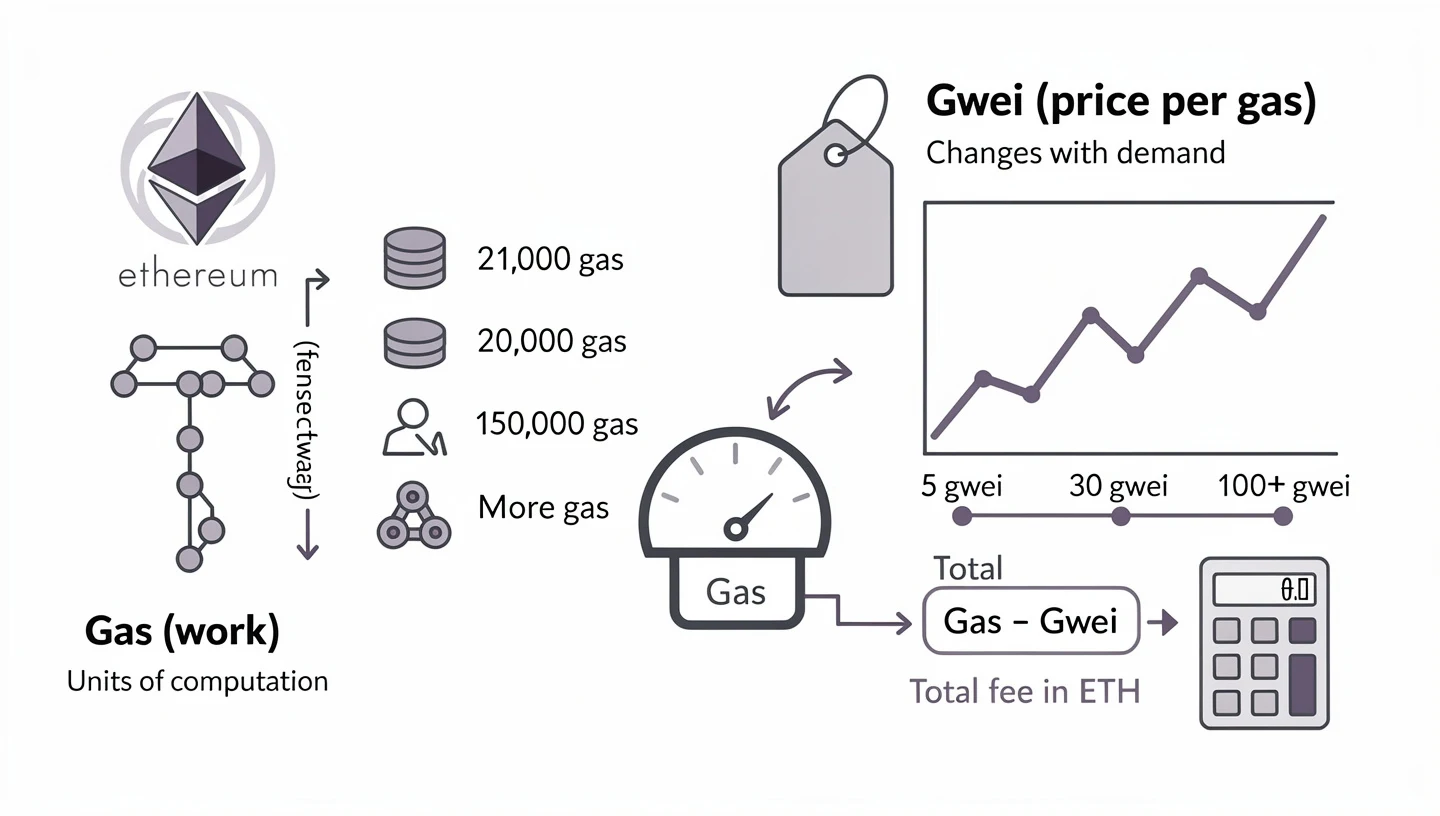
Gas measures the amount of computational work a transaction requires. Every operation the Ethereum network performs has a fixed gas cost set by the protocol. A standard ETH transfer always costs 21,000 gas units. A token swap on Uniswap costs around 150,000 gas units. These numbers do not change based on how busy the network is.
Gwei is the price you pay per unit of gas. It changes constantly based on network demand. During quiet periods the gas price might be 5 gwei per unit. During a popular NFT launch or a sudden spike in trading activity it can reach 100 gwei or higher.
The total fee is: gas used × gas price (in gwei)
| Gas | Gwei | |
|---|---|---|
| What it measures | Computational work required | Price per unit of gas |
| Set by | The Ethereum protocol (fixed per action type) | Network demand (changes each block) |
| Controlled by | The operation being performed | The user via max fee settings |
| If set too low | Transaction fails (out of gas) | Transaction stuck in mempool |
How gas fees work on Ethereum
Every action on Ethereum requires gas, and every unit of gas has a price denominated in gwei. Understanding how these two things combine tells you what you will pay before confirming any transaction.
The gas fee formula
The total fee for any transaction is: gas used × gas price (in gwei). Under EIP-1559, the gas price is made up of a base fee plus an optional priority fee. The formula in full is: gas used × (base fee + priority fee).
Every operation on Ethereum has a fixed gas cost defined by the Ethereum Virtual Machine, the execution layer that processes instructions inside smart contracts. For a closer look at how the EVM assigns gas costs to individual operations, see our guide on the Ethereum Virtual Machine.
The table below shows typical gas units and gwei ranges for the most common transaction types:
| Action | Gas units | Typical gwei range |
|---|---|---|
| ETH transfer | 21,000 | 10–30 gwei |
| Token swap (Uniswap) | ~150,000 | 30–150+ gwei |
| NFT mint | 100,000–300,000+ | 100–300+ gwei |
| Smart contract interaction | 200,000+ | 200+ gwei |
At a gas price of 30 gwei and an ETH price of $3,500, a standard ETH transfer costs 21,000 × 30 = 630,000 gwei = 0.00063 ETH, or about $2.20. A Uniswap swap at the same price costs 150,000 × 30 = 4,500,000 gwei = 0.0045 ETH, or about $15.75. Gas is always paid in ETH regardless of what token you are sending or which contract you are interacting with. For more on how smart contracts consume gas during execution, see our explainer on what smart contracts are.
EIP-1559: base fee, priority fee, and max fee
In August 2021, the Ethereum London upgrade introduced EIP-1559, which changed how gas fees are structured. Before this upgrade, users guessed a gas price and competed in a blind auction where overpaying was common and predicting fees was difficult. EIP-1559 replaced that model with an algorithmic base fee.
Every transaction now has three fee components, all denominated in gwei:
- Base fee: set automatically by the protocol based on how full the previous block was. If the previous block was more than 50% full, the base fee rises by up to 12.5%. If it was less than 50% full, it falls by the same amount. The base fee is permanently burned, removing that ETH from circulation rather than paying it to validators.
- Priority fee (tip): an optional amount added on top of the base fee, paid directly to the validators who include your transaction in a block. A higher tip means faster confirmation when the network is busy.
- Max fee: your personal upper limit per gas unit. If the actual base fee when your transaction is confirmed is lower than your max fee, the difference is refunded to your wallet.
Example: base fee of 28 gwei plus a priority fee of 2 gwei equals 30 gwei total. If you set a max fee of 40 gwei and the base fee at confirmation time turns out to be only 22 gwei, you pay 22 + 2 = 24 gwei and the remaining 16 gwei is returned to you.
The base fee burn is one of the reasons ETH supply has trended deflationary during periods of high network use. For more on how validators earn priority fees and how proof of stake replaced the older mining system, see our guide on Ethereum proof of stake.
Why gwei prices go up and down
Five main factors drive changes in the gwei price at any given moment:
- Network congestion: when more transactions compete for the same block space, users raise their priority fee to get included sooner, and the base fee rises as blocks fill above the 50% target.
- NFT minting events: when thousands of users interact with the same contract simultaneously, demand for block space spikes and base fees jump within minutes.
- DeFi surges and protocol launches: new protocols attract liquidity providers, traders, and yield seekers transacting at the same time, adding sustained pressure on block space.
- Market volatility: rapid price moves prompt holders to rebalance and move assets quickly, flooding the network with transactions and pushing base fees higher block by block.
- ETH price: the gwei price itself may stay flat in gwei terms, but if ETH rises in dollar value, every transaction costs more in dollars even at the same gwei level.
Where you will see gwei in everyday use
Gwei appears across most of the interfaces used when working with Ethereum. When you send ETH from MetaMask, the confirmation screen shows the estimated gas fee in both gwei and its ETH equivalent. When you swap tokens on Uniswap or another decentralized exchange, the fee estimator displays the gas cost in gwei. On NFT platforms like OpenSea, minting fees and listing transactions show gwei amounts before you confirm.
Gas trackers display three speed tiers: low, average, and high. Each tier shows a recommended gwei amount and an estimated confirmation time. Low is the cheapest but slowest option. Average is the standard choice for most situations. High is for when you need fast confirmation and are willing to pay more to secure it.
DeFi platforms show gwei on approval screens whenever you interact with a smart contract. Most wallets include a built-in gas estimator that translates the current gwei amount into a USD equivalent so you can judge the fee without calculating it yourself. For more on how the Ethereum network handles and confirms these transactions at the protocol level, see our guide on how Ethereum works.
How to check current gwei prices
Checking the gwei price before sending a transaction takes under a minute and can save a meaningful amount on fees during busy periods. Two tools cover the majority of use cases:
- Etherscan Gas Tracker (etherscan.io/gastracker): shows low, average, and fast gas prices in gwei alongside estimated confirmation times. Also displays a live chart of the base fee over recent blocks. This is the most widely used reference for checking current fees.
- Blocknative Gas Estimator (blocknative.com/gas-estimator): uses real-time mempool data and gives probabilistic estimates by confidence level, such as a 70th or 95th percentile price. More detailed than Etherscan and useful when you need a high probability of fast inclusion.
Wallets like MetaMask, Trust Wallet, and Rainbow also include built-in estimators. The slow, market, and fast preset options in MetaMask correspond to the same three tiers shown on Etherscan. For most transactions, the built-in wallet estimate is enough. For larger transactions or time-sensitive ones, cross-checking with Etherscan first is worth the extra step. For a full walkthrough of MetaMask and how to configure its gas settings, see our guide on how to set up MetaMask.
How to pay less gas without overcomplicating it
Timing your transactions is the simplest method. Gas prices on Ethereum follow a weekly pattern tied to when users in the US and Europe are most active. Fees tend to drop during late-night hours in those time zones and fall further on weekends. Checking Etherscan before a non-urgent transaction and waiting a few hours during peak periods can cut the fee by 40% or more without any technical changes.
Checking a gas tracker before confirming takes 30 seconds. Open Etherscan Gas Tracker, check the current base fee, compare it to what your wallet suggests, and select the slow preset if the transaction is not time-sensitive. The transaction will confirm as soon as the base fee drops to your level.
Using Layer 2 networks is the largest single saving available to most users. Networks like Arbitrum, Optimism, and Base process transactions off the Ethereum mainnet and post compressed batches of them back to Ethereum periodically. The same token swap that costs $15 on mainnet typically costs less than $0.10 on Arbitrum or Base. For a step-by-step guide to moving ETH to a Layer 2 network, see our guide on how to bridge ETH to Layer 2.
Setting the slow speed preset in your wallet saves money on transactions where a wait of several minutes or longer is acceptable. As long as your max fee is above zero and the base fee eventually drops, the transaction will confirm without any action on your part.
One method that no longer works: gas tokens like GST2 and CHI. These relied on a storage refund mechanism that was removed by EIP-3529, the same upgrade package as EIP-1559 in August 2021. Any guide recommending gas tokens was written before that date and the advice no longer applies.
What happens if gwei is set too low?
Setting the max fee or gas limit too low produces two different outcomes depending on which limit is hit.
If the max fee per gas is set below the current base fee, the transaction cannot be included in any block until the base fee drops to your level. It sits in the mempool, the queue of pending transactions waiting for confirmation. The transaction neither confirms nor fails during this time. It simply waits. Most wallets show it as “pending.” If the base fee eventually falls to your level the transaction confirms automatically. If you need it resolved sooner, MetaMask offers a “Speed Up” option that resubmits with a higher max fee, or a “Cancel” option that voids it by sending a replacement transaction with the same nonce at a higher fee.
If the gas limit is set too low, the transaction runs out of gas partway through execution and fails with an “out of gas” error. The ETH spent on gas up to the point of failure is not refunded. The transaction does not complete. This is why wallets add a buffer to gas limit estimates rather than setting them to the absolute minimum. Setting a gas limit slightly above the estimate is the safe default.
The practical rule is: never set the max fee below the current base fee shown on Etherscan, and do not reduce the gas limit below what your wallet estimates unless you have a specific reason. For more on what a stuck or failed transaction looks like on-chain and how to trace it, see our guide on how to transfer Ethereum.
Frequently asked questions
How much is 1 gwei in ETH?
One gwei equals 0.000000001 ETH, also written as 10⁻⁹ ETH. Going the other direction, one ETH equals 1,000,000,000 gwei. To convert any gwei amount to ETH, divide by one billion. To convert ETH to gwei, multiply by one billion.
Is gwei the same as gas?
No. Gas measures the amount of computational work a transaction requires, such as 21,000 gas units for a standard ETH transfer. Gwei is the price you pay per unit of gas. The total fee equals gas used multiplied by the gas price in gwei. Gas units are fixed by the Ethereum protocol. Gwei prices change with network demand every block.
Do you need to buy gwei?
No. Gwei is not a separate token or asset. It is a denomination of ETH, similar to how cents are a denomination of dollars. When you hold ETH in a wallet, you hold ether that can be expressed in gwei. You pay gas fees in ETH, and the amount is displayed in gwei for readability. No special purchase is needed.
How do you convert gwei to ETH?
Divide the gwei amount by 1,000,000,000. For example, 25 gwei divided by 1,000,000,000 equals 0.000000025 ETH. To convert ETH back to gwei, multiply by 1,000,000,000. The Etherscan Unit Converter at etherscan.io/unitconverter handles this automatically for all ETH denominations at once.
What is gwei also called?
Gwei is also called Shannon, named after the mathematician Claude Shannon, and nanoether or nano. These names appear in some developer documentation and older Ethereum materials. Shannon refers to the same denomination as gwei. In current wallets, gas trackers, and block explorers, gwei is the term used exclusively.
What is a normal gwei price on Ethereum in 2026?
On Ethereum mainnet in 2026, the base fee ranges from roughly 5 to 40 gwei during normal conditions, with spikes to 100 gwei or higher during major events like large token launches or sudden market liquidations. On Layer 2 networks such as Arbitrum, Base, and Optimism, the effective gas price for routine transactions is typically well below 1 gwei, making everyday use far cheaper than transacting on mainnet.