The short answer is: yes and no, depending on what you measure. Ethereum’s protocol layer has over one million validators spread across dozens of countries, making it the largest Proof of Stake network by validator count. At the same time, one liquid staking protocol controls roughly 30% of all staked ETH, most users access the blockchain through centralized servers rather than their own nodes, and Ethereum’s co-founder exercises influence over the network’s direction that no single Bitcoin developer could match. Whether ETH is decentralized is not a yes-or-no question. It is a question about which layer you are looking at and what standard you are holding it to.
What Does “Decentralized” Actually Mean for a Blockchain?
Decentralization in a blockchain context means no single entity controls the network’s rules, transaction history, or ability to participate. A fully centralized system has one owner who sets the rules and can change them. A fully decentralized system has no such owner. Most real networks sit somewhere in between, and Ethereum is no exception.

Three layers where decentralization either holds or breaks
Ethereum operates across three layers that each have different decentralization properties. The consensus layer is where validators propose and confirm blocks. The execution layer is where transactions are processed and smart contracts run. The application layer is how users actually access the network – through wallets, RPC providers, and interfaces built on top of the protocol.
The protocol can be decentralized at the consensus level while remaining centralized at the application level. Vitalik Buterin acknowledged this directly in January 2026, writing that Ethereum’s challenge is to “be usable at global scale and remain genuinely decentralized” simultaneously – and that this applies not just to the blockchain itself but to the applications built on top of it, many of which depend on centralized services despite running on a decentralized protocol. Understanding how Ethereum works at the protocol level helps clarify which layer each concern sits on.
Why decentralization matters – censorship resistance and trust
Censorship resistance is the practical payoff of decentralization. A sufficiently decentralized network cannot be pressured by any government, company, or individual to freeze addresses, block transactions, or change the rules. When validators are spread across many jurisdictions and no single entity controls enough of the network to act unilaterally, the system becomes resistant to that kind of interference. The moment one entity gains enough control to influence what gets included in blocks or what the protocol rules are, that resistance weakens. This is why the concentration of staked ETH matters: it is not just a theoretical governance concern but a question about whether the network can actually resist coordinated pressure.
Where Ethereum Is Genuinely Decentralized
Several meaningful measures of decentralization favor Ethereum strongly. Before examining the problems, the strengths deserve honest treatment because they are real and significant.
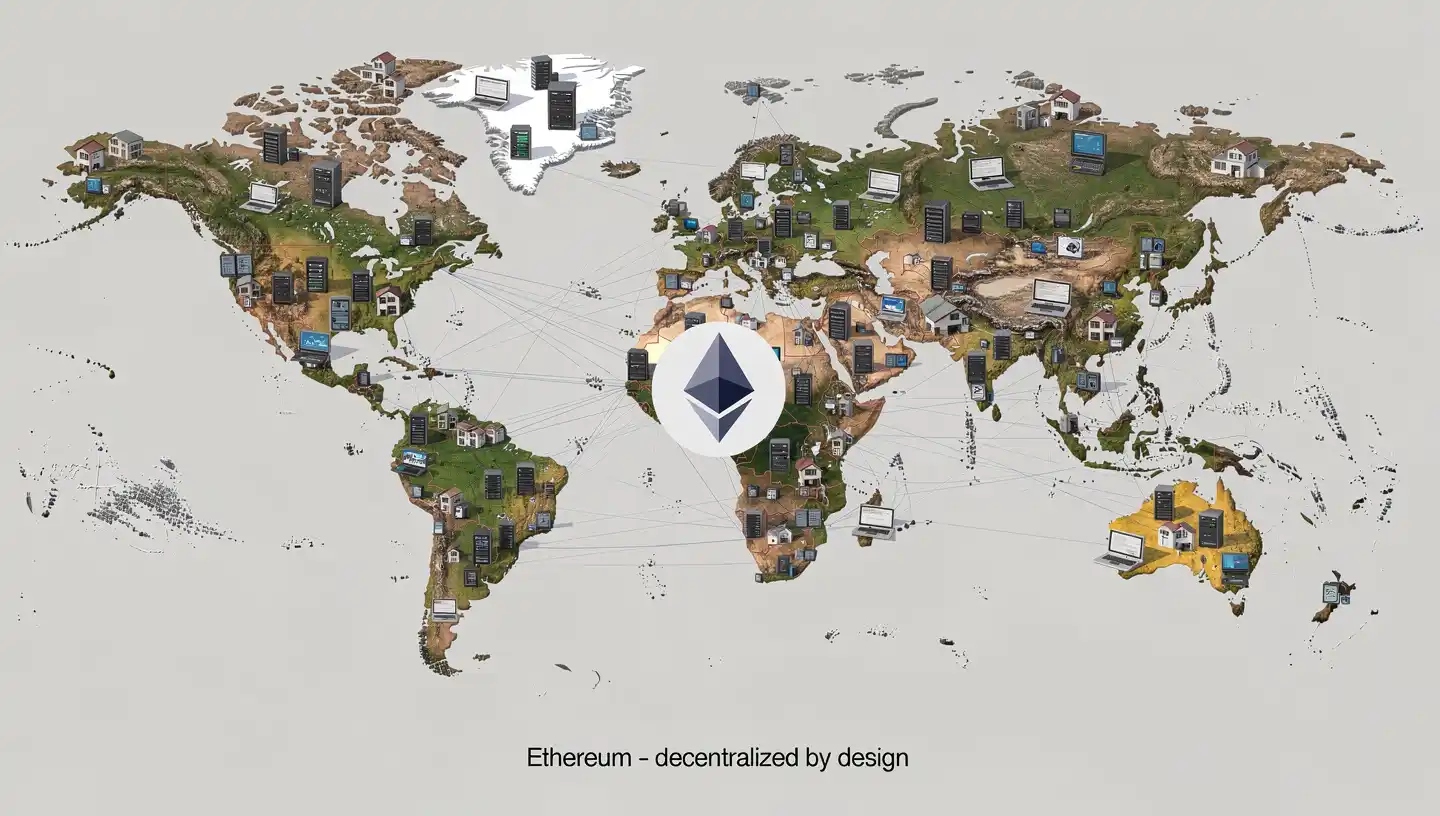
Over one million validators – the largest PoS network
Ethereum’s validator count crossed one million in 2024 and has continued growing since. According to cryptonews.net analysis from May 2026, Ethereum is “the most decentralized proof-of-stake network by a wide margin.” For comparison, Solana operates with roughly 1,500 to 2,000 active validators. Cosmos chains typically have a few hundred. The sheer number of independent operators proposing and attesting to blocks on Ethereum means that any attack on the network’s consensus requires controlling an enormous number of separate parties, each of whom would have to act against their own economic interest.
Each validator requires exactly 32 ETH staked as collateral. Validators who misbehave – either by going offline for extended periods or attempting to sign conflicting blocks – face slashing, which destroys a portion of their staked ETH. This economic penalty structure gives each validator a direct financial incentive to operate honestly and independently. The full mechanics of how validators earn rewards and what slashing conditions look like are covered in the guide on Ethereum Proof of Stake.
Geographic distribution – no single country dominates
Ethereum validators operate across the United States, Germany, the United Kingdom, France, Singapore, Canada, and dozens of other countries. No single jurisdiction holds a majority of the validator set. This matters for censorship resistance because a government action against validators in one country cannot take down the network. Bitcoin mining had a notable concentration problem when Chinese miners controlled a majority of hash rate, which was eliminated when China banned mining in 2021. Ethereum’s staking distribution, while imperfect, does not have a comparable single-jurisdiction vulnerability at the validator level.
Client diversity – no single software controls the network
Ethereum runs two types of software clients: execution clients that process transactions and consensus clients that handle block proposals and validation. On the execution side, Geth holds roughly 50% of nodes, down from over 80% in earlier years, with Nethermind at approximately 25% and Besu and Erigon making up most of the remainder. On the consensus side, Prysm, Lighthouse, Teku, and Nimbus each hold meaningful shares with no single client dominating.
This distribution matters because a critical bug in one client does not crash the entire network. If Geth had a severe vulnerability, nodes running Nethermind or Besu would continue operating normally. The Ethereum Foundation actively works to discourage any single client from exceeding 33% of the consensus layer, because that threshold is where a client bug could theoretically affect finality. Client diversity is one of the genuine strengths of Ethereum’s decentralization story in 2026 compared to earlier periods.
Permissionless participation – anyone can run a node
Running an Ethereum node requires no permission, registration, or approval from any authority. A full node downloads and independently verifies the entire blockchain, checking every transaction against the protocol rules without trusting any third party. In mid-2026, the transition to Verkle trees is underway, which will reduce the storage requirements for running a full node from several hundred gigabytes to something manageable on a standard consumer laptop. This is a significant improvement for decentralization because it lowers the hardware barrier for independent node operation, reducing dependence on professional node operators.
Where Ethereum Has Real Centralization Problems
Acknowledging Ethereum’s strengths does not mean ignoring its documented centralization risks. Three of them are serious enough to warrant specific attention from Ethereum’s own developers and co-founder.

Lido controls too much of the validator set
Lido is the largest liquid staking protocol on Ethereum. Users deposit ETH into Lido and receive stETH in return, a token that represents their staked position and accrues rewards. Lido then deploys that ETH across a network of professional validators. The problem is scale: Lido controls approximately 23-30% of all staked ETH as of 2026, according to dextools.io. Vitalik Buterin has publicly recommended that no single entity should control more than 15% of the validator set. Lido is running at roughly double that threshold.
Justin Garland, co-founder of Asymmetry Finance, put it directly: “Lido running 38% of validators is more than double what Vitalik said is too much for any single entity to control.” The relevant threshold is 33%. At that level, a single entity could theoretically prevent the network from reaching finality – not steal funds, but halt the confirmation of new blocks. Lido’s influence over validators has declined from its 2023 peak, but it remains well above the level Ethereum’s own founder considers safe.
| Staking entity | Share of staked ETH | Risk level |
|---|---|---|
| Lido | ~30% | Exceeds Vitalik’s recommended 15% limit |
| Coinbase | ~12% | US regulatory jurisdiction |
| Solo validators | ~25% | Distributed, low risk |
| Rocket Pool | ~5% | Decentralized model, low risk |
| Other protocols and exchanges | ~28% | Mixed |
60% of staked ETH sits with just four providers
The concentration extends beyond Lido. Deltec Bank’s analysis found that approximately 60% of staked ETH is controlled by only four providers, and 69% by eleven providers. The four dominant providers – Lido, Coinbase, Binance, and Kraken – are all legal entities incorporated and operating in the United States or European Union. This creates a regulatory attack surface: governments in those jurisdictions could theoretically compel these providers to censor specific transactions or addresses as a condition of continued operation.
Coinbase holds approximately 12% of staked ETH and is a publicly listed company in the United States, regulated by the SEC and CFTC. It cannot easily ignore a legal order to censor transactions. This does not mean Ethereum is broken – these entities would have to act in coordinated fashion to actually harm the network, and the remaining distributed validators would continue operating. But it does mean the staking layer has meaningful exposure to regulatory pressure that the protocol layer does not.
RPC provider centralization – the invisible bottleneck
Most Ethereum users never run their own node. They use MetaMask or another wallet that queries an RPC provider – a service that reads blockchain data and submits transactions on their behalf. The two dominant RPC providers are Infura and Alchemy. When Infura experienced a significant outage in November 2020, MetaMask stopped working for a large portion of its users. That is not decentralization. That is a web service with a single point of failure.
Vitalik Buterin addressed this directly in January 2026: “The current ecosystem forces users to rely on trusted servers and RPCs.” Users are not verifying the blockchain themselves. They are trusting that Infura or Alchemy is telling them the truth about their balance and transaction history. This is a centralization problem at the application layer that the protocol’s technical decentralization cannot solve on its own. It is also the problem that Helios – a light client in development – is specifically designed to fix.
MEV and block builder concentration
MEV stands for Maximal Extractable Value: the additional value that can be captured by controlling the order of transactions within a block. Specialized block builders compete to construct the most profitable block for each slot, and validators accept these pre-built blocks rather than constructing their own. The result is that a small number of professional block builders – typically three to five firms – construct the majority of Ethereum blocks. This concentration means a small group has significant influence over transaction ordering, which affects things like which transactions get included first and whether certain types of arbitrage or liquidations happen at all. Proposer-Builder Separation (PBS) is Ethereum’s structural response to this problem, but the concentration of the building side remains a live concern.
The Ethereum Foundation’s disproportionate influence
In October 2025, Péter Szilágyi, who led the Geth client team from 2015 until his departure earlier that year, published a letter he had written to the Ethereum Foundation in May 2024. In it, he wrote: “Ethereum may be decentralised, but Vitalik absolutely has complete indirect control over it.” He described a “small ruling elite of 5-10 people around Buterin” that shaped which projects succeeded and which developers got compensated.
Neither the Ethereum Foundation nor Vitalik Buterin responded publicly to the letter’s specific claims. The broader point – that Vitalik’s informal influence over the network’s direction is disproportionate for a system that claims to be leaderless – is acknowledged even by people who are broadly positive about Ethereum. Vitalik does not control the protocol through formal governance rights. But his public statements move markets, shift developer priorities, and determine which proposals get serious consideration. That is a form of centralization even if it is not written into any code. Understanding who built Ethereum and why this founding dynamic matters is covered in the guide on who created Ethereum.
The 33% Threshold: Why Lido’s Market Share Is the Central Concern
The number 33% comes up repeatedly in discussions about Ethereum’s staking centralization. It is worth explaining precisely why that number matters and what it does and does not mean.
What happens at 33% validator control
Ethereum’s consensus mechanism requires two-thirds of validators (66%) to attest to a block for it to reach finality. An entity controlling 34% of validators could prevent the network from ever reaching finality by simply refusing to attest. This is not the same as stealing funds or rewriting history. It is closer to a denial-of-service attack on block confirmation. Transactions would remain in limbo, unconfirmed, without an attacker needing to actually execute the attack. The credible threat alone has value for coercion.
Controlling 51% of validators would allow reordering recent blocks. Controlling 66% would give absolute control over finality. Neither of these is within reach for any single current entity. But the 33% threshold for disruption is within striking distance of Lido’s current position, which is why the Ethereum community treats it as a serious structural risk rather than a theoretical one.
Lido’s response and the Community Staking Module
Lido has not ignored the criticism. The protocol introduced a Community Staking Module (CSM) that allows permissionless validator participation – meaning any operator meeting technical requirements can join without Lido’s approval. As of mid-2026, approximately 5% of Lido’s stake runs through the CSM. A governance proposal to raise that to 10% has been approved but not yet implemented, according to lido.fi’s public scorecard.
Lido is also developing Distributed Validator Technology (DVT), which splits each validator across multiple independent operators so that no single operator’s failure or coercion can take down the whole validator. And the Dual Governance proposal, if implemented, would give stETH holders the ability to veto governance decisions made by LDO token holders, reducing the governance power of Lido’s venture capital backers. These are genuine structural improvements. They do not eliminate the concentration concern, but they show a protocol actively trying to reduce its own centralization risk rather than simply defending it.
Is Lido a threat or a feature?
Lido’s original stated purpose was to prevent centralized exchanges from dominating Ethereum staking and to make staking accessible to anyone without 32 ETH. On both counts, it has partially succeeded. Exchange staking is large but not dominant, and millions of users stake small amounts through Lido who could not otherwise participate. The problem is that solving those two issues by routing a third of all staked ETH through a single protocol creates a new concentration risk that arguably replaced the problems it solved.
Ethereum Foundation researcher Dankrad Feist framed the tension clearly: “perfect alignment is impossible for the simple reason that centralized systems are more efficient than decentralized ones.” Lido is more efficient than a thousand separate staking operators. That efficiency is also why it grew to dominate the market. Economic incentives do not naturally produce decentralization. They have to be engineered for it.
Ethereum vs Bitcoin vs Solana: Who Is Actually More Decentralized?
Comparing Ethereum’s decentralization to other major networks provides useful context for whether its problems are unusual or typical of the space.

Bitcoin’s decentralization model
Bitcoin uses Proof of Work, where miners compete using hardware and electricity rather than staked capital. Running a Bitcoin full node is accessible on modest hardware – the Bitcoin blockchain is smaller than Ethereum’s and the software requirements are lower. There are approximately 15,000-17,000 reachable Bitcoin nodes globally. Mining is more concentrated: Foundry USA, AntPool, and F2Pool collectively mine a majority of Bitcoin blocks, which is a different kind of concentration than Ethereum’s staking problem. Bitcoin has no equivalent of Lido because the barrier to mining is hardware rather than capital, and mining pools do not control validator keys the way Lido does. The consensus view in the crypto community is that Bitcoin is the most decentralized major blockchain, though its mining pool concentration is its own valid concern.
Solana’s centralization tradeoffs
Solana operates with roughly 1,500 to 2,000 validators. Running a Solana validator requires high-spec hardware: 12 to 24 CPU cores, 256 gigabytes of RAM minimum, and high-bandwidth internet. This hardware requirement effectively limits participation to professional operators and data centers. A significant portion of Solana validators run on Amazon Web Services infrastructure in US data centers. Solana achieves its high transaction throughput partly by accepting these hardware demands, which concentrate the validator set. By validator count alone, Ethereum is far more decentralized than Solana.
Where Ethereum sits on the spectrum
Ethereum has more validators than any other Proof of Stake network and lower hardware requirements than Solana. Its staking concentration problem with Lido is real but different in character from Bitcoin’s mining pool concentration: Lido controls staking keys, mining pools do not control miner hardware. Ethereum’s RPC centralization problem is shared by almost every consumer-facing blockchain. Its governance centralization around Vitalik is a genuine issue without a clear parallel in Bitcoin, which has no comparable founding figure with active influence.
The honest assessment is that Ethereum is more decentralized than Solana at the validator layer, roughly comparable to Bitcoin in some dimensions, and faces its own specific centralization problems in the staking and application layers that Bitcoin does not have. No major blockchain is fully decentralized across all dimensions. What matters is whether the network is decentralized enough in the specific dimensions that matter for its use case. The broader picture of what ETH is used for shapes which decentralization properties matter most for each type of user.
What Ethereum Is Doing to Improve Decentralization in 2026
The January 2026 roadmap announcements from Vitalik Buterin represent the clearest public acknowledgment that Ethereum has work to do. The roadmap is specific enough to evaluate whether the improvements are likely to be real.
Vitalik’s January 2026 admission and roadmap
On January 16, 2026, Vitalik Buterin stated publicly that Ethereum had “backslided” on decentralization over the past decade. His specific diagnosis: the focus on scalability had come at the cost of self-sovereignty and local verification. “The current ecosystem forces users to rely on trusted servers and RPCs,” he wrote, acknowledging that most users interact with Ethereum through centralized intermediaries rather than verifying data themselves. His stated goal for 2026: “take back ground in terms of self-sovereignty and trustlessness.”
This admission matters because it came from the person with the most informal influence over Ethereum’s direction. When Vitalik identifies a problem publicly, the developer community tends to treat it as a priority. The specific technologies he named – Helios, Verkle trees, and ZK-EVM improvements – are all in active development.
Verkle trees – running a full node on a laptop
A current Ethereum full node requires storing several terabytes of blockchain data to independently verify transactions. This hardware requirement pushes most users toward trusting RPC providers rather than running their own verification. Verkle trees replace the current data structure with a more efficient one that reduces the storage needed for a stateless client to a fraction of the current requirement. By mid-2026, the Verkle tree transition is underway, with the goal of making it possible to run a full verification client on a standard consumer laptop within the year. If successful, this directly lowers the barrier to independent node operation and reduces dependence on Infura and Alchemy. The underlying technology that makes this possible operates through the Ethereum Virtual Machine, which processes the state transitions that Verkle trees make more efficient to store and verify.
Helios – ditching Infura and Alchemy
Helios is a light client that verifies Ethereum data locally without downloading the full blockchain and without trusting an RPC provider. Instead of asking Infura “what is my account balance?”, a wallet using Helios asks the Ethereum network directly and verifies the answer cryptographically. Combined with ZK-EVM proofs – which allow instant verification of computation without rerunning the full calculation – Helios would let a standard wallet on a phone verify its own transactions without trusting any third party.
If Helios gets integrated into MetaMask and similar wallets, the RPC centralization problem largely disappears for end users. That is a significant conditional: wallet developers have to adopt it, users have to update, and the technology has to work reliably across the variety of conditions real users operate under. The development roadmap suggests this is a realistic 2026-2027 timeline rather than a distant aspiration.
Client diversity progress in 2026
Geth’s share of the execution client market has fallen from over 80% in 2021 to approximately 50% in 2026. Nethermind has grown significantly, and Besu and Erigon remain active alternatives. On the consensus side, no single client has ever held a dominant majority, and the current distribution across Prysm, Lighthouse, Teku, Nimbus, and newer clients is more balanced than it was at The Merge. The Ethereum Foundation funds development across multiple clients and actively discourages single-client dominance. Progress here is real and measurable. The concern is that Geth’s remaining 50% execution client share still represents a significant bug-surface concentration, and reducing it further requires wallet providers and infrastructure companies to switch, which happens slowly.
Is ETH Decentralized Enough? A Practical Assessment
The answer depends on what you need from the network. “Decentralized enough” is not a universal standard. It is a question about whether Ethereum’s specific decentralization properties match the use case you care about.
What “decentralized enough” means for different users
For someone holding ETH as a long-term investment, the protocol’s validator-layer decentralization provides meaningful protection against the kind of single-point failure that has destroyed centralized crypto platforms. For a DeFi user who cares about censorship resistance, the protocol layer is strong but the RPC layer is a real vulnerability that Helios is designed to address. For an institutional investor evaluating systemic risk, over one million validators across multiple jurisdictions provides strong assurance against the network being taken down by action against any single country or company. For someone ideologically committed to trustless operation at every layer, Ethereum’s current dependence on Infura, Lido’s concentration, and Vitalik’s informal influence are all legitimate concerns that the 2026 roadmap is actively working to fix.
The honest scorecard
| Dimension | Assessment | Notes |
|---|---|---|
| Validator count | Strong | 1M+ validators, largest PoS network |
| Validator concentration | Moderate concern | Lido ~30%, 4 providers hold 60% of staked ETH |
| Client diversity | Improving | Geth ~50% execution, down from 80%+ |
| RPC centralization | Weak | Infura and Alchemy dominate; Helios addresses this |
| Geographic distribution | Good | No single jurisdiction holds majority of validators |
| Protocol governance | Good | No on-chain voting; changes through rough consensus |
| Informal governance | Weak | Vitalik’s informal influence is disproportionate |
| Node accessibility | Improving | Verkle trees in progress; currently high storage burden |
Ethereum is genuinely decentralized at the protocol layer in ways that matter for security and censorship resistance. It has specific, documented centralization problems at the staking layer (Lido concentration) and the application layer (RPC dependence) that its own development roadmap is actively addressing. Anyone claiming Ethereum is completely decentralized is overstating the case. Anyone claiming it is not decentralized at all is ignoring the validator count, geographic distribution, client diversity, and permissionless participation that distinguish it from centralized systems. The more useful question – and the one Ethereum’s developers are working from – is which specific centralization problems are most important to fix and in what order. The broader picture of what the Ethereum network is and what it does provides context for why these decentralization properties matter beyond just ideology.
Frequently Asked Questions
Is ETH decentralized?
Ethereum is decentralized at the protocol layer, with over one million validators spread across dozens of countries, no single entity controlling the rules, and permissionless participation for anyone who wants to run a node. It has real centralization problems at the staking layer, where Lido controls approximately 30% of staked ETH, and at the application layer, where most users access the network through centralized RPC providers. The 2026 development roadmap directly addresses both of these problems.
Is Ethereum more decentralized than Bitcoin?
By validator count, Ethereum has far more independent participants than Bitcoin has miners or full nodes. Bitcoin’s mining is concentrated in a small number of pools. Ethereum’s staking is concentrated around Lido and a few exchanges. The two networks have different centralization risks rather than one being clearly superior to the other. Bitcoin has no equivalent of Lido’s concentration. Ethereum has no equivalent of Bitcoin’s geographic mining concentration history.
Is Lido a centralization risk for Ethereum?
Yes, by Ethereum’s own standards. Vitalik Buterin has publicly recommended that no single entity control more than 15% of the validator set. Lido controls approximately 30%, double that threshold. The 33% mark is where a single entity could theoretically prevent the network from reaching finality. Lido is actively developing structural improvements including the Community Staking Module and Distributed Validator Technology to reduce this concentration.
Can the US government shut down Ethereum?
No government can shut down Ethereum’s protocol because no single entity controls it. Governments can take action against specific centralized participants – exchanges, staking providers, RPC services – but the underlying protocol continues operating as long as any validators remain active globally. The US government pressuring Coinbase (which holds ~12% of staked ETH) would not stop the network. It would need to simultaneously pressure the majority of the validator set across multiple jurisdictions to meaningfully disrupt operations.
How many validators does Ethereum have?
Ethereum passed one million active validators in 2024 and continues adding validators as more ETH gets staked. This is the largest validator count of any Proof of Stake network. Each validator requires 32 ETH as a collateral deposit and faces financial penalties for misbehavior through the slashing mechanism.
What is the biggest centralization risk on Ethereum?
The two most significant risks are Lido’s control of approximately 30% of staked ETH and the dependence of most users on centralized RPC providers like Infura and Alchemy. Lido’s concentration is being addressed through the Community Staking Module and Distributed Validator Technology. RPC dependence is being addressed through Helios and Verkle trees, which together would allow users to verify blockchain data locally without trusting any third party.
Is Ethereum more decentralized than Solana?
By almost every measure, yes. Ethereum has over one million validators. Solana has roughly 1,500 to 2,000. Solana’s validator hardware requirements – 256 gigabytes of RAM, high-spec CPUs – effectively limit participation to professional operators and data centers. Ethereum’s hardware requirements are lower and continue decreasing with the Verkle tree upgrade. Solana achieves higher transaction throughput partly by accepting these hardware demands, which is a deliberate architectural tradeoff rather than an oversight.