As of May 2026, there are approximately 120.7 million ETH in circulation. That number changes every single day because new ETH is issued to validators who secure the network, and ETH is permanently destroyed through the burn mechanism built into every transaction. Unlike Bitcoin, which has a hard cap of 21 million coins, Ethereum has no fixed maximum supply. What it does have is a system that ties supply growth directly to how much the network is actually being used. The more activity on Ethereum, the more ETH gets burned, and during busy periods the burn rate exceeds the issuance rate, making the total supply shrink.
How Many Ethereum Coins Are There Right Now?
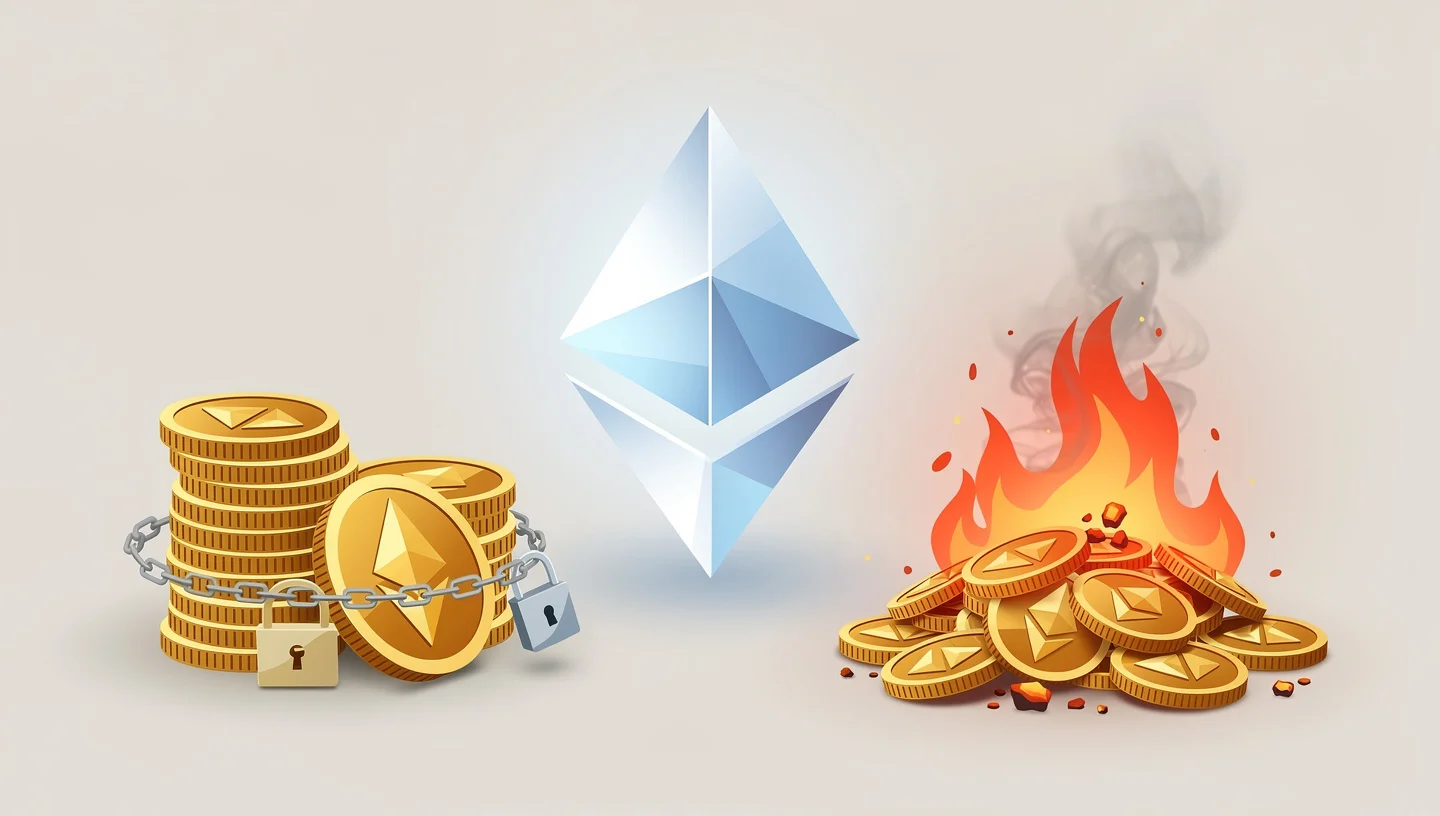
The number you see on CoinMarketCap or CoinGecko for ETH circulating supply is a snapshot that is already slightly outdated by the time you read it. Roughly 1,700 new ETH are issued every day as rewards to validators. At the same time, a portion of every transaction fee is burned and removed from circulation forever. The net change each day is small but it accumulates over time.
Current ETH circulating supply in 2026
According to Etherscan data, the total ETH supply as of May 2026 sits at approximately 120.7 million ETH. This figure has stayed within a narrow band since The Merge in September 2022 because the new issuance rate is low and the burn rate frequently offsets it. For real-time tracking, ultrasound.money shows the live supply, current issuance rate, burn rate, and whether ETH is in a net inflationary or deflationary state at any given moment. It is the most useful single tool for monitoring ETH supply dynamics without reading raw blockchain data.
There is no maximum supply cap in Ethereum’s code. The protocol can always issue new ETH to validators. The practical constraint is that EIP-1559 burns ETH continuously, which means supply growth is self-limiting based on network demand rather than an arbitrary number written into the protocol.
How ETH supply has changed since launch
| Period | Approximate total supply | Daily issuance | Key event |
|---|---|---|---|
| July 2015 (genesis) | 72 million ETH | ~30,000 ETH/day | Network launch |
| June 2016 | ~80 million ETH | ~30,000 ETH/day | PoW at full output |
| August 2021 | ~117 million ETH | ~13,000 ETH/day | EIP-1559 activated |
| September 2022 | ~120.5 million ETH | ~1,700 ETH/day | The Merge – PoS begins |
| May 2026 | ~120.7 million ETH | ~1,700 ETH/day | Current |
The table shows something that surprises most people: the total supply has barely grown since September 2022. Ethereum went through a period of net deflation from late 2022 through early 2024, and has since settled into very mild inflation. The supply today is still lower than it was at the time of The Merge.
Where Did the Initial ETH Supply Come From?
Ethereum did not start with mining. The first 72 million ETH came from a public crowdsale and a premine allocation before the network ever produced a single block. Understanding that initial distribution helps explain why Ethereum’s supply looks the way it does today.
The 2014 crowdsale and the genesis block
In July and August 2014, the Ethereum Foundation ran a public token sale. Buyers sent Bitcoin and received ETH in return. The sale raised approximately $18.3 million in Bitcoin. 60 million ETH was sold to the public at prices ranging from 2,000 ETH per BTC at the opening to 1,337 ETH per BTC as the sale progressed. An additional 9.9% of the total amount sold, roughly 12 million ETH, was allocated to the Ethereum Foundation and early contributors. That brought the genesis block total to 72 million ETH on the day the network launched in July 2015.
To understand the broader context of how Ethereum was built and why its founders made these decisions, the guide on who created Ethereum covers the background of Vitalik Buterin and the founding team in detail.
Early contributors, the Ethereum Foundation, and the premine
The Ethereum Foundation holds approximately 0.297% of the total ETH supply according to its 2022 annual report, with over 99% of its treasury held in ETH. Vitalik Buterin publicly shared one of his main ETH addresses in 2018. At the time of writing, that address holds less than 1 ETH. The bulk of his holdings have been distributed through donations over the years, most notably $1 billion worth of Shiba Inu tokens to India’s COVID relief fund in 2021.
Other significant holders include cryptocurrency exchanges running custody wallets, the Ethereum staking contract holding over 30% of supply, and smart contract protocols like Wrapped ETH (WETH) which hold millions of ETH deposited by DeFi users. In May 2026, Bitmine reported holding 5.2 million ETH on its balance sheet, one of the largest single disclosed corporate positions.
How New ETH Is Created: Issuance and Validators
Since The Merge in September 2022, no new ETH is created through mining. Every new ETH that enters circulation comes from validator rewards. Understanding how that system works explains why the current issuance rate is so much lower than it was under Proof of Work.

How validators earn ETH and why issuance is low
Validators are the computers that propose and attest to blocks on Ethereum’s Proof of Stake network. To become a validator, an operator must deposit exactly 32 ETH into the staking contract as collateral. In return for keeping their validator online and voting honestly on blocks, they earn a small ETH reward with each epoch (roughly every 6.4 minutes). The total amount distributed across all validators comes to approximately 1,700 ETH per day. That number rises slightly as more validators join the network and falls if validators go offline or get slashed for misbehaving.
The reason issuance is so low compared to the mining era is that staking requires almost no resources relative to mining. Miners needed expensive hardware and consumed enormous amounts of electricity to compete for block rewards. Validators need a computer, a stable internet connection, and 32 ETH. The lower cost to participate means less ETH needs to be paid out to keep the system running securely. The full mechanics of how this works are covered in the guide on Ethereum Proof of Stake.
From 13,000 ETH per day to 1,700 – the triple halvening
Under Proof of Work, Ethereum issued approximately 13,000 ETH per day. This came from a 2 ETH block reward paid roughly every 13 seconds, across around 6,600 blocks per day. When The Merge switched the network to Proof of Stake, that figure dropped to approximately 1,700 ETH per day, an 87% reduction. The crypto community nicknamed this the “triple halvening” because the supply shock it created was equivalent in relative terms to three consecutive Bitcoin halving events happening simultaneously.
Bitcoin halvings reduce issuance by 50% at a time and happen every four years. Ethereum’s transition achieved an 87% reduction in one event on one day. This is one of the reasons ETH supply entered a deflationary period shortly after The Merge: new issuance dropped so sharply that the existing burn mechanism from EIP-1559 was suddenly more than enough to offset it.
How much new ETH enters circulation per year
The current annual issuance rate runs between 620,000 and 830,000 ETH depending on how many validators are active on the network. At 120.7 million total supply, that represents roughly 0.5-0.7% annual inflation from issuance alone, before accounting for the burn. When the burn rate is subtracted, net inflation or deflation depends entirely on how much transaction activity the network is processing on any given day.
EIP-1559: How ETH Gets Burned With Every Transaction
Before August 2021, every ETH transaction fee went to miners as income. The introduction of EIP-1559 as part of the London Hard Fork on August 5, 2021 changed that permanently. Part of every fee is now destroyed, removing it from the total supply forever. This single change transformed Ethereum’s monetary policy from purely inflationary to conditionally deflationary.
What EIP-1559 actually changed
Every Ethereum transaction now has two fee components. The base fee is set by the protocol based on how full the previous block was. This base fee is burned entirely. The priority fee (or tip) is an optional extra payment that goes directly to the validator who includes the transaction. Users who want their transaction included faster set a higher tip. The base fee, the part that gets burned, adjusts upward when blocks are full and downward when blocks are less than half full. This creates a more predictable fee market and builds a deflationary pressure into every period of high network usage.
Understanding how gas fees work in practice and why the base fee moves the way it does is covered in the guide on Ethereum gas fees.
How much ETH has been burned since EIP-1559?
Since EIP-1559 went live in August 2021, over 3.6 million ETH has been burned as of mid-2026 according to ultrasound.money data. At ETH’s peak price levels, this represented more than $18 billion worth of ETH permanently removed from circulation. The burn accumulates across every single transaction on Ethereum mainnet, whether it is a simple ETH transfer, a token swap on Uniswap, an NFT mint, or a DeFi deposit. Each one contributes to the running total.
The burn rate varies dramatically with network activity. During the NFT boom of 2021 and peak DeFi activity, the daily burn frequently exceeded 20,000 ETH. During quiet periods in 2023 and early 2024, it fell below 1,000 ETH per day. The long-run average sits well below the burn rates of the most active periods, which is why supply has remained mildly inflationary across 2025 and 2026 rather than strongly deflationary.
When does ETH become deflationary?
ETH becomes net deflationary when the daily burn rate exceeds the daily issuance of approximately 1,700 ETH. This happens during periods of high transaction demand when the base fee rises significantly. ETH first became net deflationary on November 9, 2022, less than two months after The Merge. Since then, Ethereum has alternated between short deflationary periods during high-activity bursts and mild inflation during quieter stretches.
Fortunly’s analysis of ultrasound.money data projects that if historical burn trends continue, there could be 10 million fewer ETH in existence by 2030 compared to the peak supply at The Merge. That projection depends heavily on sustained network activity levels, which cannot be predicted with certainty. The actual trajectory will be determined by how much DeFi, NFT, and stablecoin activity runs through Ethereum mainnet over the coming years. If you want to understand how Ethereum’s underlying architecture processes transactions and generates these fees, the overview of how Ethereum works covers the mechanics.
Layer-2 networks and the burn rate
Layer-2 networks like Arbitrum, Optimism, and Coinbase’s Base process transactions off Ethereum mainnet and periodically post compressed data back to the main chain for settlement. Each of these settlement transactions costs gas on Ethereum mainnet, and that gas fee includes a base fee component that gets burned. As Layer-2 adoption grows and more users transact on these cheaper networks, the volume of settlement transactions going back to mainnet also grows, contributing to the ETH burn indirectly.
This relationship is rarely mentioned in ETH supply discussions but it matters for long-term projections. Ethereum’s roadmap involves moving the majority of user activity to Layer-2 networks while keeping mainnet as the settlement layer. If that transition succeeds, mainnet transaction volume from L2 settlements could sustain meaningful burn rates even as individual users pay lower fees on L2. To understand how bridging between mainnet and Layer-2 works in practice, the guide on bridging ETH to layer 2 covers the mechanics.
How Much ETH Is Staked? The Locked Supply
Beyond circulating supply, a significant portion of all ETH is locked in staking contracts and not available for immediate trading. This locked supply affects how the market actually functions even though it does not change the headline circulating supply number that trackers report.
Total ETH in staking contracts right now
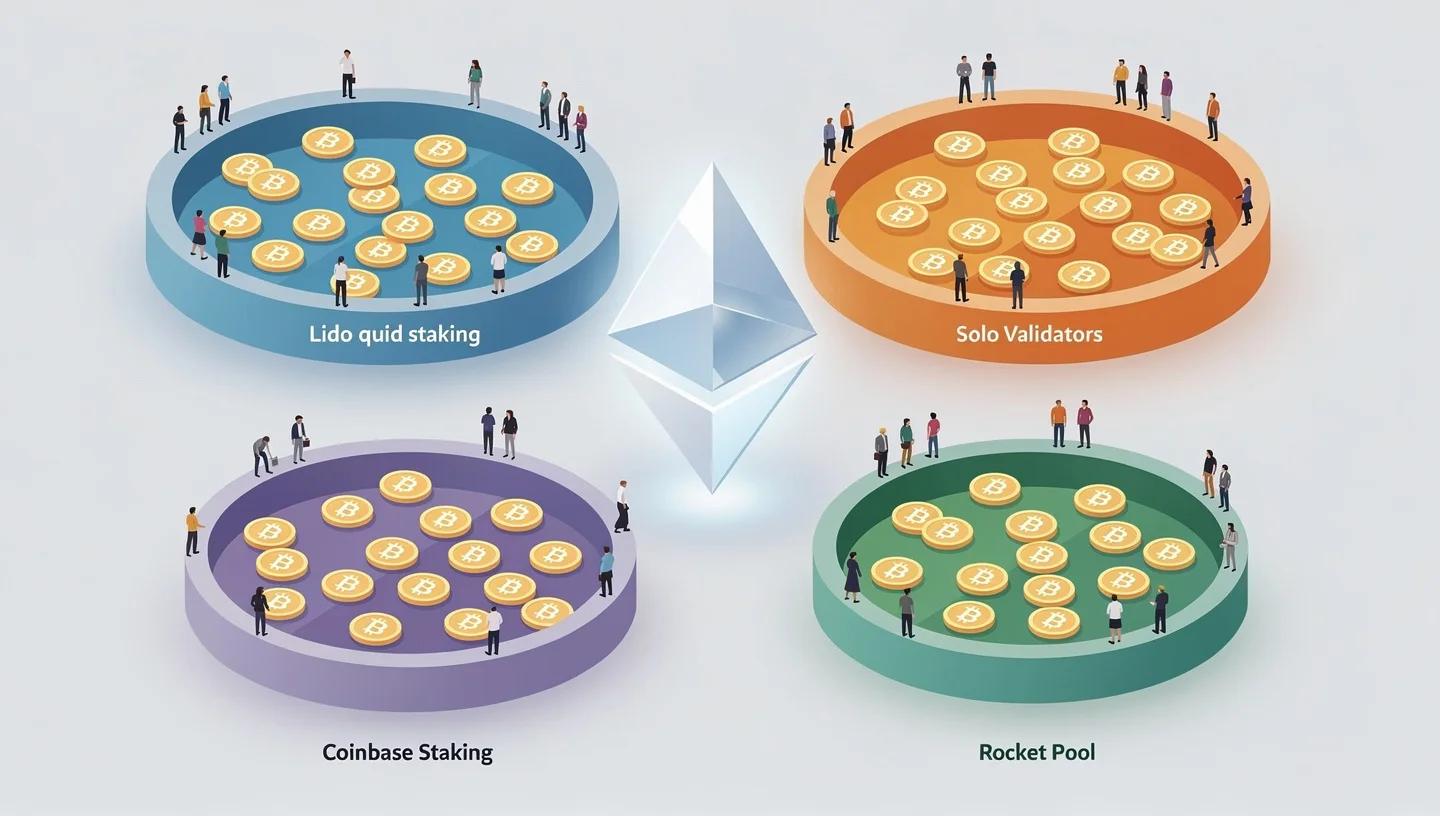
As of 2026, over 30% of the total ETH supply is locked in staking contracts, representing a new all-time high according to Fortunly. Some estimates put the figure higher. MEXC’s analysis cites over 55 million ETH in staking contracts. This means roughly one third of all ETH that exists cannot be sold or transferred without going through the validator exit queue, which can take days or weeks depending on how many validators are trying to exit simultaneously.
The staked ETH is not lost. Validators can initiate withdrawals, and those ETH return to their wallets after the exit queue processes the request. But the queuing mechanism means that large-scale unstaking events cannot happen instantly, which provides a natural buffer against sudden supply flooding into the market.
Who is staking ETH – Lido, Rocket Pool, and solo validators
| Staking method | Estimated share of staked ETH | Minimum ETH | Type |
|---|---|---|---|
| Lido (stETH) | ~30% | No minimum | Liquid staking protocol |
| Coinbase (cbETH) | ~12% | No minimum | Exchange staking |
| Solo validators | ~25% | 32 ETH | Direct staking |
| Rocket Pool (rETH) | ~5% | 0.01 ETH | Liquid staking protocol |
| Other protocols and exchanges | ~28% | Varies | Mixed |
Lido dominates liquid staking. When users stake through Lido, they receive stETH in return, a token that represents their staked ETH and accrues staking rewards over time. stETH can be traded, used as collateral in DeFi, or held passively. This means Lido’s share of staked ETH is technically liquid in the sense that stETH circulates, even though the underlying ETH remains locked in the Beacon Chain contract. Rocket Pool operates similarly with rETH. For a full walkthrough of how to stake ETH and which method suits different situations, the guide on how to stake Ethereum covers all three approaches.
What staked ETH means for circulating supply
When over 30% of all ETH is locked in staking, the effective float available for trading is meaningfully smaller than the headline circulating supply figure suggests. An investor looking at 120.7 million ETH total supply should note that roughly 36-55 million of that is not actively circulating in the same way as unstaked ETH. The liquid staking tokens (stETH, rETH, cbETH) partially compensate for this by allowing holders to maintain exposure to staking rewards while still having a tradeable asset, but they are not interchangeable with ETH on a one-to-one basis in all contexts.
Does Ethereum Have a Maximum Supply?
No. Ethereum has no hard cap equivalent to Bitcoin’s 21 million coin limit. This is a deliberate design decision, not an oversight. The reasoning is practical: a network that needs to pay validators forever cannot have a fixed supply, because at some point the block reward would hit zero and the network would have to rely entirely on transaction fees to incentivize validators. That model may work if fees are consistently high, but it creates security uncertainty if fees ever drop significantly.
Why there is no ETH hard cap
Ethereum’s founders built the protocol with the assumption that validators will always need some baseline reward to stay online. A hard cap creates a coordination problem: once all coins are issued, validators earn only transaction fees. If fee revenue drops during a bear market or quiet period, running a validator becomes unprofitable, potentially leading to fewer validators and a less secure network. Ethereum avoids this by always issuing a small amount of new ETH. The counter to inflation concerns is EIP-1559, which burns fees and can more than offset new issuance during active periods.
Ethereum’s approach – utility-driven scarcity
Rather than algorithmic scarcity from a fixed cap, Ethereum relies on demand-driven scarcity. When the network is busy, more ETH burns than is issued, and the supply shrinks. When the network is quiet, supply grows slightly. This means ETH supply responds to actual usage rather than following a predetermined schedule. Critics argue this makes ETH less predictable as a store of value. Proponents argue it ties the asset’s supply directly to the health and utility of the underlying network, which is a more honest reflection of value.
Could ETH ever run out?
No. The protocol always issues new ETH to validators as long as the network is running. Even during the most deflationary periods recorded since The Merge, the issuance never stopped, it was simply outpaced by the burn. A scenario where ETH supply reaches zero is not possible under the current protocol design. The floor is set by the ongoing validator reward structure, and any scenario where issuance dropped so low as to threaten network security would trigger community discussion about adjusting the parameters through a protocol upgrade. Understanding what Ether actually is within the Ethereum system gives useful context for why the protocol is designed to always maintain a minimum issuance.
ETH vs Bitcoin: Different Supply Philosophies
The most common comparison people make is between ETH’s unlimited supply and Bitcoin’s 21 million coin hard cap. Both are in the top two by market capitalization, which tells you that markets have validated both models. What differs is the underlying philosophy and what each model is optimized for.

Bitcoin’s fixed supply model
Bitcoin’s 21 million cap is written into the protocol and cannot be changed without a hard fork that would require near-unanimous agreement from the network. New Bitcoin enters circulation through mining rewards that halve approximately every four years. The last Bitcoin will be mined around 2140. After that, miners will rely entirely on transaction fees. Bitcoin’s model prioritizes certainty: everyone knows exactly how many coins will ever exist and on what schedule. That predictability is a feature for people who hold Bitcoin as a store of value comparable to gold.
Ethereum’s demand-responsive supply
Ethereum’s supply model is more complex. There is no hard cap, but EIP-1559 creates a mechanism where supply growth is self-limiting based on usage. Bitcoin offers predictability through an unchanging algorithm. Ethereum offers a different kind of scarcity: one that responds to whether anyone is actually using the network. When Ethereum is busy, ETH becomes scarcer. When it is quiet, supply grows slowly. This is a fundamentally different value proposition.
ETH also offers something Bitcoin does not: yield through staking. Holding ETH and staking it generates 3-4% annually in validator rewards. This changes the investment calculation significantly. Bitcoin holders earn nothing from holding. ETH holders who stake earn yield on top of any price appreciation. The total investment case for ETH combines potential scarcity, utility as network fuel, and staking income – three separate value drivers rather than one. To see the full picture of what ETH is used for beyond just supply mechanics, the breakdown of what ETH is used for covers each use case with numbers.
Which model is better for investors?
Neither model is objectively superior. Bitcoin’s fixed supply appeals to investors who want certainty and simplicity. Ethereum’s demand-responsive supply appeals to investors who believe the network’s utility will drive sustained burn rates that keep supply in check. The market has validated both approaches: Bitcoin holds the top position by market cap and Ethereum holds the second position, with a combined market cap in the trillions of dollars. Both models can coexist because they serve different purposes and attract different types of holders.
ETH Denominations: From Wei to Ether
ETH is divisible into extremely small units, which matters for gas fee calculations and smart contract interactions. Most users only ever see ETH and gwei, but the full denomination table is worth knowing.
| Name | Number of wei | Common use |
|---|---|---|
| wei | 1 | Smart contract calculations, lowest unit |
| kwei | 1,000 | Rarely used in practice |
| mwei | 1,000,000 | Rarely used in practice |
| gwei | 1,000,000,000 | Gas prices – what you see in your wallet |
| microether | 1,000,000,000,000 | Occasional technical use |
| milliether | 1,000,000,000,000,000 | Occasional technical use |
| Ether (ETH) | 1,000,000,000,000,000,000 | Standard unit for trading and holding |
Wei is named after Wei Dai, a Chinese computer engineer and cryptographer whose work on digital cash predated Bitcoin. The denomination most users encounter is gwei, which is what wallets display for gas prices. When MetaMask shows a gas price of 20 gwei, it means 20 times one billion wei per unit of gas. One ETH equals one quintillion wei (1 followed by 18 zeros). Smart contracts work in wei internally because Ethereum’s virtual machine handles only integers, and working in the smallest unit avoids rounding errors in financial calculations.
Frequently Asked Questions
How many ETH coins are there in total?
As of May 2026, approximately 120.7 million ETH are in circulation. This number changes daily because roughly 1,700 new ETH are issued to validators each day and a variable amount is burned through EIP-1559. The total supply has stayed within a narrow range since The Merge in September 2022 because new issuance and burn rates are relatively balanced.
Does Ethereum have a maximum supply?
No. Ethereum has no hard cap on total supply. Unlike Bitcoin’s fixed limit of 21 million coins, Ethereum can always issue new ETH to validators. The counterbalance is EIP-1559, which burns part of every transaction fee. During high-activity periods, the burn rate exceeds issuance and the total supply shrinks. The result is a supply model that responds to network usage rather than following a fixed schedule.
How much ETH is burned every day?
The daily burn rate varies significantly with network activity. During quiet periods it can fall below 1,000 ETH per day. During high-activity periods like major NFT launches or DeFi booms, it has exceeded 20,000 ETH per day. The long-run average since EIP-1559 launched in August 2021 is in the range of 1,500-3,000 ETH per day. More than 3.6 million ETH has been burned in total since EIP-1559 went live.
How much ETH is staked right now?
Over 30% of the total ETH supply is currently locked in staking contracts, representing a new all-time high as of 2026. Estimates from MEXC put the figure at over 55 million ETH. Lido holds the largest share of staked ETH at approximately 30% of the staked total, followed by Coinbase at around 12%. Solo validators running their own nodes account for roughly 25% of staked ETH.
Is Ethereum inflationary or deflationary?
Both, depending on network activity. Ethereum alternates between mild inflation and deflation. When the burn rate from EIP-1559 exceeds the issuance rate of roughly 1,700 ETH per day, the supply shrinks and ETH is net deflationary. When the network is quiet and burn rates are low, supply grows slowly. As of early 2026, ETH is showing an annual inflation rate of approximately 0.23-0.8%, meaning it is mildly inflationary. ETH first went net deflationary on November 9, 2022.
How does ETH supply compare to Bitcoin?
Bitcoin has a fixed hard cap of 21 million BTC, approximately 19.7 million of which are in circulation as of 2026. Ethereum has approximately 120.7 million ETH with no hard cap. Bitcoin’s issuance halves every four years following a fixed schedule. Ethereum’s net supply change depends on how much the network is used. Both assets are in the top two by market capitalization, which reflects that markets value both approaches to supply management.
What is gwei and how does it relate to ETH?
Gwei is a denomination of ETH equal to one billionth of one ETH (0.000000001 ETH). Gas prices are denominated in gwei because transaction fees are too small to express conveniently in full ETH. When your wallet shows a gas price of 15 gwei, it means you are paying 15 billionths of one ETH per unit of gas consumed by your transaction. One ETH equals one billion gwei, or one quintillion wei (the smallest possible unit).