Anyone holding stETH for more than a few months eventually notices something strange. The number on a price chart shows stETH trading at 0.998 ETH, or 1.002 ETH, or some other figure that is close to one but never quite exactly one. If stETH is supposed to be backed one to one by ETH locked in Lido, why does the market price ever move away from that number at all? The short answer is that the peg is a backing guarantee, not a price guarantee, and the gap between those two things is exactly what this guide breaks down.
Understanding this ratio matters whether you are staking your first bit of ETH or already using stETH as collateral somewhere in DeFi. This guide walks through what backs the token, why the ratio can drift, what actually happened during the well known 2022 depeg, and how the mechanisms in place today keep things far steadier than they used to be. By the end you should be able to look at any stETH price quote and understand exactly why it sits where it does.
What Is stETH and Why Does It Have a Ratio to ETH?
stETH, short for Lido Staked Ether, is the token you receive when you deposit ETH into the Lido protocol. Lido takes that ETH and stakes it across a large network of professional node operators who run validators on the Ethereum network. In exchange, you get stETH sitting in your wallet, an ERC-20 token that represents your original deposit plus whatever staking rewards have accrued since.
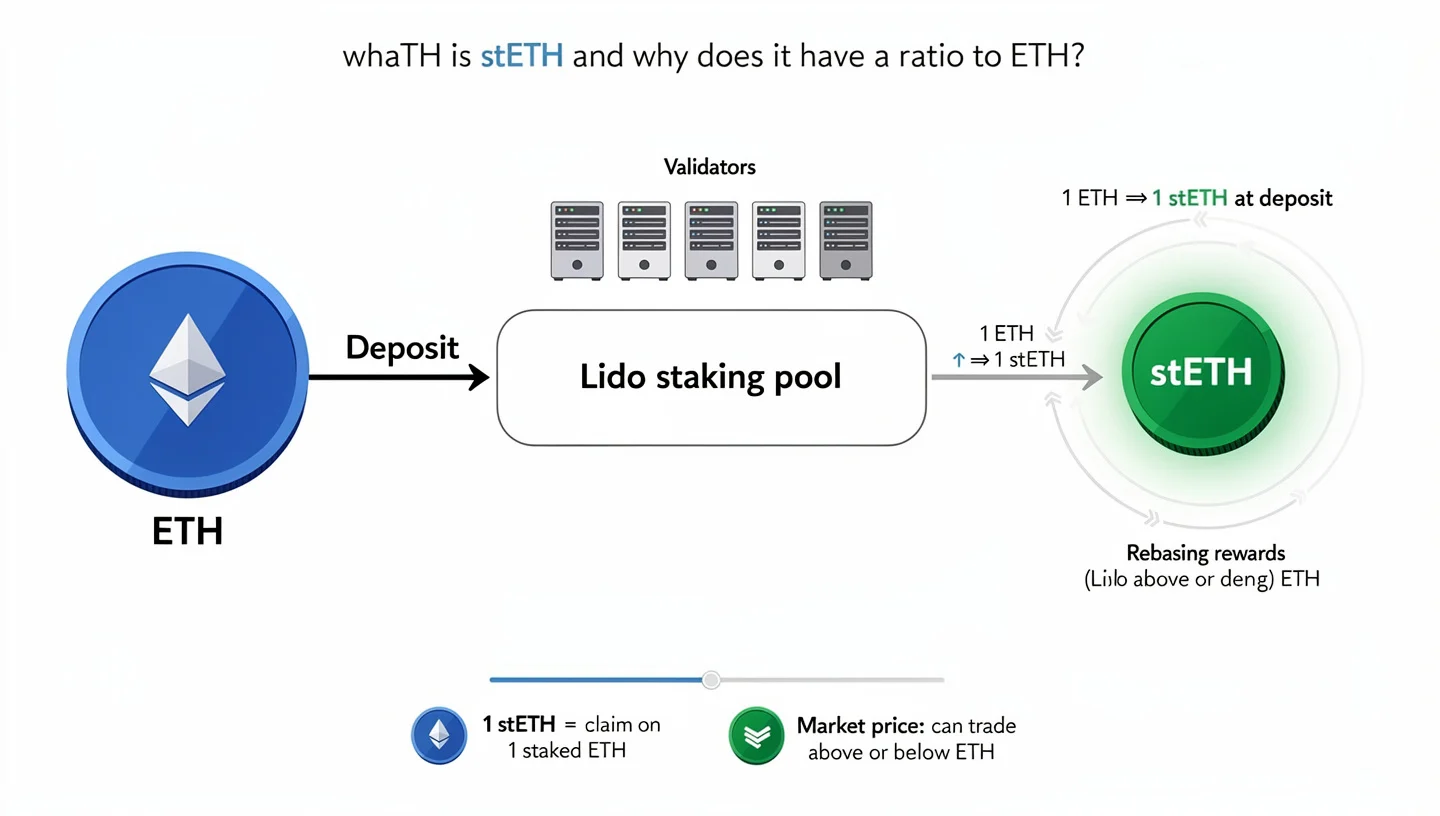
The ratio exists because stETH needs a reference point. Since one stETH is minted for every ETH deposited, the token was designed to track ETH value at a one to one rate from day one. As staking rewards come in, your stETH balance grows on its own through a daily rebase, so the ratio in terms of backing never really changes, it is always one stETH claim against one staked ETH. What changes is the price people are willing to pay for that claim on the open market.
How the stETH to ETH Peg Is Supposed to Work
The word peg gets thrown around loosely in crypto, often compared to stablecoins pegged to the dollar. stETH works on a different principle entirely. A stablecoin peg depends on market confidence and reserves that can be redeemed on demand at any moment. The stETH peg depends on a backing relationship: every stETH token corresponds to ETH that is genuinely staked on the Beacon Chain under proof of stake, tracked by oracles that report validator balances back to the Lido smart contract.
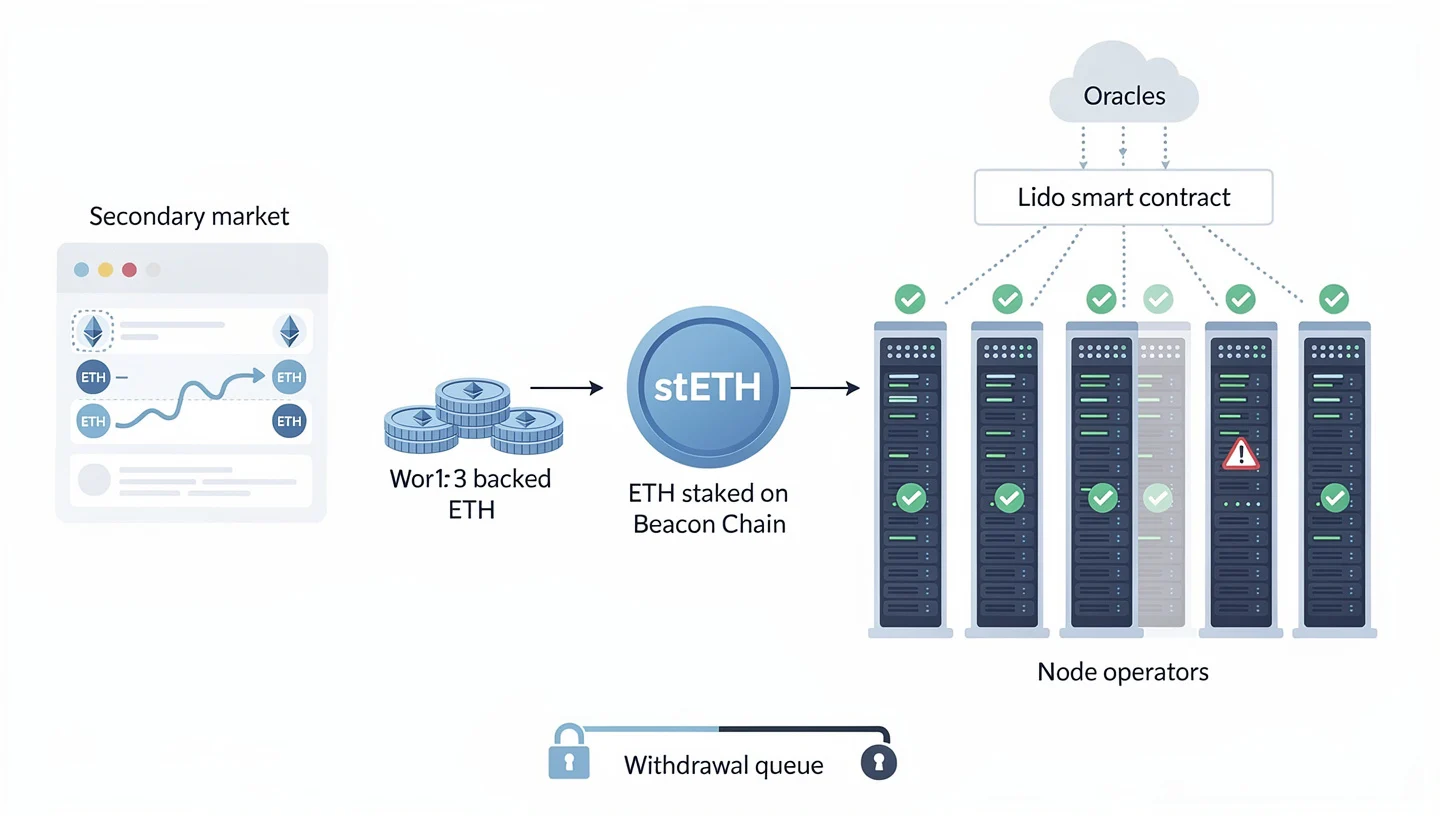
In theory, this backing should make stETH rock solid. The ETH is there, it is earning rewards, and it will eventually be redeemable. The catch is timing. Staked ETH cannot be pulled out instantly, and before certain upgrades it could not be pulled out at all. That mismatch between guaranteed future value and immediate liquidity is where the ratio starts to wobble on secondary markets, even though the underlying backing stays intact. This backing relationship is fundamentally different from how a regular smart contract based token might trade, since the value here is tied to a real staking position rather than pure market speculation.
Node operators play a quiet but important part in keeping this backing accurate. These are the professional entities that actually run the validators behind the scenes, and their performance directly affects how much ETH ends up backing each stETH over time. If a validator gets penalized for going offline or acting improperly, that loss is shared across all stETH holders rather than falling on one person, which is part of why Lido spreads deposits across dozens of separate operators instead of relying on just a handful.
Why the Ratio Isn’t Always Exactly 1:1
Market Price vs Redemption Value
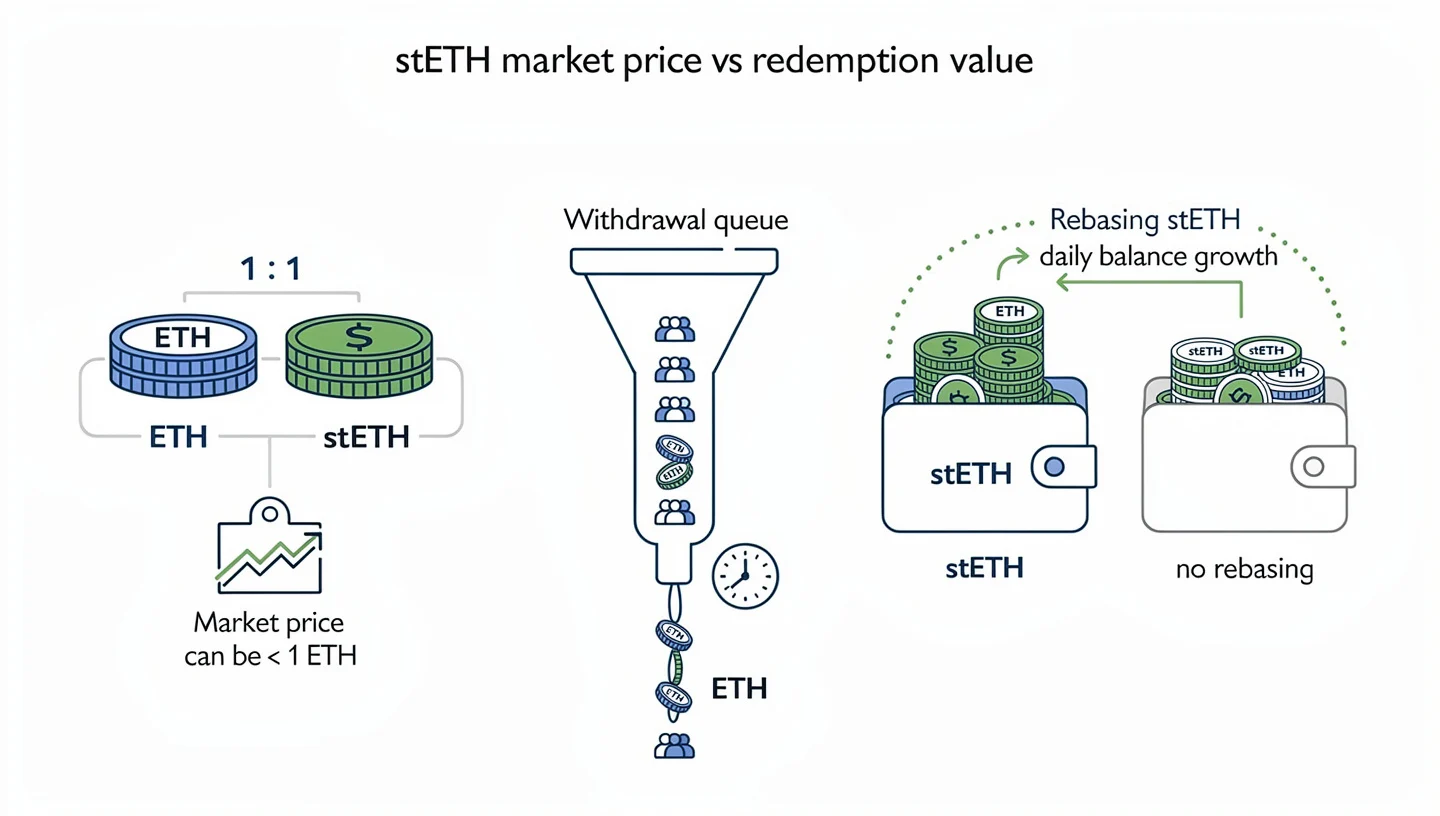
The price you see on an exchange is not the redemption value, it is whatever a buyer and seller agree to trade at right now. If a lot of people want to sell stETH for ETH quickly and there are not enough buyers stepping in, the price gets pushed below one ETH, even though every stETH is still backed by real staked ETH sitting on the beacon chain. This gap is often called a discount rather than a loss, because the underlying claim on ETH has not actually shrunk.
The Withdrawal Queue Bottleneck
Lido runs a native withdrawal queue for converting stETH back into ETH directly through the protocol. Ethereum only allows a limited number of validators to exit per epoch, roughly every six and a half minutes, which caps how fast ETH can flow out of staking regardless of how many people are waiting. Under normal conditions this queue clears in a matter of hours to a few days, but during periods of heavy demand it can stretch out much longer, and that uncertainty pushes some holders to accept a discount on the open market instead of waiting in line.
Rebasing and Daily Balance Growth
stETH is a rebasing token, meaning your wallet balance of stETH tokens grows every single day to reflect staking rewards, rather than the price of each token climbing. If you deposit 10 ETH and see 10 stETH in return, a year later you might hold 10.3 stETH instead of 10, with the extra 0.3 representing rewards. Some decentralized exchanges and lending platforms find rebasing tokens awkward to work with, which is part of why a wrapped, non-rebasing version of the token exists and gets used heavily across DeFi. This is different from how ETH itself works, since ETH has no rebasing behavior at all and simply sits at whatever quantity you hold.
The June 2022 Depeg: What Actually Happened
The most well known stretch of stETH trading meaningfully below ETH came in June 2022, when the discount reached somewhere between five and eight percent depending on the exchange and the moment you checked. The trigger was not a flaw in stETH itself. It started with the collapse of the Terra ecosystem and its algorithmic stablecoin, which sent a wave of panic through anything resembling a pegged asset, deserved or not.
Large holders such as Celsius Network and Three Arrows Capital were sitting on big stETH positions, often used as collateral for loans, and both firms were under severe liquidity pressure at the time. As they rushed to sell stETH for ETH to cover obligations, the Curve pool that handled most of the trading volume between the two tokens became heavily imbalanced. With withdrawals from staking still disabled at that point in Ethereum’s history, there was no way to redeem stETH directly for ETH at par, so sellers had to accept whatever price the market offered. That forced selling, combined with a total lack of a direct redemption option, is what pushed the discount as deep as it went. Roughly 180 million dollars worth of stETH-collateralized positions ended up getting liquidated across various DeFi protocols during that stretch, a reminder of how quickly leverage built on top of a fluctuating ratio can unwind.
How the Peg Is Maintained Today
Curve and DEX Liquidity Pools
The stETH-ETH pool on Curve Finance remains the backbone of stETH liquidity. Curve uses a StableSwap style formula built specifically for assets that are expected to trade near parity, which keeps slippage low for normal sized trades and only produces large price swings when the pool becomes seriously imbalanced. A separate concentrated pool was even deployed with a much higher amplification setting specifically to hold the peg tighter during large one-sided flows.
Deep liquidity matters more than most people realize here. When a pool has plenty of both assets sitting inside it, a single large trade barely moves the price. When one side of the pool gets drained because everyone is heading for the exit at once, even a moderate trade can shove the ratio noticeably in one direction, which is exactly the dynamic that played out during the worst days of the 2022 depeg.
Arbitrage Mechanism
Whenever stETH trades at a noticeable discount, arbitrage traders have an incentive to buy it cheap and either hold it for the yield or redeem it later at full value. That buying pressure tends to nudge the price back toward one ETH. This mechanism worked poorly during 2022 because redemption was not yet possible, so arbitrageurs had no guaranteed way to close the trade. Today, with direct redemption live, the same arbitrage plays out much faster because the endpoint value is not theoretical anymore.
Direct Redemption Since the Shanghai Upgrade
The Shanghai upgrade, paired with the Capella upgrade on the consensus layer, went live in April 2023 and finally allowed staked ETH to be withdrawn from the beacon chain. This gave stETH holders a real, protocol level path to convert back into ETH at exactly one to one, rather than relying entirely on secondary market prices. That single change is widely credited with keeping the ratio far more stable ever since, because a persistent deep discount now invites arbitrage that has an actual exit. Anyone wanting to see the mechanism firsthand can check Lido’s own withdrawal interface, which shows live queue times and lets holders request a redemption directly through the protocol.
stETH vs wstETH: Rebasing vs Wrapped Tokens
Because stETH rebases daily, some platforms built around the standard ERC-20 token format struggle to handle a balance that changes on its own without a transfer event. Wrapped staked ETH, or wstETH, solves this by keeping your token count fixed while the exchange rate between wstETH and ETH increases instead. One wstETH might equal 1.15 ETH today and 1.18 ETH a few months later, growing in value rather than growing in quantity.
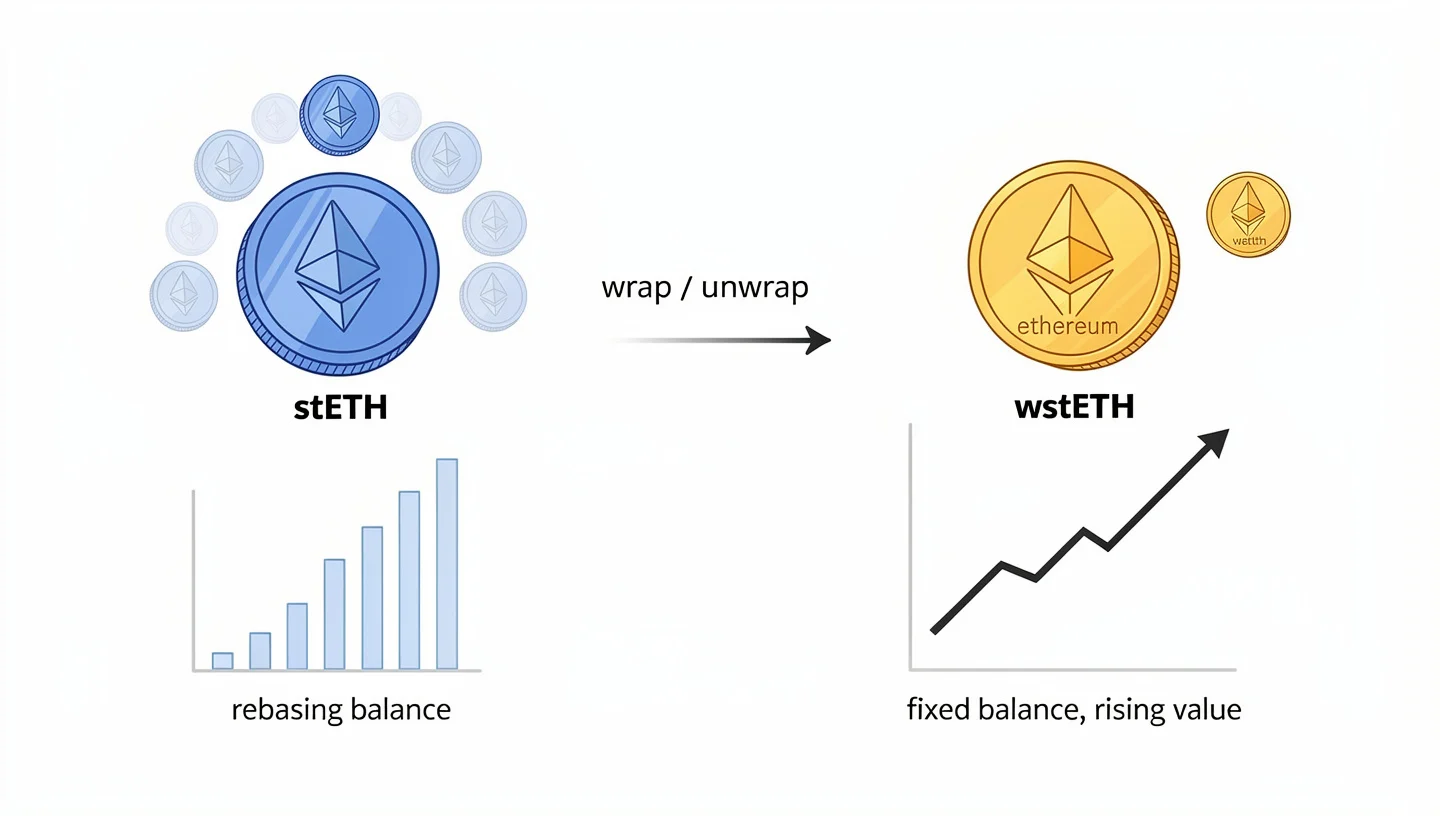
Platforms such as Uniswap and various cross-chain bridges tend to prefer wstETH for exactly this reason, since a stable token count is far easier to plug into pool math and smart contract logic than a balance that shifts every day. If you plan to move staked ETH across chains or into a liquidity pool, checking whether the platform expects stETH or wstETH will save you an extra wrapping step. Keeping track of which version sits in your wallet also matters if you ever need to reconcile your holdings against a tax report or a portfolio tracker, since the two tokens behave differently even though they represent the same underlying position. You can look up the exact contract behind either token on Etherscan’s stETH page, which also shows current holder distribution and total supply figures.
What the Ratio Means for DeFi Users
Lending platforms including Aave and MakerDAO accept stETH as collateral, typically at a loan to value ratio somewhere around 85 to 90 percent. This lets holders borrow against their staked position without giving up their staking rewards or unstaking early, which is a large part of why stETH became one of the most widely used assets in DeFi lending. It is worth remembering that this only works because stETH follows the same ERC-20 standard as most other DeFi assets, letting lending contracts treat it the same way they treat any other deposit.
Leverage Staking and Liquidation Risk
Some users take this further with a strategy sometimes called leverage staking or recursive staking: stake ETH to get stETH, deposit that stETH as collateral, borrow ETH against it, then stake the borrowed ETH again to repeat the loop. This can boost yield noticeably, but it also means a modest drop in the stETH to ETH ratio can trigger liquidations, and if enough positions get liquidated at once it can push the price down further, creating a spiral that made the 2022 event worse than it otherwise would have been.
Anyone considering this kind of leveraged position should be comfortable with how quickly things can unwind if the ratio moves against them, and should be just as cautious here as they would be around any other common risk in the space, since leveraged positions built on a fluctuating ratio can be wiped out fast during periods of stress. Keeping some of your holdings unlevered goes a long way toward avoiding a forced liquidation during a sudden dip, and checking the health factor shown on a lending dashboard before adding more leverage is a habit worth building early rather than after a scare.
Current State of the Peg
These days stETH generally trades within a fraction of a percent of ETH value under normal market conditions, a big improvement over the wide swings seen in 2022. Deeper liquidity across more exchanges, wider adoption of wstETH for cross-chain use, and the standing option of direct proof of stake withdrawal all work together to keep the gap small. The withdrawal queue itself still fluctuates with overall network demand, sometimes clearing in under a day and other times stretching to a week or more when large amounts of ETH are exiting staking across the board, so it is still worth checking current conditions before assuming an instant swap or a native withdrawal will be faster.
It also helps to remember that stETH holders are not staking in isolation. The same validator infrastructure that secures stETH deposits is part of the broader network that keeps ETH functioning as a settlement layer, and gas costs on that same network are what determine how expensive it is to deposit, withdraw, or move stETH around in the first place. On a busy day, gas fees alone can influence whether a small arbitrage trade closing a stETH discount is even worth executing, since a trade that only closes a tiny gap might not be worth the cost of the transaction itself.
Watching total value locked across Lido and its various integrations can also give a rough sense of how much conviction the market currently has in the peg holding steady. When TVL is climbing steadily, it usually means new deposits are outpacing withdrawal requests, which tends to keep the ratio calm. A sharp drop in TVL over a short window, on the other hand, has historically been an early sign that the ratio might come under pressure, since it often means large holders are heading for the door at the same time.
| Situation | Typical Ratio Behavior |
|---|---|
| Normal market conditions | Trades within roughly 0.2 percent of ETH |
| Heavy selling pressure or panic | Can trade at a temporary discount |
| Withdrawal queue backed up | Discount may widen slightly until queue clears |
| Direct redemption through Lido | Always settles at exactly 1:1 |
None of these numbers are fixed forever, since they move with overall market conditions, how much ETH is entering or leaving staking at any given time, and how much liquidity is sitting in the major trading pools. Treating the table above as a general pattern rather than a strict rule will serve you better than expecting the ratio to behave identically in every market cycle.
Key Terms to Know
Peg refers to the intended one to one backing relationship between stETH and staked ETH, not a guaranteed market price. Rebasing describes the daily adjustment to your stETH balance that reflects staking rewards. A node operator is one of the professional entities running validator infrastructure on behalf of Lido depositors. An oracle is the mechanism that reports validator balances back to the smart contract so rewards can be calculated accurately. The withdrawal queue is the line staked ETH has to pass through before it can be released back to a user, governed by how many validators Ethereum allows to exit per epoch. An LST, or liquid staking token, is the general category stETH belongs to, alongside similar tokens issued by other staking providers. Keeping these terms straight makes it much easier to follow discussions about the ratio without getting lost in jargon that sounds more complicated than it actually is.
Frequently Asked Questions
Is stETH always worth 1 ETH?
Not exactly, though it is meant to be close. Every stETH is backed by staked ETH on a one to one basis, but the market price can drift slightly above or below that figure depending on supply, demand, and how long the withdrawal queue is at any given moment.
Why did stETH depeg in 2022?
A combination of the Terra collapse triggering panic across pegged assets, forced selling from large holders like Celsius and Three Arrows Capital, and the fact that direct redemption for ETH did not exist yet all combined to push the discount down to around five to eight percent for a period.
How long does it take to convert stETH back to ETH?
Using Lido’s native withdrawal queue usually takes anywhere from a few hours to several days, depending on how many other users are exiting at the same time. Swapping stETH for ETH instantly through a decentralized exchange like Curve or Uniswap is faster but exposes you to whatever the current market price happens to be.
What is the difference between stETH and wstETH?
stETH rebases, meaning your token count grows daily as rewards accrue. wstETH keeps a fixed token count while its exchange rate against ETH rises over time instead. wstETH tends to be the preferred format for DeFi platforms and cross-chain bridges that do not handle rebasing balances well.
Is a stETH discount a buying opportunity?
A discount can attract arbitrage traders who buy stETH cheap and either hold for yield or redeem it later at full value, which is part of what helps restore the ratio. That said, a discount also reflects real short-term liquidity risk, so it is not automatically a safe bet, especially if the withdrawal queue is unusually long at the time.
Can the stETH peg break again?
A severe, sustained break is considered unlikely under current conditions since direct redemption through Ethereum’s staking withdrawal system now exists, something that was not available during the 2022 event. Short-term discounts during periods of high market stress are still possible, but the mechanisms in place today give arbitrage traders a clearer path to correct them, which is a meaningful structural improvement over the environment that produced the original depeg.