Many Muslim investors ask the same thing before they buy their first coin: is Ethereum halal? The question is fair, because Ethereum is not only digital money. It is a network that runs smart contracts, pays validators, charges fees in ETH and hosts everything from lending apps to games. Some of that activity is clearly halal, and some of it is clearly haram.
The honest answer is that Islamic scholars do not agree on one ruling. Some say ETH is permissible because it has real use on the network. Others warn about gharar (excessive uncertainty), speculation and the haram activity that runs on top of the chain. This guide goes through the main arguments, the opinions that exist, and what changes for staking, trading, mining and zakat, so you can decide with the right information and the right scholar.
Is Ethereum Halal or Haram? The Short Answer
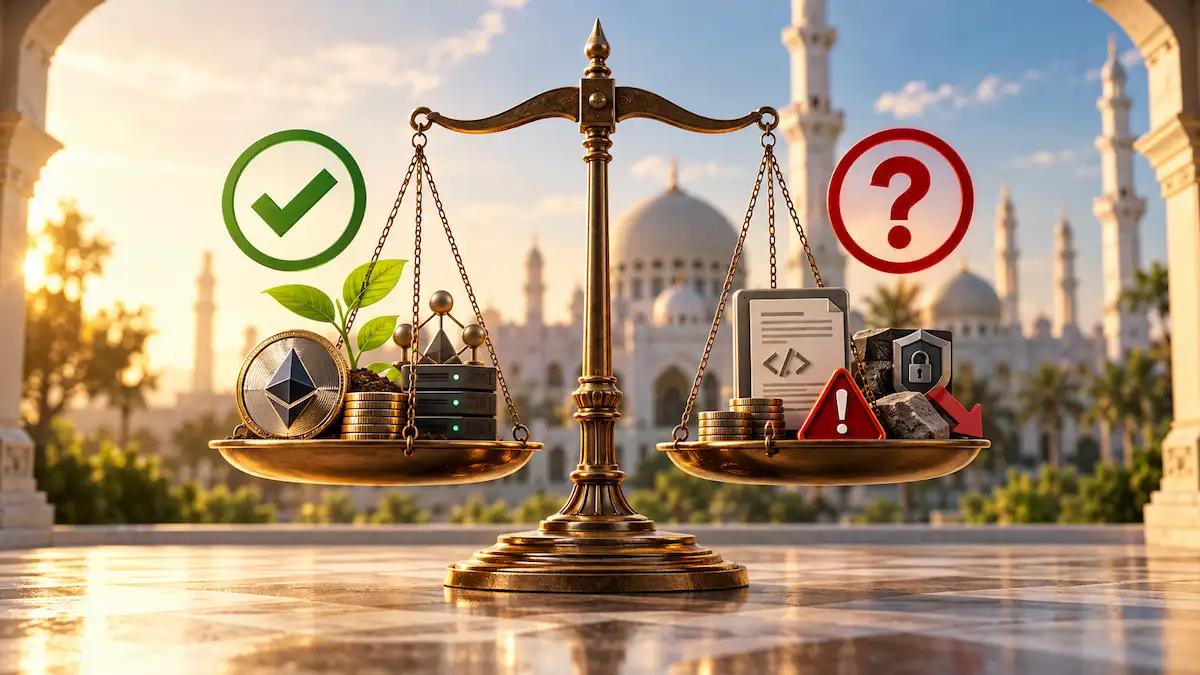
There is no single ruling that every scholar accepts, so the short answer is that ETH is halal for many scholars, conditionally halal for others and haram for a smaller group. Those who permit it point out that ETH is a utility token. You need it to pay gas fees and to run smart contracts, so it has a purpose beyond price speculation. Those who forbid it point to volatility, speculation and the fact that no company, government or physical asset stands behind it.
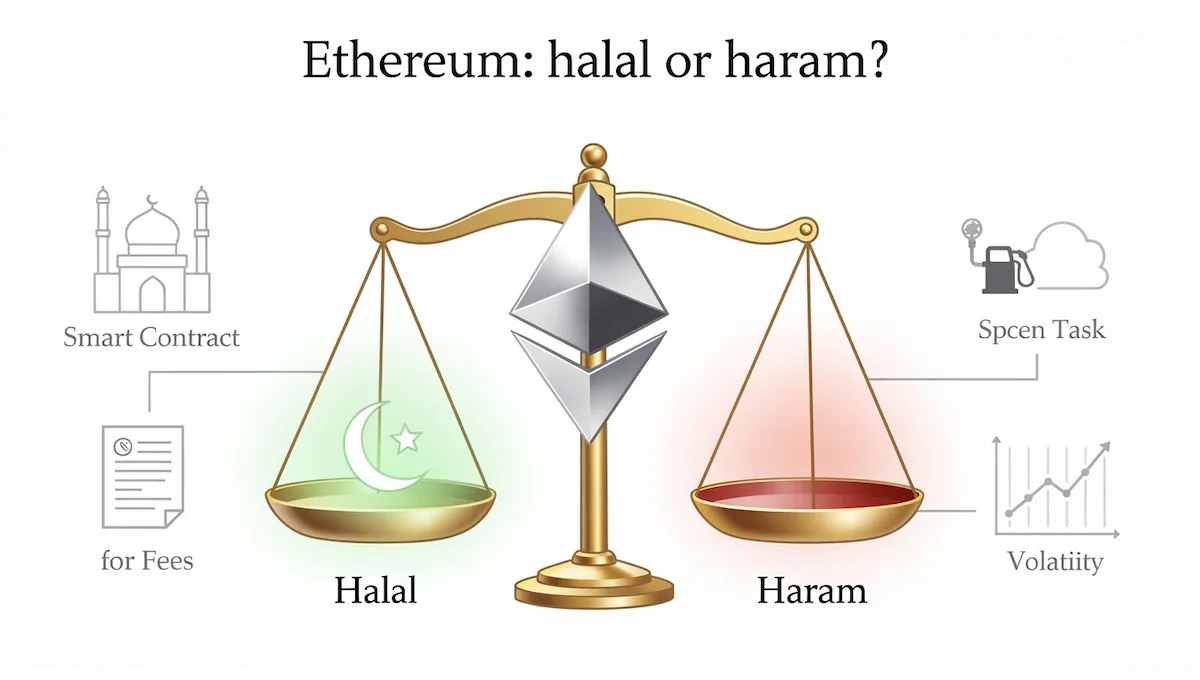
When people search whether ethereum is halal or haram, the best way to read the answer is by activity. Buying and holding ETH for real use is the safest halal position. Staking through the network itself is debated. Lending coins for interest, borrowing with interest and trading futures with borrowed money fall under riba and maysir, and most scholars treat them as haram no matter which coin is used.
This article is not a fatwa. It is a summary of what published scholars, Shariah advisory firms and Islamic finance sites have said so far. If you plan to hold a large amount, ask a qualified scholar who understands crypto.
| Position | Who holds it | Main reason |
|---|---|---|
| Permissible | Amanie Advisors (2019 whitepaper), Shariah Review Bureau | ETH has utility, it pays for computation on the network |
| Conditionally permissible | Many scholars and Islamic finance sites | Halal if there is no riba, no borrowed money and no haram use |
| Prohibited | Councils and scholars who rule against crypto in general | Speculation, gharar and no physical backing |
What Makes a Cryptocurrency Halal or Haram in Islamic Finance?
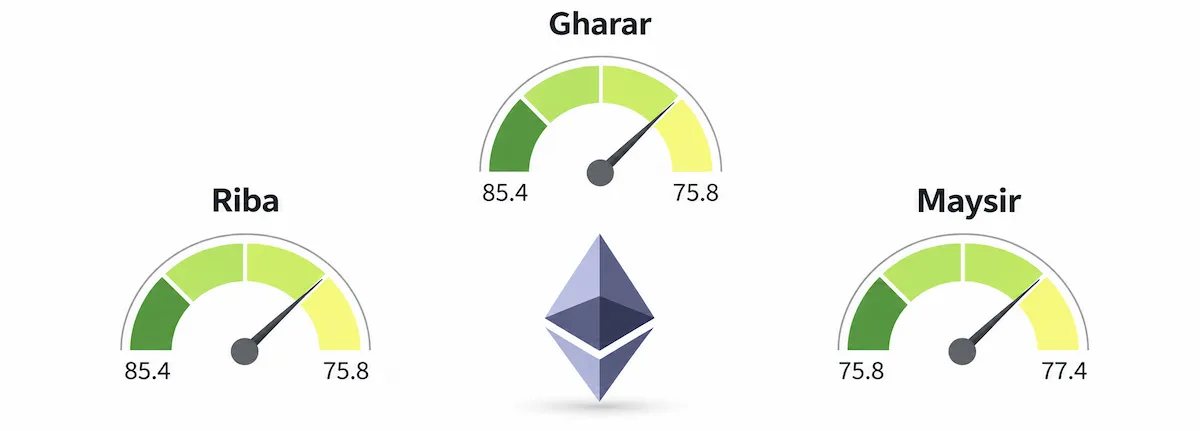
Before looking at ETH, it helps to know the tests that scholars apply to any digital asset. Islamic finance does not judge a coin by its name or its price. It looks at what the asset is, how it is used and how the deal around it is built. The same four ideas come up again and again in Shariah-compliant reviews: riba, gharar, maysir and whether the asset counts as mal.
Riba (Interest) and Why It Matters for Crypto
Riba means interest, or any guaranteed extra return on a loan. It is prohibited in every school of Islamic law. Holding ETH does not create riba by itself, because you are not lending anything. Riba appears when ETH is placed into a product that promises a fixed return, such as an exchange earn program with a set APY, or a DeFi pool where you lend coins and receive interest. A fixed return on a loan of coins is riba in substance, even if the platform calls it a reward.
Gharar (Excessive Uncertainty) and Maysir (Gambling)
Gharar is excessive uncertainty in a deal, for example selling something that does not exist yet or whose terms are unclear. Maysir is gambling, which means gaining money by chance at the loss of another person. Price swings alone do not make an asset haram, because shares and commodities also go up and down. The problem starts when trading behaves like betting, with high borrowed positions, short timeframes and no interest in the asset itself.
Is Ethereum Considered Mal? Ownership and Intrinsic Value
Islamic law requires that something sold or owned must be mal, a property with value, a lawful use and clear ownership. Critics say crypto has no intrinsic value, because there is nothing physical behind it. Supporters answer that value comes from use and demand, the same way paper money and many services get their value. For ETH, the strongest point is utility: the coin is consumed every time someone sends a transaction or runs a smart contract, which gives it a function that a pure speculative token does not have.
What Is Ethereum and How Does It Work?
Ethereum is a public blockchain launched in 2015. If you want the full background, read what is Ethereum first, then come back to the Shariah questions. In short, the network lets anyone publish programs that run exactly as written, without a company controlling them. Its native coin is ether, written as ETH, which is used to pay for every action on the chain. Anyone can send ETH to anyone else, anywhere in the world, at any hour, and the record of every transfer is public and cannot be edited later, which is why the network is described as open and decentralized.
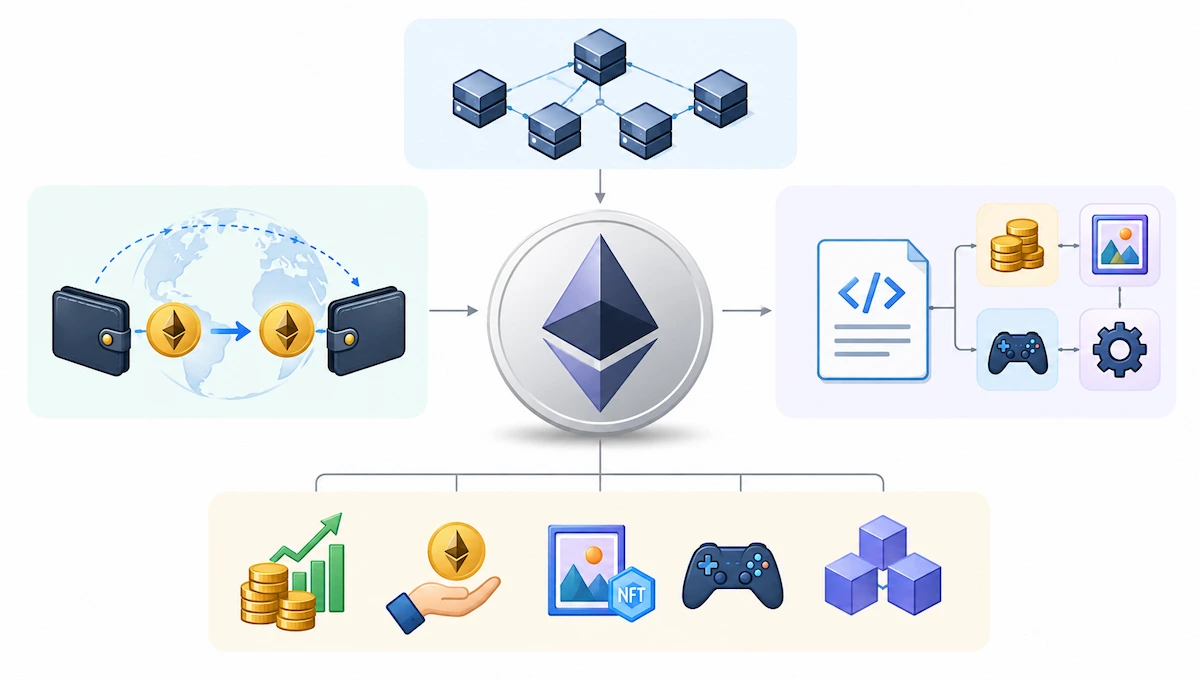
The part that matters for a halal review is that Ethereum is a platform, not only a currency. People use it to send payments, trade tokens, lend money, collect digital art and build games. The same chain therefore carries halal activity and haram activity side by side. Programs that run on it are called smart contracts, and each one is judged by what it does. A contract that sells a lawful product is fine. A contract that runs a casino or an interest-based loan is not, and the coin used to pay for it does not change that.
Why Many Scholars Consider Ethereum Halal
Supporters of the halal view build their case on utility, on the work done by the network and on the opinions of Shariah advisory firms that studied the project directly. Their reasoning is that ETH is closer to a service token than to a speculative coin, and that the existence of haram apps on the chain does not make the coin itself haram, in the same way that a bank note is not haram because someone can buy alcohol with it.
Real Utility, Gas Fees and Smart Contracts
Every action on Ethereum costs a fee, and that fee is paid in ETH. This is the main argument for real utility. You cannot send a transaction, swap a token or run a smart contract without spending ETH, so the coin is needed to use the network. The cost of an action goes up or down with demand, which you can see in detail in the guide to Ethereum gas fees. Scholars who permit ETH say this makes it a coin that people use and consume, not a chip that exists only to be traded.
The Amanie Advisors Whitepaper
In 2019 Amanie Advisors, a Shariah advisory firm whose chairman is Dr. Mohamed Ali Elgari, published a whitepaper after working with the Ethereum Foundation. The study concluded that ETH can be considered permissible because ether has a real function on the network and pays for computation. The paper was written before the Merge in 2022, when Ethereum still used proof of work, so reports at the time said the proof of stake question was left for a later review. Amanie Advisors is also a different firm from Amanah Advisors, which is led by Mufti Faraz Adam, and many articles mix the two up.
Shariah Review Bureau Opinion
In 2018 the Shariah Review Bureau in Bahrain reviewed ether and, according to reports, reached a similar conclusion based on its use in paying for network operations. Like the Amanie paper, this opinion predates the move to proof of stake, so it should be read as an opinion on ETH as a utility coin and not as a ruling on every product built around it.
Why Some Scholars Consider Ethereum Haram
The opposite view does not usually attack Ethereum as a technology. It focuses on how the coin behaves in the market and on what people do with it. Scholars who take this position say that the lawful uses of ETH are real, but that they are small compared with the amount of speculation, and that a careful Muslim should stay away from a coin where most buyers are betting on price.
Price Volatility and Speculation
ETH can lose or gain a large part of its value in a few weeks. For critics this brings gharar and a gambling mindset, especially when most people buy it only to sell at a higher price. They say that an asset where profit depends mostly on other buyers arriving later looks more like maysir than like investment. Supporters reply that volatility is not forbidden by itself, and that the real test is the intention and the way the deal is made.
Haram Activity on the Network
Ethereum hosts gambling apps, interest-based lending markets, leveraged trading products and scam tokens. Some scholars argue that holding ETH, and especially staking it, supports a network that also processes these deals. Others answer that the network is neutral infrastructure, like the internet, and that the user is responsible only for his own actions. This disagreement is one of the main reasons the answer to the halal question depends on which scholar you ask.
No Physical Backing, Is It Mal?
A common objection is that ETH is not backed by gold, a company or a government, so it cannot be treated as mal. The reply from the permissible side is that backing is not required for something to have value. Value can come from use, and Ethereum has a clear use. This is the same dispute that exists around digital money in general, and it has not been settled by any central Islamic authority.
Ethereum Halal Fatwas and Opinions by Country
Most official statements are about crypto in general or about Bitcoin, not about Ethereum by name. They are still useful, because the same reasoning is applied to ETH by local scholars and by the sites that follow them. None of the statements below is a specific fatwa on Ethereum, so use them to understand the direction of each country and not as a final ruling.
Egypt and Dar al-Ifta
Egypt’s Dar al-Ifta has in the past described Bitcoin trading as haram, mainly because of speculation, uncertainty and the lack of regulation. The same reasoning is often extended to other coins, although I could not confirm a separate Dar al-Ifta fatwa on ETH.
Turkey and Diyanet
The Turkish Presidency of Religious Affairs, known as Diyanet, stated in 2021 that crypto assets are not permissible in their current form, pointing to speculation, the lack of control and the risk of use in illegal activity.
Indonesia and MUI
The Indonesian Ulema Council (MUI) ruled in 2021 that crypto is haram as a currency, but that it can be traded as a commodity or digital asset if it has an underlying basis and a clear benefit. This is the closest official position to the utility argument used for ETH.
Pakistan and Scholars Like Mufti Taqi Usmani
In Pakistan, Darul Uloom Karachi has issued a fatwa against Bitcoin, while other scholars, including those who work with Islamic banks, have called for more study before a final ruling. Because the opinions are split, many Muslims there follow the advice of their own scholar.
Is Ethereum Staking Halal?
Anyone who asks is ethereum halal will soon ask about staking too. This is the question where the answer changes most from person to person. Staking means locking ETH to help secure the network and receiving rewards for it, and the type of staking you choose decides how a scholar will look at it. The four main types are native staking, liquid staking, exchange earn programs and delegation to a pool, and they do not carry the same ruling.
How Proof of Stake Works After the Merge
Ethereum moved from mining to proof of stake in September 2022. Validators now lock ETH as a deposit, propose and check blocks, and earn rewards for honest work. If they cheat or stay offline, part of the deposit can be taken, which is called slashing. The full process is explained in the guide to Ethereum proof of stake, and the official staking page at ethereum.org describes the requirements. Because rewards are paid for work and the deposit can be lost, many scholars see it as closer to payment for a service (ujrah) than to interest.
Native Staking and Solo Validators
Running your own validator needs 32 ETH, and this is the cleanest form of staking from a Shariah point of view. The reward is not guaranteed, the risk of loss is real and the validator does actual work. Scholars who allow it say there is no loan, so there is no riba. Those who disagree raise the earlier concern, that a validator may include haram transactions in blocks, since it cannot filter every one.
Liquid Staking and stETH
Liquid staking lets people with less than 32 ETH stake through a protocol and receive a token such as stETH in return. It adds more layers: smart contract risk, a fee to the protocol and the fact that the receipt token can be used in DeFi lending, where interest is involved. Whether the stETH token is worth one ETH at all times is covered in the article on the stETH to ETH ratio. Stakers who want to stay safe usually keep the token in their wallet and do not put it into any lending product.
Exchange Earn Programs and Fixed APY
Many exchanges offer an earn product with a fixed yearly percentage on ETH. This is the form that most scholars warn against. If the exchange promises a set return no matter what happens, the deal looks like a loan with a guaranteed extra, and that is riba in substance. A product is better only if it clearly says that rewards come from real network staking and can change, and that the exchange does not guarantee them.
Are Validators Complicit in Haram Transactions?
This is the question almost nobody covers in detail. A validator includes transactions in a block without knowing or choosing what each one is for. Scholars who permit staking compare it to a postal service or an internet provider that carries messages without approving them. Scholars who are stricter say that helping a sinful deal, even indirectly, is a problem. No council has settled this point yet, which is why a person who stakes should ask a scholar and not rely only on an article.
Is Ethereum Mining Halal?
Is ethereum halal to mine? The question no longer applies in practice, because mining ETH is no longer possible. The Merge in 2022 ended proof of work on Ethereum, so there is nothing to mine on the main network, and any service that sells ETH mining today deserves strong suspicion. You can read how this changed in the guide on whether you can mine Ethereum. Before the Merge, many scholars treated mining as permissible work, since the miner spent real electricity and effort to secure the chain.
Is Trading Ethereum Halal?
Is ethereum halal for trading? It can be, but trading is where most Muslims lose the halal status of their ETH, not because of the coin but because of the method. The same asset can be bought in a lawful way and in an unlawful way, and the difference sits in how the deal is built.
Spot Trading
Spot trading means you pay now and receive the coin now. Most scholars who accept ETH say this is allowed, because ownership passes at once and there is no interest or delayed exchange. If you want to buy it this way, the steps are in the guide on how to buy Ethereum. Keep the intention clear: you buy to hold or use the coin, not to chase every small price move.
Margin, Leverage and Futures
Trading on margin means borrowing money from the exchange, and the borrowing comes with interest or funding fees. Futures and perpetual contracts also involve selling something you do not own and betting on direction. Most scholars treat these as haram, because they combine riba, gharar and maysir in one product. This ruling applies to Bitcoin, to ETH and to any other coin.
DeFi Lending and Borrowing
Lending ETH in a DeFi protocol for a variable rate, or borrowing against it, is interest in another form. Even when the lender is a smart contract and not a bank, the deal is still a loan with a return that depends on time. A Muslim who wants to use DeFi should stay with services that do not involve interest, such as simple swaps, and avoid anything that pays or charges a rate.
Is Holding ETH in a Wallet Halal?
Holding ETH in your own wallet is the simplest case. You own the coin, you control it and nothing in the arrangement involves interest or a delayed deal. Scholars who allow ETH generally accept self-custody without conditions, because it matches the idea of clear ownership. If you need to choose where to keep it, compare the options in the list of Ethereum wallets.
So is ethereum halal when it is simply sitting in a wallet? For most scholars who accept it, yes. Keeping ETH on an exchange is slightly different, because the exchange holds the keys and you hold a claim on it. That is usually accepted for short periods when you plan to trade, but it adds counterparty risk, and some exchanges lend out customer coins without saying so, which would bring riba back into the picture and make the holding doubtful instead of clearly halal. For long term holding, a personal wallet with a backup is the safer choice, and you can follow the steps on how to keep your Ethereum safe.
Zakat on Ethereum and Profit Purification
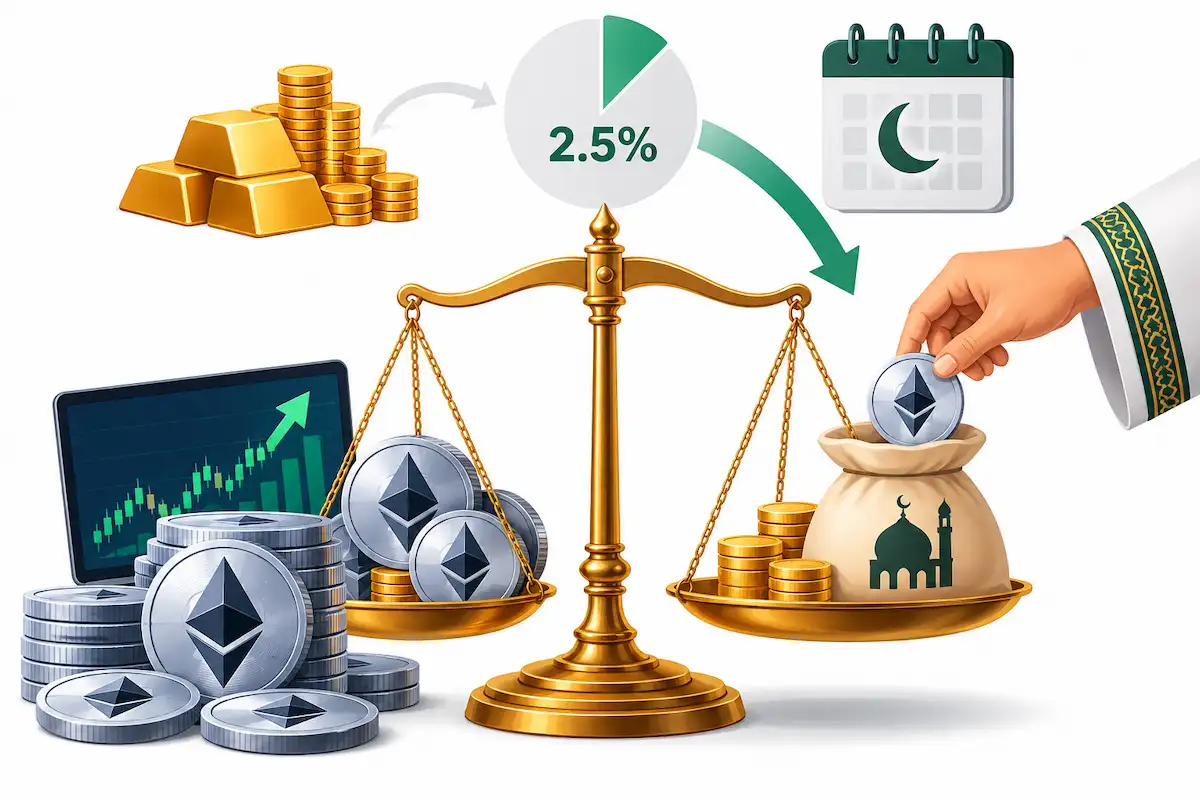
If you treat ETH as an asset held for profit, most scholars say zakat is due on it, in the same way as on gold, silver and trade goods. The details below follow the general rule used for wealth, but the exact method should be confirmed with your own scholar.
How to Calculate Zakat on ETH
The rate is 2.5% of the market value. It applies when your total wealth, including ETH, is above the nisab, which is the value of about 85 grams of gold, and when you have held it for a full lunar year, known as hawl. Take the value of your ETH on the day you pay, add your other zakatable wealth and take 2.5% of the total. If you hold it only to use on the network, some scholars say zakat may not apply, so ask for guidance on your case.
Purifying Profits
Some Islamic crypto sites suggest giving away a small part of the profit, often between 0.5% and 1%, to cover any mixed or doubtful income. This is a recommendation from those sites and not a ruling accepted by every scholar. The simplest way to avoid the issue is to keep all dealings clean from the start: no interest, no borrowed money and no gambling apps.
Is Ethereum More Halal Than Bitcoin?
Is ethereum halal in a way that Bitcoin is not? Many scholars find it easier to defend ETH than Bitcoin, because Ethereum has an obvious use. Bitcoin is mostly held as a store of value, so critics say its value depends on belief and demand, while ETH is used to pay for computation on a working network. Questions like whether bitcoin is halal usually get more cautious answers for that reason.
That does not mean ETH passes every test. Both coins have the same price swings, and both can be used in haram ways. The difference is mainly in the argument for utility, and that argument is what led firms like Amanie Advisors to review ETH in the first place.
AAOIFI and Halal Screening Tools
You will see some websites say that ETH is approved by AAOIFI, or that it is a halal coin certified by a standard. Treat that claim carefully. AAOIFI, the Accounting and Auditing Organization for Islamic Financial Institutions, has not published a final standard on crypto assets. Its Shari’a Standard No. 21 covers shares and bonds, so it cannot be used to certify a coin. You can check the organization’s own publications at aaoifi.com.
Halal screening apps also have limits. They work well for company shares, because they can check debt levels and income sources, but a coin has no balance sheet to check. A halal label on one of these apps is an opinion from the app, not a ruling from a scholar, and a haram label deserves the same caution.
A Practical Halal Checklist Before Buying ETH
Use this list before you put money into ETH or any product built around it.
- Buy on the spot market and avoid margin, futures and perpetual contracts.
- Do not lend your ETH for interest, either on an exchange or in a DeFi pool.
- Choose native staking or a clear staking service over a fixed APY earn product.
- Keep your coins in a wallet you control when you plan to hold them for a long time.
- Avoid gambling apps, casino tokens and any project with no real use.
- Calculate zakat each year after one lunar year of ownership.
- Check any promised return, because guaranteed profit is a warning sign for fraud and for riba. The guide on Ethereum scams shows the common tricks.
- Ask a qualified scholar if your situation is large or unclear.
Conclusion
So, is ethereum halal? For a growing number of scholars the answer is yes, as long as ETH is bought on the spot market, held without interest and used without borrowed money. Others take a stricter view because of volatility, speculation and the haram activity on the network. There is no final ruling from a central authority, and the older opinions were written before Ethereum moved to proof of stake.
The safest halal path is to keep ETH simple: buy it, hold it in your own wallet, pay zakat and stay away from riba, leverage and gambling. When a question is not clear, such as staking through a pool, take it to a scholar who understands both Islamic finance and crypto.
Frequently Asked Questions
Is Ethereum halal to buy and hold?
Many scholars say yes, because halal ETH is ETH with real use on the network and holding it involves no interest. Others disagree because of speculation and volatility. Buying on the spot market and keeping it in your own wallet is the position with the fewest objections.
Is Ethereum staking halal or haram?
It depends on the type. Native staking is accepted by many scholars because the reward is paid for real work and can be lost. Exchange earn products with a fixed APY look like riba and are usually treated as haram. Liquid staking sits in the middle and depends on how the token is used afterwards.
Is ETH halal or haram according to Islamic scholars?
Scholars are split. Amanie Advisors and the Shariah Review Bureau considered it permissible, some scholars allow it with conditions, and others reject crypto in general. No central body such as AAOIFI has issued a final ruling.
Is Ethereum mining halal?
Mining ETH is not possible anymore, since the Merge ended proof of work in September 2022. Before that, many scholars treated mining as permissible work. Any offer to mine ETH today should be treated as a possible scam.
Do I have to pay zakat on Ethereum?
If you hold ETH as an investment, most scholars say zakat of 2.5% is due once your total wealth is above the nisab and you have owned it for a full lunar year. Use the market value on the day you pay.
Is stETH halal?
The token represents staked ETH, so it carries the same questions as staking, plus the added risk of the protocol. It becomes a problem when you use it in lending or borrowing products where interest is paid or charged. Holding it without lending it is the safer option.
Is trading Ethereum futures halal?
Most scholars say no. Futures involve borrowed money, fees tied to time, selling what you do not own and betting on price direction. These features bring together riba, gharar and maysir.
Is Ethereum more halal than Bitcoin?
Many scholars find ETH easier to defend because it has a clear function: it pays for transactions and smart contracts. Bitcoin is mostly seen as a store of value, so its case rests more on demand. Both still carry price risk, so the method of buying and using them matters most.